
If you are looking for your first proper weighted 88-key digital piano, you have almost certainly narrowed it down to these two. The Yamaha P71 (an Amazon-exclusive version of the famous P-45) and the Roland FP-10 are the two titans of the entry-level world.
For years, the advice was simple: “Just buy the Yamaha.” It was the Toyota Camry of pianos—reliable, standard, and everywhere. But the Roland FP-10 changed the conversation. It brought technology usually reserved for $1,000+ instruments down to the budget category.
If you are stuck between the brand recognition of Yamaha and the feature-rich spec sheet of the Roland, you are not alone. I have played both extensively, and the difference comes down to one major question: Do you prioritize sound brightness or finger technique?
A Brief Comparison Table
| Feature | Yamaha P71 (P-45) | Roland FP-10 |
| Key Action | GHS (2-Sensor, Glossy Plastic) | PHA-4 (3-Sensor, Ivory Feel, Escapement) |
| Sound Engine | AWM Stereo Sampling | SuperNATURAL Piano Engine |
| Polyphony | 64 Notes | 96 Notes |
| Bluetooth | No | Yes (MIDI only, for apps) |
| Speakers | 2 x 6W (Clear, User-facing) | 2 x 6W (Downward firing, can sound muffled) |
| Weight | 25 lbs (11.5 kg) | 27 lbs (12.3 kg) |
| Connectivity | USB to Host, Headphone (1/4″) | USB to Host, Bluetooth MIDI, Headphone (1/8″) |
| Best For | Absolute Beginners / Casual Play | Students building serious technique |
My Experience With Yamaha P71
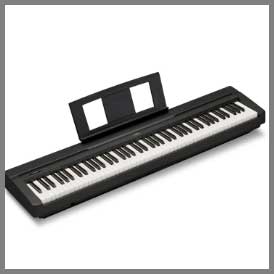
The Yamaha P71 is actually identical to the Yamaha P-45; “P71” is just the model number used for Amazon exclusives.
When you sit down at this piano, it feels immediately familiar.
If you’ve ever played a digital piano in a school or church, it probably felt like this.
The sound is bright, crisp, and clean. Yamaha samples their own concert grands, and the P71 sounds great right out of the box.
I didn’t have to fiddle with settings to get a pleasing tone.
However, the “GHS” (Graded Hammer Standard) action is starting to show its age. The keys are glossy plastic, which can get slippery if your hands sweat, and the mechanical noise (the thumping sound when you hit a key) is a bit clunky. It feels like a digital piano, not an acoustic one. But for learning notes and chords? It is bulletproof.
Pros Of Yamaha P71
- The “Standard” Sound: Yamaha’s sample is bright and cuts through the mix. For pop, rock, and jazz, many beginners prefer this snappy tone over the darker Roland sound.
- Simplicity: There are no hidden menus or app requirements. You press the power button, adjust the volume, and play. It is the ultimate “low friction” practice tool.
- Lighter Touch: The keys are weighted, but they are lighter than the Roland. For a young child or someone with weaker hand strength, the Yamaha is often less fatiguing to play for long periods.
- Reliability: The P-45/P71 platform has been around for years. It is known to be a workhorse that rarely glitches or fails.
Also read: My Thoughts On Donner Digital Piano
Cons Of Yamaha P71
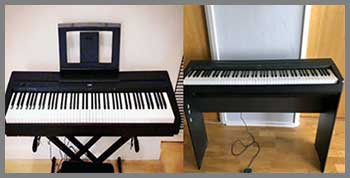
- Outdated Action: The GHS action has only two sensors. If you try to play a note very quickly (like a trill), the Yamaha sometimes misses a beat because the key has to fully return to the top before it can sound again.
- Slippery Keys: The glossy white keys can feel “plasticky” and cheap compared to the matte finish on the Roland.
- Headphone Jack Location: The headphone jack is on the back of the unit. This is incredibly annoying if you have the piano against a wall; you have to fumble around blindly to plug in your headphones.
My Experience With Roland FP-10
The first time I touched the Roland FP-10, I was genuinely confused about how they sold it at this price point. The keys have a matte texture (synthetic ivory) that feels premium. More importantly, the action is heavy.
When you press a key gently on a real grand piano, there is a subtle “click” or resistance near the bottom—this is called escapement. The Roland FP-10 mimics this; the Yamaha P71 does not.
Connecting the FP-10 to my iPad via Bluetooth was seamless. I opened the Roland Piano Partner 2 app and could control the sounds and view digital sheet music without a single cable. However, the sound through the speakers is mellower and darker than the Yamaha. Because the speakers fire downward (under the keyboard), if you put this on a table instead of a proper stand, the sound gets muffled.
Pros Of Roland FP-10
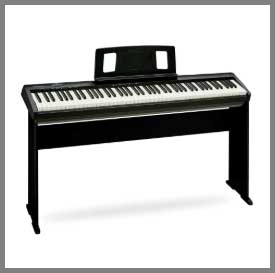
- Superior Key Action (PHA-4): This is the main reason to buy the FP-10. It uses the same key action found in Roland’s more expensive FP-30X and FP-60X. It has triple sensors (better for fast repetition), escapement, and textured keys. It builds better finger strength for transitioning to a real acoustic piano later.
- Bluetooth MIDI: Being able to connect wirelessly to GarageBand, flowkey, or Simply Piano is a massive convenience feature that the Yamaha lacks entirely.
- SuperNATURAL Sound Engine: Unlike standard sampling (recording a sound and playing it back), Roland uses modeling technology to simulate string resonance. If you hold down a chord and hit a staccato note, the virtual strings “resonate” sympathetically. It’s subtle, but it adds realism.
- Higher Polyphony: With 96 notes of polyphony (vs Yamaha’s 64), you are less likely to have notes “drop out” when playing complex classical pieces with lots of sustain pedal.
Cons Of Roland FP-10
- Downward-Firing Speakers: The speakers point at the floor. If you play with the piano on a thick carpet or a solid desk, the sound is absorbed. You really need headphones to hear the full quality of the engine.
- Hidden Features: Because there is no screen, changing the metronome speed or selecting a specific sound involves holding down a “Function” button and pressing a specific piano key. It requires memorizing combinations or keeping the manual nearby.
- Heavier Keys: Some absolute beginners find the Roland action too heavy. It takes actual effort to play, which is good for learning, but can be discouraging for casual players just wanting to relax.
Maintenance Tips For Yamaha P71 and Roland FP-10
- Dust is the Enemy: Both keyboards have sensors under the keys. If dust gets in, you will get loud “spikes” in volume (velocity jumps). Buy a stretchable dust cover ($15 on Amazon) and use it whenever you aren’t playing.
- Cleaning the Keys:
- Yamaha P71: You can use a slightly damp microfiber cloth. The plastic is smooth and easy to wipe.
- Roland FP-10: Be careful with the textured “ivory feel” keys. Do not use paper towels (they leave lint in the texture) and do not use harsh chemicals. A barely damp microfiber cloth is best.
- Pedal Upgrade: Both pianos come with a terrible plastic square switch that acts as a sustain pedal. It slides around the floor. Do yourself a favor and buy a generic “M-Audio” or “On-Stage” sustain pedal ($20) that looks like a real piano pedal. It works on both.
Also read: My Thoughts On SVS Ultra Evolution Bookshelf Speakers
Comparison with other brands
- Alesis Recital Pro vs. Yamaha P71: The Alesis is cheaper and has “hammer action,” but the feel is spongy and inconsistent. The sound samples are also much lower quality. Only buy the Alesis if you literally cannot afford the Yamaha or Roland; otherwise, the P71 is a significant upgrade.
- Casio CDP-S160 vs. Roland FP-10: The Casio is super slim and portable, but the pivot point of the keys is very short (making it hard to press the keys near the back). The Roland FP-10 has a much more realistic mechanism.
- Kawai ES120 vs. Roland FP-10: The Kawai is significantly more expensive, but it is the only piano that rivals the Roland for key action in the portable category. If you have a higher budget ($800+), the Kawai sounds better than both the Yamaha and Roland.
Frequently Asked Questions (FAQ)
For sound projection and ease of use, the Yamaha P71 is better. For key feel and piano technique, the Roland FP-10 is the clear winner. Most piano teachers prefer the Roland because the keys behave more like a real acoustic piano.
Yes. They are 100% identical in hardware, software, and dimensions. The P71 is simply the model number Yamaha assigns to units sold exclusively by Amazon.
No. It has Bluetooth MIDI. This means you can wirelessly connect to apps (like Piano Partner 2 or GarageBand) to send note data. You cannot stream Spotify from your phone through the Roland’s speakers.
Usually, no. The “Base” package for both includes the keyboard, a music rest (for sheet music), a power adapter, and a basic footswitch. You usually need to buy a stand (X-stand or furniture stand) and a bench separately.
Conclusion
This choice ultimately depends on your goals as a pianist.
Buy the Yamaha P71 if:
- You are buying for a child or casual beginner who just wants to have fun.
- You want a brighter, clearer sound out of the built-in speakers.
- You want a “plug and play” experience with no learning curve.
Buy the Roland FP-10 if:
- You are an adult learner serious about learning proper technique.
- You plan to take lessons on a real acoustic piano eventually (the transition will be easier).
- You want to use iPad/Android apps to help you learn via Bluetooth.
- You play mostly with headphones (where the sound engine truly shines).