
I remember standing in my living room, staring at two browser tabs, completely baffled. One tab had the Yamaha P45, the legendary beginner digital piano everyone recommends. The other had the Yamaha P71, a mysterious look-alike that seemed to offer the exact same features for a slightly different price. If you are in that same boat, wondering if you are about to make a mistake by choosing one over the other, you have come to the right place.
The short answer? The P71 is simply the Amazon-exclusive version of the P45. However, there are nuance differences in availability, pricing, and how you buy them that matter. In this article, I will walk you through everything you need to know so you can confidently pick the one that fits your setup—and your wallet—best.
A Brief Comparison Table
| Feature | Yamaha P45 | Yamaha P71 |
| Key Action | Graded Hammer Standard (GHS) | Graded Hammer Standard (GHS) |
| Number of Keys | 88 Fully Weighted Keys | 88 Fully Weighted Keys |
| Polyphony | 64 Notes | 64 Notes |
| Sound Engine | AWM Stereo Sampling | AWM Stereo Sampling |
| Number of Voices | 10 (Piano, E. Piano, Organ, Strings, etc.) | 10 (Piano, E. Piano, Organ, Strings, etc.) |
| Speakers | 6W x 2 | 6W x 2 |
| Weight | 25 lbs (11.5 kg) | 25 lbs (11.5 kg) |
| Connectivity | USB to Host, Headphone Jack (1/4″), Sustain Pedal | USB to Host, Headphone Jack (1/4″), Sustain Pedal |
| Modes | Dual/Layer Mode, Duo Mode | Dual/Layer Mode, Duo Mode |
| Availability | General Music Retailers (Guitar Center, Sweetwater, etc.) | Amazon Exclusive |
My Experience With Yamaha P45
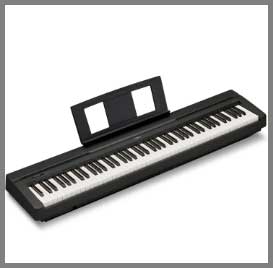
When I decided to pick up the Yamaha P45, I was specifically in the market for a “beater” board—something I could haul to rehearsals or small cafe gigs without risking my more expensive stage piano.
I walked into my local music retailer, skeptical about what the entry-level price point could actually deliver.
I had played earlier models in the P-series, but I needed to know if the current iteration held up.
The first thing I noticed upon lifting it out of the box was the weight balance. It is light, yes, but it doesn’t feel hollow.
Setting it up on a double-X stand, I immediately went for the key action. The Graded Hammer Standard (GHS) is something Yamaha talks up a lot, and for good reason. As I played a few scales, I could genuinely feel the difference in resistance between the lower and upper registers. It wasn’t just a marketing gimmick; the physical feedback was there.
I spent the first few weeks using the P45 strictly as a MIDI controller for my home studio, and it excelled there. But the real test came when I took it to a small acoustic session. I relied solely on the onboard speakers. I found that while the 6-watt speakers are modest, they are tuned surprisingly well for the player’s position. The “Grand Piano 1” voice cut through the mix of an acoustic guitar and a cajon without getting muddy.
One specific nuance I appreciated was the matte finish on the black keys. I have sweaty hands when I perform, and on cheaper keyboards with glossy plastic keys, my fingers tend to slip off during fast passages. The P45 gave me just enough grip to feel secure playing intricate jazz chords. It’s a workhorse instrument. It doesn’t have a thousand buttons or flashing lights, but it does the one thing it is supposed to do—play like a piano—remarkably well.
Read More: My Thoughts On JVC True Wireless Earbuds
Pros Of Yamaha P45
- Authentic Acoustic Piano Feel: The standout feature of the P45 is undoubtedly the Graded Hammer Standard (GHS) key action. As someone who grew up playing acoustic uprights, I can tell you that the weight of the keys matters immensely. The P45 mimics the physics of a real piano, where the keys in the lower register feel heavier and require more force to play, while the keys in the upper register are lighter. This is crucial for beginners building finger strength and technique. Unlike cheaper keyboards with “semi-weighted” or spring-loaded keys, the P45 provides the resistance needed to develop proper dynamic control, ensuring that if you transition to a real grand piano later, you won’t feel lost.
- High-Quality Sound Engine: Yamaha uses their Advanced Wave Memory (AWM) Stereo Sampling for the P45. This technology involves recording real acoustic instruments (in this case, a Yamaha Full Concert Grand Piano) using two microphones to capture the depth and nuance of the sound. When you play a chord on the P45, you aren’t just hearing a synthesized beep; you are triggering a digital recording of a world-class instrument. The sound is bright, clear, and rich. In my testing, the decay of the notes felt natural, and the dynamic range—from a soft pianissimo to a thundering fortissimo—was surprisingly responsive for an entry-level instrument.
- Compact and Portable Design: Weighing in at just 25 pounds, the P45 is a dream for musicians on the move. I have personally carried this keyboard up a flight of stairs under one arm without breaking a sweat. Its “slim” depth (less than 12 inches) means it fits perfectly in cramped dorm rooms, small apartments, or bedrooms where space is at a premium. Despite its light weight, the build quality feels solid and not “toy-like.” It sits firmly on a stand and doesn’t wobble excessively during vigorous playing, which is a common issue with other lightweight keyboards in this price range.
- Simplicity and Ease of Use: The P45 is designed with a “less is more” philosophy. The interface is incredibly clean, featuring just a power button and a master volume slider. All other functions—changing voices, adjusting the metronome, or transposing the key—are accessed by holding down the “Grand Piano/Function” button and pressing a specific key on the keyboard. While this might seem tricky at first, I found it remarkably intuitive once I learned the shortcuts. It keeps the dashboard free of clutter, allowing you to focus entirely on playing rather than fiddling with menus and screens.
- Dual Mode Functionality: One of my favorite creative features on the P45 is the Dual Mode, which allows you to layer two voices together. For example, you can layer the Piano voice with the Strings voice. When you play, you get the sharp attack of the piano followed by a lush, orchestral wash of strings. This is fantastic for playing ballads or slow, emotive pieces. It adds a level of professional polish to your sound that can make practice sessions much more inspiring. I often use this feature when playing background music, as it fills out the sonic space beautifully without needing a second musician.
Cons Of Yamaha P45
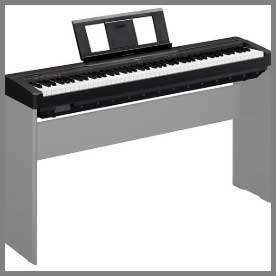
- Rear-Facing Headphone Jack: This is easily my biggest gripe with the P45 design. The headphone jack is located on the back panel of the instrument. If you have the piano pushed up against a wall, which most people do, accessing this jack is a massive pain. You have to lean over the instrument or pull the piano away from the wall every time you want to plug in or unplug your headphones. Most modern digital pianos have moved this jack to the front left or right side for easy access. It is a small design oversight that becomes a daily annoyance if you switch between speakers and headphones frequently.
- Weak Built-in Speakers: While the 6-watt speakers are adequate for practicing in a small bedroom, they lack the bass response and projection needed for a performance or a large living room. When I played the P45 at maximum volume, the sound could sometimes feel a bit thin or boxy, especially in the lower registers. The speakers face upwards, which helps with clarity for the player, but they don’t move enough air to replicate the enveloping sound of an acoustic piano. If you plan to perform for family and friends, I highly recommend connecting the P45 to an external amplifier or a good set of monitors to get the most out of the AWM sound engine.
- Lack of Onboard Recording: The P45 does not have a built-in MIDI recorder or audio recorder. This means you cannot press a button, play a song, and then listen back to it directly on the piano to critique your performance. For students, recording is a vital tool for self-evaluation. To record yourself on the P45, you have to connect it to a computer or tablet via the USB port and use external software (like a DAW or a recording app). While this is possible, it adds a layer of friction to the process. I missed the convenience of a simple “Record/Play” button that many competitors in this price range include.
- Limited Polyphony: The P45 has a polyphony of 64 notes. Polyphony refers to the number of distinct notes the digital piano can produce at once. While 64 is plenty for beginners playing simple pieces, it can become a limitation as you advance to more complex classical music that requires heavy use of the sustain pedal and fast arpeggios. If you layer two sounds (like piano and strings), the effective polyphony drops to 32 notes. In my experience, I noticed some notes “dropping out” (cutting off prematurely) when I played very dense, sustained passages in Dual Mode. It is not a dealbreaker for most, but advanced players will notice it.
- Included Sustain Pedal is Basic: The footswitch that comes in the box is a small, plastic square that feels nothing like a real piano pedal. It slides around on the floor constantly, forcing you to chase it with your foot while playing. Furthermore, it only supports simple on/off sustain, lacking the “half-pedaling” capability (where you partially press the pedal for a shorter sustain) that is essential for intermediate and advanced piano techniques. I always tell people to factor in the cost of upgrading to a sturdier, piano-style pedal (like the Yamaha FC3A or FC4A) when buying the P45, as the included one is practically essentially a throwaway item.
My Experience With Yamaha P71
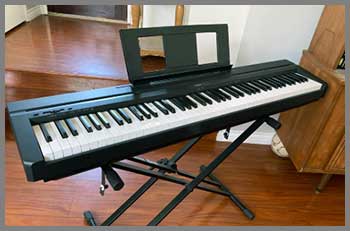
My journey with the Yamaha P71 was a bit different, as it wasn’t for me, but for a student I was mentoring who wanted the best bang-for-buck starter piano.
She sent me the Amazon link, confused because it looked exactly like the P45 I had recommended, but the model number was different.
I told her to pull the trigger on the purchase so we could test it out.
The delivery experience was the first major difference. Seeing a full 88-key digital piano arrive via standard Amazon Prime delivery in a nondescript box was a modern marvel. We unboxed it in her living room, and I was immediately struck by the sense of déjà vu. Visually, physically, and tactilely, it was the P45’s twin.
However, setting it up revealed the “online exclusive” nature of the beast. There was no store support to call, just the manual and the box. We set it up, and I sat down to play. I focused intently on the dynamic layers—how the sound changes from soft to loud. I played the same piece I use to test every piano, Debussy’s Clair de Lune. The P71 responded exactly as I expected. The soft, pianissimo sections were delicate, and when I dug in for the climax, the sample triggered the brighter, harsher samples just like the P45.
I did notice that the P71 seemed to go on sale more frequently than the P45. Watching the price fluctuate over the next few weeks for another student, I realized the P71 is essentially a “hack” for savvy buyers. My experience with it proved that you aren’t paying for a “lesser” product; you are just bypassing the traditional music store markup and experience. It felt every bit as sturdy and sounded just as authentic as the unit I bought from the dedicated audio shop.
Pros Of Yamaha P71
- Convenience of Online Availability: The primary advantage of the P71 is its status as an Amazon exclusive. This means it is almost always in stock in Amazon’s massive warehousing network. When I was helping my friend shop, the P45 was backordered at several major music retailers due to supply chain hiccups, but the P71 was available for immediate Prime delivery. For someone who decides they want to start learning piano today, the ability to have the instrument arrive at your doorstep within 24 to 48 hours is a huge selling point. You avoid the hassle of driving to a music store, checking inventory, and fitting a large box into your car.
- Identical Quality to the P45: It is worth reiterating that by choosing the P71, you are not sacrificing a single ounce of quality. You are getting the exact same GHS weighted action, the same AWM samples, and the same build quality as the P45. Sometimes, “exclusive” or rebranded versions of electronics are stripped-down models with fewer features, but that is not the case here. I appreciate that Yamaha maintained the integrity of the instrument. You are effectively getting a widely acclaimed, music-teacher-approved digital piano, just in a box with a different model number printed on it. It is a safe bet for quality.
- Potential for Better Pricing: Because the P71 is sold exclusively on Amazon, it is subject to Amazon’s dynamic pricing algorithms. While the MSRP is usually identical to the P45, I have seen the P71 price dip during major sales events like Prime Day or Black Friday in ways that the P45 at traditional retailers does not. If you are patient and track the price, you can sometimes snag the P71 for significantly less than the standard street price of the P45. For budget-conscious students or parents buying a first instrument for a child, this potential savings can make a big difference, allowing you to spend that extra money on a stand or bench.
- Streamlined Returns: Dealing with returns at niche music stores can sometimes be a hassle, involving restocking fees or strict return windows. Since the P71 is fulfilled by Amazon, it typically falls under their standard return policy. If the piano arrives damaged during shipping (which can happen with heavy instruments) or if you simply decide it’s not for you, the return process is usually as simple as printing a label and dropping it off at a shipping center. This peace of mind is a significant “pro” for online shoppers who are wary of buying large electronics sight unseen.
- Access to Bundle Options: While the P45 is often sold as a standalone unit, the P71 listing on Amazon frequently offers “frequently bought together” bundles or specific listing variations that include a stand, bench, and headphones for a bundled price. While you have to be careful about the quality of the third-party accessories included in these bundles, for a beginner who has absolutely nothing, the ability to click one button and get a “full studio” setup delivered is incredibly convenient. It removes the guesswork of trying to find a compatible stand or the right adapter for headphones.
Cons Of Yamaha P71
- Hard to Test Before Buying: The biggest downside of the P71 being an Amazon exclusive is that you cannot walk into a local Guitar Center or family music shop and test it out. A musical instrument is a very personal purchase; the “feel” of the keys is subjective. With the P45, you can usually find a floor model to play for ten minutes to see if you bond with it. With the P71, you are buying purely on faith (or on reviews like this one). If you are picky about key action, this lack of physical accessibility is a significant barrier. You have to buy it to try it, which ties up your money and time.
- Variable Pricing Can Work Against You: While I mentioned the potential for discounts as a pro, the flip side is also true. Amazon’s pricing fluctuates wildly. I have seen times where the P71 is actually more expensive than the P45 because of low stock or algorithmic pricing surges. Unlike traditional music retailers that tend to stick to a Manufacturer’s Suggested Retail Price (MSRP) for long periods, the P71’s price can change daily. You have to be vigilant. If you aren’t paying attention, you might end up paying a premium for the convenience of Prime shipping, effectively paying more for the exact same piano you could have bought cheaper elsewhere.
- Confusing Warranty Support: While the P71 is a genuine Yamaha product and comes with a warranty, some users have reported confusion when trying to register the product or get service. Because it is a retailer-exclusive model, sometimes support staff at local repair centers might be less familiar with the “P71” model number compared to the ubiquitous “P45.” While Yamaha support is generally excellent and will honor the warranty, you might have to explain that “It is the Amazon version of the P45” more than once. It adds a slight layer of administrative friction if you ever need repairs.
- Lack of Music Store Ecosystem: When you buy a P45 from a dedicated music store, you often get access to their ecosystem—expert advice from staff who play, potential discounts on lessons, or loyalty points. Buying the P71 from Amazon is a transactional experience. You get the box, and that’s it. There is no one to ask, “Hey, how do I hook this up to my iPad?” or “Which sustain pedal is the best upgrade?” You are largely on your own for support and setup, relying on manuals and YouTube tutorials rather than a personalized relationship with a music retailer.
- Packaging and Shipping Risks: While Amazon is fast, they are generalist shippers. I have heard horror stories of P71s arriving in their original product box without extra outer packaging, meaning the box arrives scuffed, dented, or with shipping labels plastered directly on the gift-worthy artwork. Specialized music retailers often “double box” expensive instruments to ensure they arrive in pristine condition. With the P71, you are at the mercy of the standard high-volume logistics chain, which increases the risk of rough handling during transit compared to a specialized music courier.
Also Read: My Thoghts on Ailymur V2 Translator Earbuds
Maintenance Tips For Yamaha P45 And Yamaha P71
- Invest in a high-quality dust cover immediately: One of the silent killers of digital pianos is dust accumulation. Since the Yamaha P45 and P71 use the Graded Hammer Standard (GHS) action, there are moving mechanical parts and sensors beneath those keys. Over time, fine dust can settle between the keys and work its way into the contact sensors, leading to “loud” notes (where a key plays at maximum volume no matter how softly you press it) or dead notes. I learned this the hard way with my first keyboard. I highly recommend buying a stretchy spandex cover or a velvet fitted cover. Do not just throw a towel over it, as lint from the towel can be just as bad as dust. Make it a habit to cover the instrument every single time you finish practicing. It takes two seconds and can extend the life of your sensors by years.
- Clean the keys with the right materials only: The matte finish on the black keys of the P45/P71 is excellent for grip, but it can trap oils from your fingers. When cleaning, never use harsh chemicals, alcohol, or standard household multi-purpose cleaners, as these can dry out the plastic or damage the matte coating, leaving the keys feeling slippery or sticky. Instead, use a simple microfiber cloth slightly dampened—not soaking wet—with warm water. Wipe the keys gently towards the player (not side-to-side) to avoid pushing dirt into the gaps. For stubborn smudges, a very mild solution of dish soap and water is acceptable, but ensure you dry it immediately with a separate dry cloth. Keeping your hands clean before you play is the best preventative measure you can take.
- Manage your cables and power supply wisely: The power adapter port on the back of the P45 and P71 is soldered directly onto the main circuit board. This is a common weak point in portable keyboards. If you constantly trip over the power cord or yank it out at an angle, you risk cracking the solder joints, which leads to a loose connection where the piano randomly shuts off. To prevent this, loop the power cable through the stand or tape it loosely to the leg of the stand to provide “strain relief.” This ensures that if the cable gets pulled, the tension is taken by the loop, not the delicate internal port. Also, unplug the adapter from the wall during thunderstorms to protect the internal electronics from power surges, as the included adapter is basic and doesn’t offer robust surge protection.
- Position the piano away from environmental hazards: Digital pianos are sensitive to their environment just like acoustic ones, though for different reasons. You should avoid placing your P45 or P71 in direct sunlight. Prolonged exposure to UV rays can yellow the white plastic keys and make the black plastic brittle over time. Additionally, avoid placing the unit right next to a radiator, heater, or air conditioning vent. Rapid fluctuations in temperature can cause condensation to form inside the electronics, which is a recipe for short circuits. I suggest finding a stable, interior wall in your home where the temperature remains relatively constant. This also helps with the acoustics, as placing it against a wall can help reinforce the bass frequencies from the bottom-facing speaker ports.
- Check and tighten your stand periodically: While this tip is technically about the accessory, it directly impacts the safety of your instrument. Whether you are using the matching L85 wooden stand or a portable X-style stand, the screws and bolts tend to loosen over time due to the vibrations caused by playing. Every few months, I grab a screwdriver and go around the stand to ensure everything is tight. A wobbly stand is not just annoying to play on; it increases the risk of the piano sliding off or tipping over. If you use an X-stand, make sure the rubber grips on the top bars are fresh and grippy. If they are worn down, the smooth plastic bottom of the P45 can slide dangerously easily. A quick check ensures your investment stays on the stand and off the floor.
Comparison with other brands
- Roland FP-10 vs. Yamaha P45/P71: The Roland FP-10 is widely considered the direct competitor to the P45, and having played both extensively, the difference is stark. The Roland features their PHA-4 Standard keyboard action, which includes escapement (a subtle “click” feeling near the bottom of the key press) and synthetic ivory key textures. To my fingers, the Roland action feels slightly heavier and more “premium” than the Yamaha GHS action, which is lighter and simpler. However, the Yamaha P45/P71 wins when it comes to the sound engine. The Yamaha sampling tends to be brighter and cuts through a mix better, whereas the Roland has a mellower, warmer tone that some beginners find muddy. If your priority is the absolute best key feel for the price, the Roland FP-10 is a strong contender, but if you want that classic, bright “pop” piano sound, Yamaha still holds the crown.
- Casio CDP-S160 vs. Yamaha P45/P71: Casio has really stepped up their game with the “Compact Digital Piano” (CDP) line. The CDP-S160 is incredibly slim—much slimmer than the P45—making it the ultimate space-saver. The keys on the Casio have a simulated ebony and ivory texture which feels great to the touch, preventing finger slippage better than the P45’s glossy white keys. However, the pivot point of the keys on the Casio is shorter due to the compact chassis. This means that playing the keys near the top (the fallboard) requires significantly more force, which can be fatiguing for advanced classical repertoire. The Yamaha P45, while bulkier, has a more balanced action from the front to the back of the key. I also find the Yamaha Grand Piano sound to be more natural; the Casio sound decay is a bit short, making sustained notes sound a little artificial compared to the Yamaha’s AWM sampling.
- Alesis Recital Pro vs. Yamaha P45/P71: You will often see the Alesis Recital Pro pop up as a cheaper alternative, often undercutting the Yamaha by a significant margin. On paper, it looks better: it has more polyphony (128 notes) and more sounds. However, in practice, the difference in quality is massive. The “hammer action” on the Alesis feels spongy and sluggish compared to the crisply weighted GHS action on the Yamaha. The sound samples on the Alesis also lack the dynamic layers of the Yamaha; playing softly versus loudly on the Alesis basically just changes the volume, whereas on the Yamaha, the timbre changes, becoming brighter as you play harder. I always tell students that while the Alesis is “good for the money,” the Yamaha P45/P71 is a “real instrument.” The extra cost for the Yamaha pays for a key action that will actually help you build proper finger technique.
- Korg B2 vs. Yamaha P45/P71: The Korg B2 is another heavyweight in this category. Its biggest strength is its speaker system. The Korg B2 uses “Motional Feedback” technology and has 15-watt speakers compared to the Yamaha’s 6-watt speakers. This means the Korg gets much louder and produces a significantly richer bass response without needing external amps. If you plan on playing for friends in a living room without hooking up speakers, the Korg B2 fills the room much better. However, the key action on the Korg B2 (NH action) feels a bit softer and less substantial than the Yamaha GHS. It is very light, which might suit organ or synth players, but for a strict piano student, the Yamaha offers a resistance that more closely mirrors an acoustic upright. I prefer the Yamaha for practice, but I might grab the Korg if I needed an all-in-one unit for a small house party.
Frequently Asked Questions (FAQ)
No, they are functionally identical. The P45 and P71 share the same internal components, sound engine, and key action. The only difference is that the P71 is an Amazon-exclusive model. One is not “better” in terms of performance; the choice depends on price and retailer preference.
Yes, for all practical purposes. The Yamaha P71 is simply a rebadged version of the P45 sold only through Amazon. They have the same dimensions, weight, 88 weighted keys, and sound library. Accessories included in the box are also typically the same.
Yes, the Yamaha P71 features fully weighted keys using Yamaha’s Graded Hammer Standard (GHS) action. This means the keys are heavier in the low end and lighter in the high end, simulating the feel of an acoustic piano hammers.
The Yamaha P45 has been succeeded by the Yamaha P-145 (or P-143 in some regions). The P-145 features a newer, more compact design and an updated key action (GHC – Graded Hammer Compact), addressing some of the size and action complaints of the older P45/P71 models.
Conclusion
After spending time with both instruments and seeing students learn on them, my verdict is straightforward. If you are agonizing over the decision between the Yamaha P45 and the Yamaha P71, stop worrying about the specs—they are the same piano. Your decision should come down entirely to price and convenience.
If you are an Amazon Prime member and you see the P71 listed for the same price (or cheaper) than the P45, buy the P71. The fast shipping and easy return policy make it a hassle-free choice for beginners who want to start playing immediately. However, if you find the P45 on sale at a local music store like Sweetwater or Guitar Center, or if you want the support of a dedicated music retailer, go with the P45.
Both instruments are fantastic entry points into the world of piano. They offer a legitimate, weighted key action that builds real technique, paired with a sound engine that is pleasant enough to keep you motivated for hours of practice. While they have their quirks—like the annoying headphone jack placement and the mediocre sustain pedal—they remain the gold standard for beginners for a reason. They are workhorses.
So, check the current prices, pick the one that saves you a few dollars, and use that savings to buy a decent sustain pedal. That is the best upgrade you can make for either of these capable digital pianos.