
For the last three years, WiiM has dominated the budget audiophile conversation with “smart” devices—streamers that do everything for a fraction of the cost of a Sonos. But with the release of the WiiM VibeLink Amp, they have done something unexpected: they built a “dumb” box.
Released in early 2025, the VibeLink Amp removes the Wi-Fi, the Bluetooth, and the streaming brains found in the original WiiM Amp. What is left is a pure, dedicated Class D integrated amplifier designed to do one thing: drive speakers.
At $299, it is positioned as the perfect muscle to pair with the WiiM Ultra streamer, but is it worth buying a non-streaming amp from a streaming company? I paired it with my WiiM Ultra (and a few other preamps) to see if this “stack” is the new budget reference system. For those building a separates system, I recommend buying this bundled with the WiiM Ultra for the best integration, as they are designed to stack physically and aesthetically.
My Experience With The WiiM VibeLink Amp
When I unboxed the VibeLink, the first thing I noticed was the build quality.
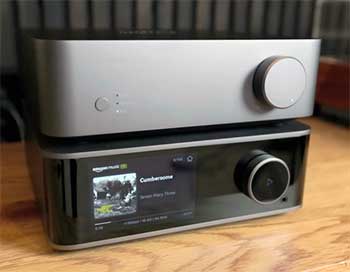
It shares the same sleek, Mac Mini-esque aluminum chassis as the WiiM Ultra and the Amp Pro.
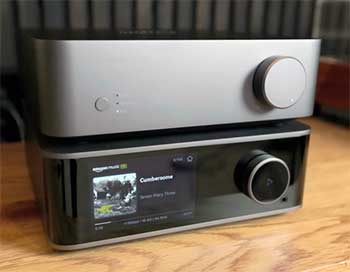
It feels dense and cool to the touch. I placed it directly underneath my WiiM Ultra, and the two look like a single monolithic unit. It is a visually satisfying “mini-stack” that takes up barely any space on my desk.
Setup was hilariously fast because there is no app to configure. No Wi-Fi passwords, no firmware updates (at least, not for the amp itself). I simply connected the RCA out from my WiiM Ultra to the RCA in of the VibeLink, wired up my KEF Q150 speakers, and flipped the switch.
The power is the headline here. The VibeLink pushes 100 watts per channel into 8 ohms (and a massive 200W into 4 ohms). This is significantly more “grunt” than the original WiiM Amp. When I played my usual bass-heavy test tracks, the grip on the low end was noticeably tighter. The bass felt punchy and immediate, without the slight “softness” I sometimes heard with the original all-in-one WiiM Amp.
However, it is a strictly “analog” experience in terms of usability. I missed having volume control on the amp itself (there is a knob, but no remote). I had to rely entirely on my streamer (the Ultra) to control the volume. This works fine, but it means if you are using a CD player or a turntable directly into this amp, you are tethered to the physical knob unless your source has volume control.
One quirk I noticed: Heat. Like its siblings, the VibeLink uses its case as a heatsink. After about two hours of spirited listening, the top of the unit was hot—not “burn your hand” hot, but hot enough that I decided to move the WiiM Ultra off the top of it to let it breathe better.
Read more: My Thoughts on Nesco Deluxe Vacuum Sealer
Pros Of WiiM VibeLink Amp
The VibeLink isn’t trying to be a Swiss Army Knife; it’s trying to be a machete. Here is why it works.
- Massive Power for the Price: getting 100W/8Ω of clean Class D power for $299 is a steal. Most competitors in this price range (like the Fosi V3) are bare-bones DIY-style amps. The VibeLink offers that same raw power but in a chassis that actually looks good in a living room. It drives inefficient speakers (like Elac Debuts or KEFs) with ease, offering plenty of headroom.
- Zero “Software Anxiety”: The beauty of a “dumb” amp is that it cannot be bricked by a bad update. There is no AirPlay to drop out, no Wi-Fi handshake issues, and no app crashing. It just works. It turns on, it amplifies, it shuts up. For users tired of troubleshooting their smart home gear, this reliability is a major selling point.
- Perfect Companion for WiiM Ultra: This product clearly exists to solve the “WiiM Ultra Problem.” The Ultra is a fantastic streamer/preamp but has no speaker terminals. The VibeLink fills that gap. The aesthetics match perfectly (Silver or Space Grey), and the trigger input means the amp automatically wakes up when you turn on the Ultra. It creates a seamless “separates” system that functions like an integrated receiver.
- Exceptional Signal Clarity: By removing the Wi-Fi and Bluetooth antennas from inside the chassis, WiiM has minimized potential interference. The noise floor is dead silent. Even with my ear pressed to the tweeter, I heard zero hiss when the music was paused. It’s a cleaner, darker background than the original WiiM Amp.
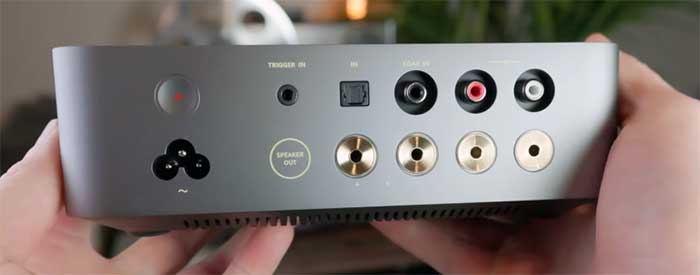
- Premium Build Quality: The aluminum oxide finish feels miles ahead of the plastic-heavy competition. The binding posts on the back are gold-plated and widely spaced, making it easy to use thick audiophile speaker wire or banana plugs without fumbling.
Cons Of WiiM VibeLink Amp
By stripping away features, WiiM inevitably left some things out that you might miss.
- No HDMI ARC: This is the biggest dealbreaker for TV users. Unlike the original WiiM Amp, the VibeLink has no HDMI port. If you want to use this for TV audio, you have to use an Optical cable from your TV. This means you cannot control the volume with your TV remote (unless you program a universal remote). It feels like a step backward for living room integration.
- No Subwoofer Output: This was a surprising omission. The VibeLink has no dedicated sub-out port. It assumes you are using a preamp (like the WiiM Ultra) that handles the subwoofer crossover and output. If you plan to use this amp standalone with a turntable, you cannot easily add a subwoofer unless your sub has “High Level” (speaker wire) inputs.
- No Remote Control Included: The box does not include a remote. WiiM assumes you will control volume via your source (streamer/DAC). If you connect a vintage CD player via RCA, you have to get up and turn the knob manually to change volume. It strictly limits the use case to “paired with a preamp.”
- Runs Warm: As mentioned, thermal management is passive. If you stack this in a tight cabinet or pile components on top of it, it will get toasty. It needs a few inches of clearance to dissipate the heat generated by that 100W chip.
- Inputs Are Limited: You get 1 Set of RCA and 1 Optical (and maybe Coax depending on region/batch). That’s it. There is no USB input for a PC and no Phono stage for a turntable. You absolutely need external devices to get sound into this thing.
Maintenance Tips For WiiM VibeLink Amp
Since this is a power amplifier, “maintenance” is mostly about heat management and connection hygiene.
- Do Not Stack (Unless Ventilated): Although it looks cool to stack the WiiM Ultra on top of the VibeLink, I advise against it for long listening sessions. The heat rises from the amp and cooks the streamer above it. Ideally, place them side-by-side. If you must stack, use “riser feet” or spacers to create an air gap of at least 1 inch between the units.
- Use the 12V Trigger: If you are pairing this with a WiiM Pro Plus or Ultra, use a 3.5mm cable to connect the “Trigger Out” on the streamer to the “Trigger In” on the amp. This syncs their power states. When you wake up your streamer with Spotify Connect, the amp clicks on automatically. It saves energy and makes the system feel magical.
- Check Speaker Wire Polarity: Because the binding posts are quite close together, it is easy to accidentally have a stray wire strand touch the chassis or the other post, which can trigger the protection mode. Use banana plugs for the safest, cleanest connection.
- Dust the Vents: The heat dissipation relies on passive airflow. If dust settles on the side or bottom vents, the amp will run hotter. give it a quick blast with compressed air once a month to keep the airflow channels clear.
Also Read: My thoughtsa on EverJar Vacuum Sealer
Comparison with Other Models

Is it better to get this or just buy the all-in-one?
- WiiM VibeLink vs. WiiM Amp (Original/Pro): The original WiiM Amp ($299) includes the streamer, HDMI ARC, and Sub Out. It is the better value for 90% of people. Buy the VibeLink ONLY if you need more power (100W vs 60W) or if you already own a high-end streamer (WiiM Ultra) and don’t want to pay for a second streamer inside your amp. The VibeLink is for “separates” people; the WiiM Amp is for “all-in-one” people.
- WiiM VibeLink vs. Fosi Audio ZA3: The Fosi ZA3 is the darling of the budget amp world and costs about $150 (half the price). The Fosi sounds 95% as good and also has a trigger input. However, the Fosi looks like a DIY science project. The VibeLink looks like hi-fi furniture. If aesthetics matter, the VibeLink wins. If you just want cheap power and plan to hide the amp in a cupboard, get the Fosi ZA3.
- WiiM VibeLink vs. Sonos Amp: The Sonos Amp is $699. It has less power (technically rated 125W but measures similarly) but has the unbeatable Sonos ecosystem and HDMI ARC. The VibeLink + WiiM Ultra combo costs roughly the same ($299 + $329 = $628) but gives you a screen, better DAC, and more inputs. The WiiM stack is the better “audiophile” choice; Sonos is still the king of easy whole-home audio.
Frequently Asked Questions (FAQ)
No. It has no wireless radios whatsoever. If you want to play Bluetooth audio, you must connect a Bluetooth receiver (or a WiiM streamer) to one of its inputs.
Yes, but you need a Phono Preamp. The VibeLink does not have a built-in phono stage. If your turntable has a switch for “Line” output, you can plug it straight in. If not, you need a separate box between the turntable and the amp.
The VibeLink is designed to be used with a preamp (like the WiiM Ultra) that handles the subwoofer signal processing. You should connect your subwoofer to your streamer, not the amp. This actually offers better bass management as the streamer can handle the crossover logic digitally.
Yes. With 100 Watts per channel into 8 Ohms (and 200W into 4 Ohms), the VibeLink is very powerful for its size. It can easily drive demanding floor-standers like the KEF Q950 or Focal Chora 826 to very loud volumes without distortion.
Conclusion
The WiiM VibeLink Amp is a niche product, but it nails that niche perfectly. It is the missing link for anyone who bought a WiiM Ultra and wondered, “What do I plug this into?” It offers clean, robust power in a beautiful package that puts typical budget amps to shame.
While the lack of HDMI ARC and a remote makes it a poor choice for a standalone TV amp, it is an unbeatable power engine for a modern modular hi-fi system. I highly recommend it as the “power half” of a WiiM Ultra stack; together, they form a system that rivals setups costing three times as much.