
I have spent countless hours behind the wheel testing radar detectors, and when it comes to Uniden’s lineup, the R8 and R4 stand out as top performers. My goal here is to share a real-world comparison based on my experience, highlighting what each model does well and where they differ. By the end, you will know which one I would choose for different driving situations.
A Brief Comparison Table
| Feature | Uniden R8 | Uniden R4 |
|---|---|---|
| Antenna Design | Dual antennas (front and rear) | Single front antenna |
| Directional Arrows | Yes (360° awareness with voice alerts) | No |
| Detection Range | Excellent on Ka bands | Often slightly longer on some tests |
| Display | Larger OLED with more info | Compact OLED |
| False Alert Filtering | Advanced with Auto mode | Strong with Auto sensitivity |
| GPS Features | Auto mute memory, speed camera alerts | Auto mute memory, speed camera alerts |
| Bluetooth/App Support | Yes | Yes |
| Price Range | Higher (around $600–$750) | Lower (around $350–$450) |
| Best For | Highway drivers needing direction | Budget-conscious users wanting max range |
My Experience With Uniden R8

I mounted the Uniden R8 in my daily driver about a year ago, and it quickly became my go-to for long highway trips.
The dual antennas give me full 360-degree coverage, and those directional arrows are a game-changer. When a Ka-band signal pops up, I instantly know if the threat is ahead, behind, or off to the side.
This helps me decide whether to slow down right away or just keep an eye out.
The larger OLED display shows signal strength and band details clearly, even in bright sunlight. Voice alerts are loud and natural-sounding, so I do not have to glance down much.
On open roads, the range impresses me every time. I have picked up instant-on radar from over two miles away in some cases, giving me plenty of time to react.
The Auto mode adjusts sensitivity based on speed, keeping things quiet in town but cranking up on the interstate. Bluetooth pairs easily with my phone, and I use the app to tweak settings without pulling over.
The mute and mark buttons sit right up front and feel responsive. I appreciate how the R8 stays quiet around most blind-spot monitoring systems once I lock them out. It has saved me from tickets more than once, especially in areas with heavy traffic enforcement. Overall, it feels premium and reliable for serious drivers.
Also read: Comparison of Galaxy Buds 2 Pro And Buds 3 Pro
Pros Of Uniden R8
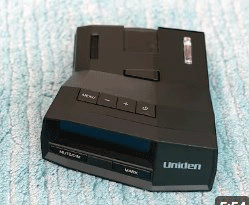
- Superior situational awareness: Directional arrows and voice prompts tell me exactly where the threat comes from, which helps me stay calm and make quick decisions on busy highways.
- Excellent long-range performance: Dual low-noise amplifiers boost sensitivity, especially on Ka bands, so I get alerts from farther away than most other detectors I have tried.
- Large, clear display: The bigger OLED screen shows more details like signal strength and band type at a glance, making it easier to understand alerts without distraction.
- Advanced false alert filtering: Auto mode and customizable K/Ka segmentation reduce noise from modern cars while keeping real threats loud and clear.
- GPS integration: Auto mute memory locks out stationary falses over time, and it warns about red-light and speed cameras effectively.
- Bluetooth connectivity: Easy pairing with apps for updates and custom settings, plus compatibility with crowd-sourced tools.
- Stealth design: Hard to detect by police radar detectors, adding peace of mind in restricted areas.
- Future-proof features: Supports upcoming accessories like laser jammers and remote keypads for added protection.
Cons Of Uniden R8
- Higher price: It costs significantly more than the R4, which might not justify the extra for casual drivers.
- Slightly bulkier size: The dual-antenna design makes it taller, sometimes pressing against the headliner or blocking rear visibility.
- Autolockout quirks: GPS-based muting works but can miss some sources or require manual tweaks occasionally.
- More false alerts in some cases: BSM systems still trigger it now and then, though less than older models.
- Power draw: Needs a solid 12V source, and some users report needing adapters for certain outlets.
- Overkill for city use: The extra features shine on highways but feel unnecessary for short urban drives.
Maintenance Tips For Uniden R8
- Clean the lens regularly: Wipe the front antenna gently with a microfiber cloth to keep detection sharp and avoid buildup.
- Update firmware often: Use the app or computer tool to install the latest versions for better filtering and bug fixes.
- Check mounting position: Ensure it has a clear view forward and rear; adjust if it touches the headliner.
- Test power source: Use a quality 12V adapter to prevent voltage drops that could affect performance.
- Lock out falses manually when needed: Drive familiar routes to build the GPS memory bank quickly.
- Store properly: Remove from the car in extreme heat to protect internal components.
- Monitor battery life: Replace the car’s battery if it weakens, as low voltage impacts startup.
- Pair with app regularly: Sync settings and GPS database for optimal performance.
My Experience With Uniden R4
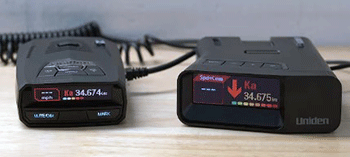
Switching to the Uniden R4 for city commuting felt like a smart downgrade in price without losing much performance.
This compact unit fits neatly on my dash and stays out of the way.
The single front antenna focuses all its power forward, and I have noticed it sometimes edges out the R8 in raw detection distance on straight roads.
Ka-band alerts come in strong and early, often surprising me with how far ahead it spots threats.
The OLED display is bright and easy to read, though smaller than the R8’s. Voice alerts are clear, and the tones are customizable so I can tell bands apart quickly.
Auto sensitivity mode is a lifesaver in stop-and-go traffic—it drops to lower power at slow speeds to cut false alerts from shopping center doors or adaptive cruise systems.
GPS features work smoothly here too, with automatic muting for recurring falses after a few passes. Bluetooth connects reliably, and the app lets me fine-tune filters on the go. I find the R4 quieter overall in urban areas once set up right.
It has become my reliable companion for everyday drives, proving that you do not need every bell and whistle to stay protected.
Read more: Comparison of Keen And Flair Smart Vents
Pros Of Uniden R4
- Outstanding detection range: Single antenna focuses power forward, often outperforming dual-antenna models like the R8 in raw distance on straight roads.
- Compact and discreet: Smaller size mounts easily and stays hidden, perfect for daily commuters.
- Great value for money: Delivers flagship-level performance at a much lower price point.
- Effective Auto mode: Automatically adjusts sensitivity by speed, keeping the cabin quiet in town without manual switching.
- Strong false alert reduction: Advanced filtering handles K/Ka bands well, muting common sources like door openers over time.
- Bright OLED display: Clear visuals with customizable colors for quick reading.
- GPS features included: Auto mute memory and camera alerts work reliably.
- Bluetooth support: App integration for easy updates and customization.
Cons Of Uniden R4
- No directional arrows: Lacks front/rear awareness, so I cannot tell threat direction without guessing.
- Smaller display: Shows less info at once compared to the R8.
- No rear detection focus: Single antenna means less effective from behind in some scenarios.
- Occasional autolockout issues: Similar to the R8, it might need manual intervention for stubborn falses.
- Less premium feel: Build quality is solid but does not match the R8’s flagship vibe.
Maintenance Tips For Uniden R4
- Keep the front clean: Dust on the lens reduces range, so wipe it weekly with a soft cloth.
- Update via app: Bluetooth makes firmware and database updates simple—do it monthly.
- Secure mounting: Use the included suction cup or hook-and-loop for a stable position.
- Build mute memory: Drive the same routes repeatedly to auto-mute common falses faster.
- Adjust brightness: Set display to auto-dim for night driving to avoid glare.
- Avoid extreme temperatures: Remove from dash in hot sun to prevent screen damage.
- Test connections: Ensure the power cord fits snugly to avoid intermittent issues.
- Customize tones: Set unique alerts for bands to recognize threats quickly.
Comparison With Other Brands
- Vs Escort models (like Redline 360c): The R8 matches or beats range while offering better false filtering in many tests.
- Vs Valentine V1 Gen2: Uniden units provide more user-friendly GPS muting and apps.
- Vs Radenso DS1: The R4 often edges out in sensitivity, with stronger MultaRadar detection.
- Vs Cobra models: Uniden detectors filter BSM systems more effectively for quieter rides.
- Vs older Uniden R3/R7: Both R8 and R4 improve on range and features significantly.
- Vs K40 systems: Uniden offers better value without professional installation.
- Vs Beltronics: Uniden’s auto modes and Bluetooth make setup easier.
- Vs overall market: Uniden leads in raw performance per dollar, especially for Ka-band.
Frequently Asked Questions (FAQ)
Yes, if you want directional arrows and better situational awareness. The R4 often has slightly better range for the price.
It ranks among the top for long-range and features, especially with arrows, but “best” depends on your needs.
The R8 stands out as the flagship for most drivers, though the R4 offers excellent performance at a lower cost.
Conclusion: For Both Products
I have tested both extensively, and honestly, both the Uniden R8 and R4 deliver outstanding protection that has saved me from tickets multiple times. If you spend a lot of time on highways and value knowing the exact direction of threats, go for the R8—it feels like a premium tool that gives you an edge. But if you want maximum range without breaking the bank and do not mind skipping arrows, the R4 performs amazingly well and might even surprise you with its sensitivity.
Whichever you pick, you will get a reliable detector that stays quiet in town and alerts early on the road. Take your driving habits into account, and you will not go wrong with either. Stay safe out there!