
We have all been there—staring at the ceiling at 3 AM, shifting for the hundredth time because your mattress feels like a slab of concrete or a sinking sandpit. You know you need a change, but the thought of dropping $2,000 on a brand-new organic mattress is enough to make you lose even more sleep. That is usually the moment when the “mattress topper loophole” enters the conversation. Why buy a whole new bed when you can just slap a layer of premium foam on top?
In your search for a solution that doesn’t involve toxic chemicals or bankruptcy, you have likely come across Turmerry. They claim to offer GOLS-certified organic latex toppers with a fancy 7-zone support system for a fraction of the price of big names like Avocado or PlushBeds. But does a “budget” organic topper actually deliver on comfort, or is it just a glorified egg crate pad?
In this comprehensive review, I am going to break down everything you need to know about the Turmerry Latex Mattress Topper. I will cover the unboxing experience, the smell (yes, we need to talk about the smell), the zoning technology, and how it holds up after months of use. Whether you are a side sleeper looking for hip relief or a hot sleeper tired of sweating on memory foam, this guide will help you decide if Turmerry is the upgrade your bed needs.
If you decide to give it a try, I highly recommend buying directly from the Turmerry official website rather than third-party marketplaces. This ensures you get the full 120-night trial period and the 5-year warranty, which can be tricky to claim if you purchase through unauthorized sellers.
My Experience With Turmerry Mattress Topper
I decided to purchase the Turmerry Latex Mattress Topper because my three-year-old innerspring mattress had started to develop a slight dip in the middle, and it was becoming uncomfortably firm on my shoulders. I am a combination sleeper—mostly side, sometimes back—so I needed something that would cushion my joints without making me feel like I was trapped in quicksand. I opted for the 3-inch “Medium” firmness topper, hoping it would be the Goldilocks solution.
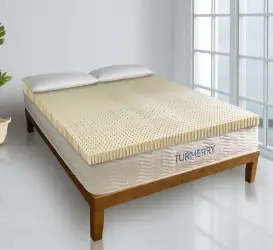
When the box arrived, it was surprisingly heavy.
Latex is dense, far denser than the cheap yellow foam pads you might remember from college dorms.
Getting it up the stairs was a bit of a workout. Upon opening the box, I was greeted by the “latex smell.”
Turmerry is transparent about this, but it is still a shock if you aren’t expecting it. It doesn’t smell like chemicals or gasoline; it smells distinctly earthy, almost like a mix of rubber and vanilla cookie dough.
It wasn’t headache-inducing, but I did have to leave the windows open for about 48 hours before the scent faded to a background note.
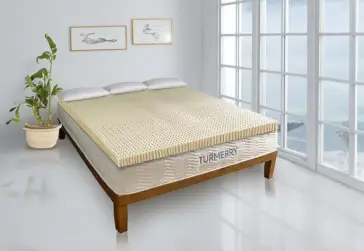
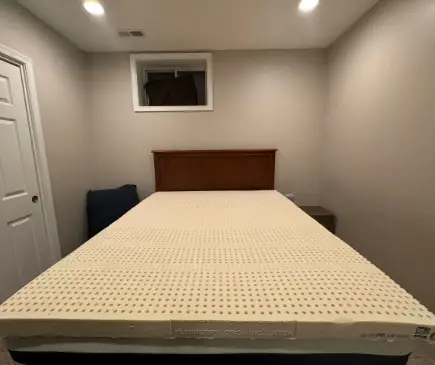
Setting it up was straightforward, though I quickly realized that because latex is “floppy” and heavy, you really have to be careful not to tear it when positioning it on the bed. One thing to note is that the standard topper does not come with a cover. It is just the raw, creamy-white latex foam with visible perforation holes. I ended up putting my fitted sheet directly over it, which worked fine, but the friction of the latex made pulling the sheet tight a bit of a wrestling match.
The first night was a revelation. The “7-zone” design, which I initially thought was a marketing gimmick, actually made a noticeable difference. The zones meant that the foam was slightly firmer under my lower back and softer under my shoulders and hips. I didn’t feel like my hips were bottoming out, which used to be my main issue. The latex has a “bouncy” pushback that is completely different from memory foam. Instead of slowly melting into a mold of your body, the topper instantly contours to you and then springs back the moment you move. This made switching positions effortlessly easy—no more fighting the bed to roll over.
Temperature regulation was another massive win. I tend to sleep hot, and memory foam usually turns into a heat trap by 2 AM. Because this topper is perforated with holes for airflow and latex is naturally breathable, I stayed cool throughout the night. It didn’t actively chill me, but it stayed temperature-neutral, which is all I really asked for.
However, it wasn’t perfect. Without a dedicated cover, the edges of the latex can be a bit fragile. I noticed that if I sat right on the edge of the bed to put my socks on, the topper would squish down almost completely flat. It doesn’t add edge support; if anything, it makes the edge feel a bit more precarious. But once I was actually lying down in the center of the bed, the comfort was undeniable. It transformed a mediocre, aging mattress into a hotel-quality sleep surface for about a fifth of the cost of a new bed.
Read More: My Thoughts On Serta Santiago Mattress
Pros Of Turmerry Mattress Topper
When evaluating the Turmerry topper against the competition, several distinct advantages make it a compelling choice, especially for the eco-conscious buyer on a budget. Here are the specific benefits that stood out during my testing.
- Genuine 7-Zone Pressure Relief System: Most mattress toppers are just a uniform slab of foam from top to bottom. Turmerry differentiates itself by engineering the latex with seven distinct zones of density. This is achieved by varying the size and spacing of the pincore holes (the perforations in the latex). The areas under your shoulders and hips have larger holes to allow for more sinkage and pressure relief, while the area under your lower back has smaller holes to provide firmer support and prevent spinal misalignment. For side sleepers, this is a game-changer because it allows your widest points to sink in without throwing your spine out of whack. You get targeted support exactly where you need it, mimicking the engineering of high-end orthopedic mattresses.
- Certified Organic and Natural Materials: In an industry rife with “greenwashing,” Turmerry brings the receipts. The topper is GOLS (Global Organic Latex Standard) certified, which is the highest standard for organic latex. It is also OEKO-TEX Standard 100 certified, ensuring it is free from harmful substances, and eco-INSTITUT certified for low emissions. This means you are not sleeping on a cocktail of petrochemicals, flame retardants, or synthetic fillers. For anyone with chemical sensitivities, allergies, or just a desire to keep their home toxin-free, this peace of mind is invaluable. You are getting a product that is harvested from rubber trees in a sustainable manner, rather than processed in a crude oil refinery.
- Superior Temperature Regulation: One of the biggest complaints about mattress toppers—specifically memory foam ones—is that they sleep hot. Turmerry’s latex is naturally breathable due to its open-cell structure, but the manufacturing process takes it a step further. The Dunlop latex is perforated with thousands of holes (part of the zoning system) that allow for continuous vertical airflow. Body heat that would normally be trapped between your skin and the mattress is able to dissipate through these channels. Unlike memory foam, which relies on body heat to soften and mold to you, latex stays supportive regardless of temperature. This makes it an excellent choice for hot sleepers or those living in warm climates who don’t want to wake up in a pool of sweat.
- Exceptional Durability and Bounce: Natural Dunlop latex is widely considered the most durable foam material on the market. While cheap poly-foam toppers might flatten out and lose their support within a year or two, a high-quality latex topper like this one can last 5 to 10 years with proper care. It is incredibly resilient; you can compress it night after night, and it will snap back to its original shape instantly. This “bounce” is also great for “bedroom activities,” as it doesn’t leave you sinking into a hole or fighting for traction. You aren’t just buying a temporary fix for your mattress; you are making a long-term investment in your sleep setup that won’t need replacing anytime soon.
Cons Of Turmerry Mattress Topper
Despite the high praise, the Turmerry topper is not without its flaws. There are specific quirks to natural latex and this brand in particular that might be deal-breakers for some users.
- Distinct Earthy “Barnyard” Smell: While it is non-toxic, natural latex is not odorless. When you first unbox the Turmerry topper, you will be hit with a unique scent that many users describe as rubbery, earthy, or even like a sweet barnyard vanilla. This is not the chemical “off-gassing” of VOCs found in memory foam, but rather the natural proteins in the rubber sap. For sensitive noses, this smell can be overpowering for the first few days or even weeks. Although it fades over time, it never truly disappears 100%; if you bury your nose in the mattress, you will likely still catch a whiff of rubber. If you are extremely sensitive to smells, you might find this distracting when trying to fall asleep.
- Heavy and Difficult to Maneuver: Dense, organic rubber is incredibly heavy compared to synthetic foams. A Queen or King-sized 3-inch topper can weigh upwards of 30 to 40 pounds and is essentially a “dead weight” with no handles. Moving it is a two-person job, and because latex can tear if you pull it too hard, you have to be gentle. This makes it difficult to adjust once it is on the bed, and even harder to take off if you want to rotate it or move it to another room. If you live alone or have limited mobility, simply getting the topper out of the box and onto the bed can be a significant physical challenge.
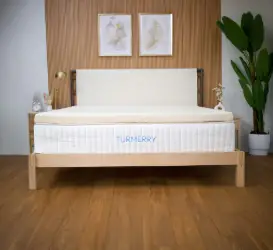
- Lack of an Included Cover: The standard price you see on the website is for the raw foam insert only. Unlike some competitors that come wrapped in a nice organic cotton zipper case, the Turmerry topper arrives “naked.” This means the latex is directly exposed to friction, UV light, and potential tears. While you can put a fitted sheet over it, the rubbery texture grips the sheet, making the bed look lumpy or hard to make. Turmerry sells a cover separately, but it is an additional cost that pushes the price up. Without a cover, the latex is also more susceptible to oxidation and crumbling over the years if it is exposed to sunlight or air.
- Edge Support is Non-Existent: This is a common issue with almost all toppers, but it is prevalent here too. The topper is designed for surface comfort, not structural support. Because the latex is soft and pliable, it will compress completely if you sit on the edge of the bed. It does not have a reinforced perimeter like a full mattress does. This can make you feel like you are going to roll off the bed if you sleep too close to the edge. It also slightly decreases the usable surface area of the bed, as the extreme edges become too soft to support weight effectively.
Maintenance Tips For Turmerry Mattress Topper
Maintaining natural latex requires a different approach than synthetic materials. Since you cannot just throw this massive slab of rubber in the washing machine, you need to be proactive about care to ensure it lasts its full lifespan.
- Protect It From Sunlight at All Costs: Ultraviolet (UV) light is the kryptonite of natural latex. Exposure to direct sunlight will cause the latex to dry out, become brittle, and eventually crumble into a fine powder. You must never air out the topper outside in the sun. Even inside the bedroom, ensure that your sheets are thick enough to block light, or use a mattress protector. If you have the topper near a window, be mindful of sunbeams hitting the bed during the day. Treat the latex like a vampire; keep it in the dark and covered to maintain its structural integrity and elasticity.
- Spot Clean Only—Never Soak: Latex is extremely absorbent and very difficult to dry once it gets saturated. If you spill something on the topper, do not try to wash it in a tub or with a hose. Instead, blot the liquid immediately with a dry towel, pressing down to absorb moisture. For stains, use a mild solution of water and a gentle detergent (like a drop of dish soap), and dab the area gently. Do not scrub vigorously, as wet latex tears easily. Allow it to air dry completely with a fan blowing on it before putting sheets back on. Trapped moisture can lead to mold growth inside the foam, which ruins the topper.
- Rotate the Topper Regularly: Although latex is durable, sleeping in the same spot every night for years can eventually cause slight impressions, especially in the hip area. To ensure even wear, you should rotate the topper 180 degrees (head to foot) every 3 to 6 months. Since the 7-zone support is symmetrical (head and foot zones are the same), rotating it will not mess up the support system. This gives the foam a chance to recover and ensures that you aren’t wearing out one specific zone faster than the others. Ask a friend to help you rotate it to avoid tearing the heavy foam.
- Handle With Extreme Care: As mentioned, latex has a low tear strength, meaning it can rip if pulled sharply. When moving or adjusting the topper, do not grab it by the edge and pull. Instead, try to “wave” air underneath it to break the friction seal with the mattress, or roll it up gently to move it. Be careful with sharp objects like jewelry or long fingernails when handling the naked foam. If you do get a small tear, it usually won’t affect the overall comfort, but it can grow larger over time if you keep pulling on that area. Treating it gently will prevent structural damage.
Comparison with Other Brands
Turmerry operates in a competitive niche of organic bedding. To understand its true value, we need to compare it to the other big players in the latex game. Here is how it stacks up.
- Sleep On Latex (Pure Green Mattress Topper): This is arguably Turmerry’s biggest direct competitor in the budget-friendly organic space. Comparison: Sleep On Latex (SOL) offers a very similar product: GOLS-certified Dunlop latex without synthetic fillers. The key difference is the zoning. SOL uses a uniform, single-zone construction, meaning the density is consistent from top to bottom. Turmerry uses the 7-zone pincore design. If you want a simple, flat surface, SOL is excellent and often ships faster with a simpler return policy (no donation requirement hurdles). However, Turmerry’s zoning offers better pressure relief for side sleepers who need that extra give in the shoulders. SOL includes a cover option more easily in their checkout flow, whereas Turmerry feels more “a la carte.” Turmerry is often slightly cheaper during sales, making it the winner for pure value, while SOL wins on simplicity and reputation for durability.
- Avocado Green Mattress Topper: Avocado is the “Apple” of the organic mattress world—premium branding, high prices, and great aesthetics. Comparison: The Avocado topper comes standard with a luxurious organic cotton cover and wool batting layer. This wool layer adds a plush, pillow-top feel that Turmerry’s raw latex lacks. However, you pay a premium for it; the Avocado topper is significantly more expensive than Turmerry. Avocado uses 2 inches of latex plus the wool, whereas Turmerry allows you to buy up to 4 inches of pure latex. If you want a “buy it and forget it” luxury experience with a cover included and don’t mind the price tag, Avocado is superior. But if you want to maximize the amount of latex you get for your dollar, Turmerry blows Avocado out of the water. Turmerry is the functional choice; Avocado is the luxury choice.
- PlushBeds Organic Latex Topper: PlushBeds is another high-end retailer known for extensive certifications and high prices. Comparison: PlushBeds creates a very high-quality product that is virtually identical in material sourcing to Turmerry (both use GOLS Dunlop). The main difference is the price and the “extras.” PlushBeds often lists their toppers at an incredibly high MSRP and then offers perpetual “sales,” which can be confusing. Turmerry’s pricing is generally more transparent and lower year-round. PlushBeds focuses heavily on their “Talalay” options as well (which are softer but more expensive), while Turmerry focuses on Dunlop. If you specifically want Talalay latex (which is bouncier and lighter), PlushBeds is the place to go. For standard Dunlop latex, there is very little reason to pay the PlushBeds markup when Turmerry offers the same organic certification and zoned support for less money.
Also Read: My Thoughts On Bed Bunny Sheets
Frequently Asked Questions (FAQ)
The 7-zone topper is a flat slab of latex with varying hole sizes to create different support levels for your body parts (softer shoulders, firmer back). The egg crate topper has a convoluted, bumpy surface (like an egg carton) designed to provide maximum airflow and a softer, more massaging feel. The egg crate version is generally cheaper and thinner, making it better for a slight comfort adjustment, while the 7-zone is a substantial upgrade for support and pressure relief.
Yes, it has a distinct natural rubber scent often described as “earthy” or like vanilla/cookies. This is not a chemical off-gassing but the natural proteins in the rubber sap. For most people, the smell dissipates to an unnoticeable level within a few days to a week. Airing it out in a well-ventilated room (away from direct sun) before putting sheets on helps reduce the odor significantly.
No, you should never wash or machine dry the latex topper. Water can get trapped inside the foam, leading to mold and degradation of the material. Spot clean stains with a damp cloth and mild soap only. If you need to freshen it up, sprinkle baking soda on the surface, let it sit for 30 minutes, and then gently vacuum it off.
Yes, it is excellent for side sleepers, especially the “Soft” or “Medium” firmness options. The 7-zone design specifically features larger holes in the shoulder and hip areas to allow for deeper sinking, which relieves pressure points. Side sleepers should typically opt for the 3-inch thickness to ensure there is enough material to cushion the hips before hitting the firm mattress underneath.
Conclusion
The Turmerry Latex Mattress Topper is a standout product that proves you don’t need to spend a fortune to get a non-toxic, organic sleep surface. It bridges the gap between budget foam pads and luxury organic bedding, offering a high-quality, GOLS-certified product at a price point that is hard to beat. The 7-zone support system is a legitimate feature that adds tangible comfort, particularly for side sleepers needing pressure relief.
While the lack of an included cover and the heavy, floppy nature of the material are minor inconveniences, they are easily outweighed by the performance and value. If you can handle the initial earthy smell and are willing to treat it with care, this topper can extend the life of your mattress by years. For anyone seeking a natural, cooling, and supportive upgrade, Turmerry is undeniably worth the investment.