
If you are standing on the fence between buying a Logitech G29 or a Thrustmaster T300 RS GT, you are looking at the classic “Entry-Level vs. Mid-Range” debate. Both are legendary in the sim racing community, but they offer vastly different driving experiences. My goal in this article is to cut through the spec sheets and give you a raw, honest comparison based on force feedback feel, pedal quality, and long-term reliability. I will help you determine if the jump in price for the Thrustmaster is actually worth it for your lap times and immersion.
A Brief Comparison Table
| Feature | Logitech G29 (Driving Force) | Thrustmaster T300 (RS GT Edition) |
| Force Feedback Tech | Helical Gear-Driven (Proven but tech from 2005) | Dual-Belt Driven (Smoother, Modern) |
| Smoothness | “Notchy” (You can feel the gears grinding) | Very Smooth (Fluid rotation) |
| Noise Level | Loud (Clacking/Rattling on curbs) | Quiet (Mostly fan noise) |
| Pedals Included | 3-Pedal Set (Excellent brake resistance) | 3-Pedal T3PA (Good, but feels lighter) |
| Wheel Rim | Hand-stitched Leather (Premium feel) | Rubber/Plastic (Functional but feels cheaper) |
| Interchangeable Wheel | No (Fixed rim) | Yes (Quick Release ecosystem) |
| Torque | ~2.1 Nm (Weaker) | ~3.9 Nm (Stronger) |
| Reliability | Tank-like (Very few failures) | Moderate (Overheating issues known) |
| Best For | Beginners, Budget Sim Racers | Intermediate, Drifting, Precision |
My Experience With Logitech G29
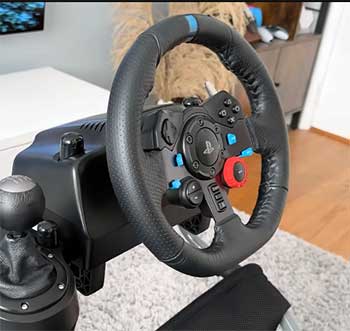
When I first clamped the Logitech G29 to my desk, it felt like shaking hands with an old friend.
This wheel is the evolution of the legendary G25/G27, and it feels incredibly robust.
The leather wrapping on the rim is a fantastic touch—it doesn’t feel like a toy; it feels like a car part.
However, the moment I hit the track in Assetto Corsa, the limitations of the gear-driven system were obvious.
There is a “dead zone” in the center where the force feedback feels vague.
When you hit a curb or go off-road, the wheel chatters loudly—a “clack-clack-clack” sound that can wake up people in the next room. It fights you in a way that feels slightly mechanical rather than like a real tire connection.
That said, the pedals are the saving grace. The brake pedal has a progressive rubber stopper inside that mimics the pressure of a real hydraulic brake. It requires serious leg strength to hit 100% braking, which actually helped me build muscle memory and consistency. For the price, it is an unbeatable package that just works, forever.
Pros Of Logitech G29
- Bulletproof Durability: The G29 is often called the “tank” of sim racing. The gear system, while older technology, is incredibly simple and rarely fails. I have seen these wheels abused for 5+ years and still run perfectly. If you want a one-time purchase that lasts a decade, this is it.
- Premium Leather Rim: Unlike the rubberized plastic on competitors, Logitech wraps the G29 in real hand-stitched leather. It feels great in the hands, especially during long endurance races where rubber grips can get slippery with sweat.
- Excellent Stock Pedals: The included pedal set is superior to the base pedals of almost any other entry-level wheel. The brake pedal is stiff and provides great resistance, allowing for “trail braking” (easing off the brake while turning) much more effectively than cheaper spring-loaded pedals.
- Integrated RPM Lights: The shift lights built directly into the center of the wheel are a neat feature. In Formula 1 games, timing your shift perfectly without looking at the on-screen UI adds a nice layer of immersion.
- Gear Shifter is Cheap: If you want to drive manual cars, the Logitech Driving Force Shifter is one of the cheapest H-pattern shifters on the market ($60 range). While it feels a bit plastic, it’s a very affordable way to learn manual transmission.
Read More: My Thoughts On Windshield Repair Kit
Cons Of Logitech G29
- Loud “Gear Chatter”: This is the biggest complaint. Because metal gears are hitting each other to create force, the wheel rattles violently when driving over bumps. It is distracting and can be very annoying to family members or roommates.
- Notchy Force Feedback: You can literally feel the “teeth” of the gears as you turn the wheel. It isn’t a smooth rotation; it feels grainy. This makes it harder to feel subtle loss of traction, like when your rear tires are just starting to slide.
- Center Dead Zone: Due to the gear mechanism, there is a tiny bit of play in the dead center of the wheel where there is no force feedback. On long straights, the wheel can feel a bit lifeless until you turn it slightly.
- Non-Interchangeable Rim: What you see is what you get. You cannot take the wheel rim off to swap it for a Formula 1 style rim or a larger rally wheel. You are stuck with the small (27cm) D-shaped rim forever unless you do risky DIY mods.
- Software Can Be Finicky: The Logitech G Hub software is known for occasionally “forgetting” settings or failing to detect the wheel, requiring a reinstall or restart.
My Experience With Thrustmaster T300
Switching from the G29 to the Thrustmaster T300 RS GT was an eye-opening experience. The first thing I noticed was the silence. The dual-belt mechanism is whisper-quiet compared to the Logitech gears.
But the real magic is the smoothness. Turning the wheel feels fluid, like steering a real car with power steering. The force feedback is significantly stronger (almost double the torque of the G29), but more importantly, it is detailed. I could feel the difference between the tires gripping the asphalt and slipping on the grass instantly. Drifting, which was a struggle on the G29 due to the jerky return speed, became much easier and more natural on the T300 because the wheel spins freely and quickly to counter-steer.
However, after about 45 minutes of intense driving in Dirt Rally 2.0, I noticed the internal fan kick into high gear. It smelled faintly of hot electronics—a known trait of this base. It didn’t fail, but it definitely runs hotter than the Logitech.
Pros Of Thrustmaster T300
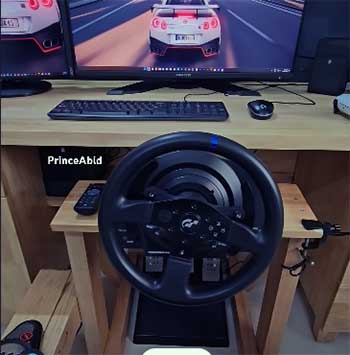
- Smooth Dual-Belt Drive: This is the game-changer. The belts absorb the vibration and deliver force feedback that is buttery smooth. You don’t feel any gears or “grain.” This allows you to feel subtle details, like the weight of the car shifting during a corner, which is impossible to feel on a gear-driven wheel.
- Interchangeable Wheel Ecosystem: The T300 base allows you to unscrew the rim and swap it. You can buy a Ferrari F1 rim, a vintage wood rim, or a Sparco rally rim. This customizability is huge for immersion if you play different types of racing games.
- Stronger and Faster Force Feedback: With roughly 3.9 Nm of torque, the T300 is strong enough to wrestle you. The rotation speed is also much faster, which is critical for drifting or catching a slide. The wheel snaps back to center instantly, whereas the G29 can feel a bit sluggish.
- Accurate Hall Effect Sensors: Thrustmaster uses magnetic sensors (H.E.A.R.T technology) that are contactless. This means they don’t wear out over time like the potentiometers used in cheaper wheels, ensuring your steering precision stays perfect for years.
- Quieter Operation: Since there are no clacking gears, the only sound you usually hear is the internal cooling fan and the physical “thump” of the soft-stops. It is much more living-room friendly.
Cons Of Thrustmaster T300
- Reliability / Overheating Issues: The T300 has a reputation for running hot. If you run the Force Feedback at 100% for long periods, the wheel can go into “fade mode” where it reduces power to protect the motor. Many users (including me) recommend forcing the fan to be “always-on” to prevent this.
- Rubber/Plastic Rim Feel: The stock rim on the T300 RS (and even the GT edition) is rubber-coated. It provides good grip, but it feels cheaper and stickier than the premium leather on the Logitech G29. It can also wear down and get ugly after heavy use.
- Pedals Feel “Light”: Even the upgraded T3PA pedals included with the GT edition lack the stiffness of the Logitech brake pedal. They are good, but they feel a bit floppier. Most serious users eventually upgrade these to the T-LCM Load Cell pedals.
- More Expensive: The T300 is significantly pricier than the G29. You are paying for the motor technology, not the materials of the rim or pedals.
- Mounting Clamp is Finicky: The desk clamp system uses a single screw with a plastic handle. It works, but it feels less secure than the dual-clamp system on the Logitech. I always worry I might overtighten and crack it.
Maintenance Tips For Logitech G29
- Cover the Leather: The leather rim absorbs sweat and oils from your hands. I highly recommend wearing thin racing gloves or cycling gloves. If you don’t, wipe the leather down with a damp cloth after every session to prevent it from cracking or smelling.
- Clean the Potentiometers: If you notice your throttle or brake flickering in the game (inputs jumping), dust has likely gotten into the pedal sensors (potentiometers). You can spray a tiny bit of electronic contact cleaner into the sensor housing to fix this without buying new pedals.
- Check the USB Breakaway Cable: The cable has a “breakaway” segment near the USB end. Ensure this connection is tight. A loose connection here is the #1 cause of the wheel disconnecting mid-race.
- Lubricate the Gears: After a few years, the grease on the internal plastic gears can dry out, making the wheel louder. Opening the casing and applying white lithium grease can restore the quietness (note: this voids the warranty).
Also Read: My Thoughts On Shiny Car Stuff
Maintenance Tips For Thrustmaster T300
- Force Fan Mode: This is the most critical tip. By default, the fan only turns on when the wheel gets hot. You can force the fan to run 100% of the time by holding the “Mode” and “Option/Start” buttons until the red light flashes twice. Do this immediately. It keeps the motor cool and prevents force feedback fade.
- Tighten the Quick Release Screw: The collar that holds the wheel rim on can loosen over time, causing the wheel to wobble. Check the small locking screw periodically, but do not overtighten it as it drills into plastic.
- Dust the Vents: The T300 sucks in air to cool the motor. If you play on a carpeted floor, it will suck in dust and clog the motor. Keep the base on a desk or rig, and use compressed air to blow out the side vents monthly.
- Update Firmware: Thrustmaster releases firmware updates that change how the cooling fan behaves. Always plug the wheel into a PC and check for updates when you first buy it to ensure you have the latest thermal protection profiles.
Comparison with other brands
- Thrustmaster T300 vs. Logitech G923: The G923 is essentially a G29 with a vibration motor (“TrueForce”). The T300 is still vastly superior to the G923 in terms of smoothness and power. The “rumble” of TrueForce doesn’t make up for the gear-driven mechanism’s limitations.
- Thrustmaster T300 vs. Fanatec CSL DD: This is the next step up. Fanatec uses “Direct Drive” (motor connected directly to the wheel shaft). The Fanatec is smoother, stronger (5-8 Nm), and faster than the T300, but it costs significantly more (often double once you add pedals and a rim). The T300 is the bridge between toys and Direct Drive.
- Logitech G29 vs. Thrustmaster T150/T128: The T150 is the direct price competitor to the G29. The T150 uses a hybrid belt-gear system. It is smoother than the G29 but feels much cheaper (all plastic). I usually recommend the G29 over the T150 purely for build quality, unless you strictly care about FFB feel.
- Thrustmaster T300 vs. Moza R5: Moza is a newer competitor offering entry-level Direct Drive. The Moza R5 bundle is slightly more expensive than a new T300 but offers Direct Drive technology. If you are buying new today, Moza is a serious threat to the T300, but the T300 still wins on console compatibility (PlayStation) as Moza is often PC-only or requires adapters.
Frequently Asked Questions (FAQ)
The Thrustmaster T300 is objectively the better wheel in terms of performance. The belt-drive system provides smoother, stronger, and more realistic force feedback compared to the notchy gear-driven Logitech G29.
Yes, if you are serious about sim racing. The jump in fidelity allows you to catch slides and feel the road surface much better. However, if you are a casual player who just wants to cruise in Forza Horizon or Truck Simulator, the T300’s premium features might be overkill, and the G29 is better value.
Absolutely. It is the gold standard for beginners because it is affordable, includes great pedals, and is nearly indestructible. It is the perfect low-risk entry into the hobby.
Thrustmaster is a brand owned by the Guillemot Corporation, a French company that designs and manufactures interactive entertainment hardware. While the engineering is European, the manufacturing takes place in China.
Conclusion
To wrap up this track battle, your choice depends on your budget and your dedication to the hobby.
If you are a beginner looking for a reliable, all-in-one package that will last for years and holds its resale value, buy the Logitech G29. It is the “Toyota Camry” of sim racing—it isn’t exciting, but it gets the job done perfectly every single time.
However, if you are chasing lap times, immersion, and drifting capability, you need the Thrustmaster T300. The belt-drive system is a massive leap forward in technology that makes driving feel like driving, not like playing a video game. Just remember to keep that cooling fan running!