
If you are standing in your bathroom, staring at your frizzy wet hair and wondering if spending rent money on a blow dryer is actually justifiable, you have come to the right place. I have been exactly where you are, weighing the legendary status of the Solia—a salon favorite that dominated the 2000s—against the futuristic, wallet-draining Dyson Supersonic. My intent here is to strip away the marketing fluff and give you a raw, honest breakdown of whether the “Apple of hair care” really beats a reliable workhorse that costs a fraction of the price. We are going to look at heat damage, drying speed, and that all-important arm fatigue to see which tool deserves a spot on your vanity.
A Brief Comparison Table
| Feature | Solia Thermal Ionic | Dyson Supersonic |
| Motor Placement | Head (Traditional) | Handle (Balanced) |
| Heat Technology | Ceramic + Tourmaline Ionic | Intelligent Heat Control (Glass bead thermistor) |
| Wattage | 1875 Watts | 1600 Watts |
| Airflow Logic | Standard Fan Force | Air Multiplier™ (Bladeless look) |
| Weight Feel | Top-heavy, substantial | Balanced, lightweight feel |
| Attachments | Snap-on Plastic | Magnetic (Rotatable) |
| Price Point | ~$80 – $140 (Varies) | $400+ |
| Sound | Standard Whoosh/Hum | High-pitched Jet Whine |
My Experience With Solia
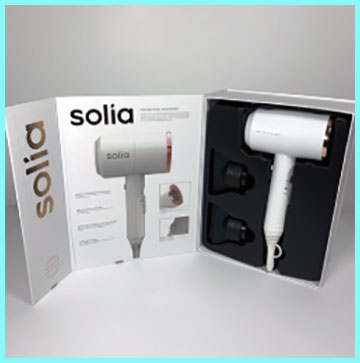
I bought my Solia back when YouTube beauty gurus were just starting to become a thing.
It was the “it” dryer to have if you wanted that pin-straight look. I remember taking it out of the box and feeling like I had bought a professional weapon.
The soft-touch rubberized finish felt expensive compared to the hard plastic Conair I had been using.
For years, this dryer was my reliable partner.
I have thick, wavy hair that loves to frizz, and the Solia could tame it into submission.
I developed a technique: high heat, high speed, round brush tension. The Solia got so hot that I could see the steam rising off my hair (probably not good, but effective). It made my hair incredibly shiny. However, the weight was always a struggle. By the time I got to the back of my head, I would be sweating.
It was a workout. And the noise—my roommates hated it. I had to close the bathroom door and stuff a towel under it if I was getting ready early. But it never failed me. It survived drops, travel, and daily abuse. It felt indestructible.
Pros Of Solia
- Raw Thermal Power For Coarse Hair: One thing that stood out to me immediately when using the Solia is the sheer intensity of the heat it can produce. In the world of hair styling, we are often told that “heat is bad,” but if you have incredibly thick, coarse, or resistant hair types, you know that sometimes you need high heat to actually reshape the bonds in the hair shaft. The Solia utilizes a ceramic heater that generates a very intense, penetrating warmth. Unlike newer smart dryers that constantly throttle the temperature down to “save” your hair, the Solia lets you crank it up. This is a massive advantage if you are trying to do a silk press on natural hair or smooth out a stubborn wave pattern that simply laughs at gentle breezes. It gives you the raw horsepower of a professional salon blowout from 2010, which, for many textures, is still the gold standard for getting that bone-straight finish without needing a flat iron afterwards.
- Proven Tourmaline Ionic Technology: While every dryer today claims to be “ionic,” Solia was one of the pioneers in really packing their grills with tourmaline. When this mineral is heated, it emits a massive amount of negative ions. I noticed that when I use the Solia, the static reduction is almost instant. The science here is that the negative ions break down the water molecules on your hair surface into smaller droplets, which are then absorbed into the hair shaft or evaporated faster. This means you aren’t just baking your hair dry; you are actually helping to seal the cuticle. For a dryer in this price range, the finish it leaves is surprisingly glossy. It gives that “I just left the chair” shine that is often hard to replicate with cheap drug store dryers that just blow hot air without the ionic benefit.
- Universal Attachment Compatibility: One of the most annoying things about proprietary tech like Dyson is that if you lose a nozzle, you are paying a premium to replace it. The Solia features a standard barrel size that fits almost any universal diffuser or concentrator nozzle you can buy at a beauty supply store. This is a huge pro for versatility. If you have a favorite “black orchid” diffuser or a specific comb attachment you have loved for years, chances are it will slip right onto the Solia nozzle without a fuss. This openness allows you to customize your tool kit without being locked into a single brand’s ecosystem. I have a drawer full of random diffusers, and knowing I can use them with the Solia makes it feel like a much more adaptable tool for different styling days.
- Simple, Tactile Controls: There is something to be said for muscle memory. The Solia uses the classic rocker switches found on professional handles—one for heat, one for speed, and a separate cool shot button.4 You can operate this thing blindfolded. When I am in a rush, with wet hands, trying to style the back of my head, I don’t want to fumble with flush buttons or digital interfaces. The Solia’s switches click firmly into place. You know exactly what setting you are on without looking. It is a “dumb” tool in the best possible way; it doesn’t try to outsmart you, it just does exactly what you tell it to do. For professionals or anyone who hates learning curves, this traditional layout is comforting and efficient.
- Cost-Effectiveness: We cannot ignore the elephant in the room. You can buy three or four Solias for the price of one Dyson. If you are someone who only blow-dries their hair once a week, or perhaps you air dry mostly and only diffuse occasionally, the return on investment with the Solia is incredible. It gets you 90% of the way to a perfect blowout for 25% of the cost. The build quality is robust—these things are known to last for years—so you aren’t just buying a cheap throwaway item; you are buying a mid-range professional tool that respects your budget.
Cons Of Solia
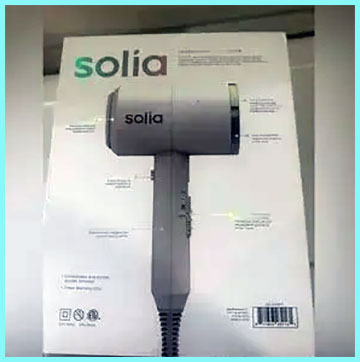
- Significant Weight and Arm Fatigue: The first time I picked up the Solia after using lighter travel dryers, I felt it. This is a traditional AC motor dryer, and the motor is heavy. Worse, the motor is located in the head of the dryer, behind the nozzle. This creates a “top-heavy” leverage effect. When you are holding the dryer up to your roots, especially if you have long hair that takes 20 or 30 minutes to dry, your wrist takes a beating. I found myself having to switch hands frequently or take breaks just to shake out my forearm. If you have carpal tunnel, arthritis, or simply weak wrists, this ergonomic design is a major drawback. It feels like you are lifting a small dumbbell by the end of a styling session.
- Risk of Heat Damage: Because the Solia gives you that raw power I mentioned earlier, it also hands you the loaded gun to destroy your hair health if you aren’t careful. It does not have the sophisticated “intelligent heat control” that measures output temperature 40 times a second. If you leave the Solia on a section of hair for too long, it will fry it. I have had moments where I got distracted and smelled that distinct “toasted hair” scent. It requires you to be vigilant and skilled. You cannot just zone out while drying; you have to keep the dryer moving and manage your distance, or you risk boiling the moisture right out of your cortex, leading to long-term brittleness and split ends.
- Dated Noise Profile: Turning on the Solia is like turning on a mini jet engine in a tunnel. It has that classic, loud, mechanical drone. It operates at a frequency that cuts right through conversations. I cannot listen to a podcast or watch Netflix while drying my hair with the Solia unless I have noise-canceling headphones on. If you live with roommates or a partner who sleeps in, using this dryer in the morning is a guaranteed way to wake up the entire house. It lacks the acoustic engineering of modern luxury dryers, relying instead on brute force air movement which naturally creates a lot of turbulence and noise.
- Bulky for Travel: This is not a throw-in-your-gym-bag kind of tool. The Solia is long, the cord is thick and heavy, and the handle does not fold. It takes up a significant amount of real estate in a suitcase. Whenever I have traveled with it, I have had to sacrifice a pair of shoes just to fit it in. It is strictly a “home base” dryer. If you are a jet-setter or someone who needs to style their hair at the gym before work, the Solia is cumbersome and inconvenient compared to the compact designs dominating the market today.
- Switch Placement Issues: While I praised the tactile nature of the switches, their placement on the handle has a downside. I have found that because of where they sit—right where your palm grips the handle—it is very easy to accidentally bump the heat setting from “Hot” to “Warm” or turn the unit off entirely in the middle of a blowout. It happens when you are maneuvering the brush and shifting your grip. There is nothing more frustrating than realizing you have been blowing cool air on a section you wanted to straighten for the last thirty seconds because your thumb grazed the rocker switch.
My Experience With Dyson
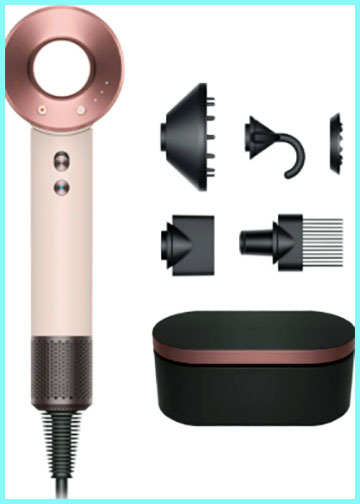
The switch to Dyson was jarring. I received it as a gift, and my first thought was, “This looks like a microphone, not a dryer.”
The first time I turned it on, I laughed at the sound—it was a high-pitched pew-pew noise.
But then I started drying.
The air pressure was shocking. It didn’t feel like heat; it felt like compressed air.
My hair was drying visibly faster, but it was tangling because I wasn’t used to the wind speed.
I had to attach the smoothing nozzle immediately to control it.
Once I adjusted my technique, the difference was undeniable. I finished my whole head in 12 minutes instead of my usual 22.
My arm wasn’t tired. My bathroom didn’t feel like a sauna.
The biggest realization came a few months later. I noticed I wasn’t trimming my ends as often. My hair felt softer when air-dried on off days. The lack of extreme heat was actually healing my hair. However, I do miss the “grip” of the Solia sometimes. The Dyson makes my hair so slippery and soft that sometimes it’s hard to hold a curl. It’s almost too healthy. But for the convenience and the speed, I haven’t touched my Solia in two years. It sits in a drawer as a backup, a heavy relic of a past era.
Pros Of Dyson
- Revolutionary Weight Distribution: The moment you hold a Dyson Supersonic, you realize everything else has been designed wrong. Dyson moved the tiny, powerful V9 digital motor into the handle, not the head. This shifts the center of gravity into your palm. Even though the actual weight difference on a scale might not look massive compared to some travel dryers, the feel is transformative. I can blow dry my hair for 45 minutes without a single ache in my wrist. It feels like an extension of your arm rather than a tool you are holding up. This balance allows for much more precise angulation of the airflow because you aren’t fighting gravity.
- Intelligent Heat Control: This is the feature that justifies the price tag for me. The Dyson Supersonic has a glass bead thermistor that measures the air temperature 40 times per second and transmits this data to the microprocessor. If the air gets too hot, it instantly adjusts the heating element. I have literally pressed this dryer directly against my scalp (don’t recommend, but I did it for science) and it never burned me. This safety net is invaluable for maintaining hair health. It ensures you never cross that threshold where keratin starts to denature. Over months of use, I noticed my hair had significantly fewer split ends and felt softer, simply because I wasn’t accidentally overheating it every morning.
- Magnetic Attachments: I cannot overstate how satisfying the magnetic attachment system is. The nozzles and diffusers just snap onto the front of the dryer with a reassuring click. But the real genius is that you can rotate them 360 degrees effortlessly. If you are doing a blowout and need to change the angle of the concentrator blade from horizontal to vertical to hit a specific piece of fringe, you just nudge it with your finger. No unscrewing, no burning your fingers on hot plastic clips, no wrestling with a tight fit. It makes the workflow of styling so much faster and more fluid. It feels premium and thoughtful.
- Air Multiplier Technology: Dyson doesn’t just blow air; it multiplies it. The design draws air in from the bottom handle and amplifies it through the ring head, creating a high-velocity jet of controlled air.8 This means you get a massive volume of air movement without needing extreme heat. This “high wind, lower heat” approach is safer for hair. It pushes the water off the strand physically rather than just evaporating it with heat. I have found this cuts my drying time down by about 30-40%. For someone with thick hair that holds water like a sponge, getting 20 minutes of my life back every morning is a tangible benefit.
- Acoustically Tuned Motor: The Dyson is not silent, but it is different. The digital motor spins at up to 110,000 rpm, which pushes the sound frequency up beyond the audible range of humans for one of the tones. The resulting noise is more of a rush of air than a mechanical grind. It is significantly quieter than a traditional dryer like the Solia. I can actually have a conversation with my partner while drying my hair without screaming. I can listen to music without maxing out the volume. It is a much more civilized, less aggressive auditory experience that leaves you feeling less frazzled before you’ve even had your coffee.
Cons Of Dyson
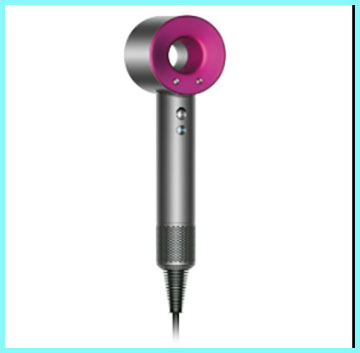
- The Astronomical Price Tag: There is no way around it: $400+ for a hair dryer is a painful purchase. It is an investment that requires serious justification. For that price, you could buy a Solia, a high-end flat iron, and a curling wand, and still have money left over for dinner. If you are on a tight budget, the Dyson is simply inaccessible. It forces you to ask if drying your hair slightly faster is worth the cost of a car payment. For many users, the law of diminishing returns kicks in hard here—is it really 10 times better than a $40 dryer? Probably not. It is a luxury good, and you are paying a “Dyson Tax” for the brand engineering and aesthetics.
- The Clunky Power Brick: While the dryer itself is a marvel of engineering, the power cord features a massive, heavy “brick” (the transformer) about a foot down from the plug. This thing is annoying. It drags on the counter, it gets caught on drawer handles, and it adds weight to the cord that can sometimes pull the dryer if you aren’t careful. It feels like a design oversight in an otherwise sleek product. You have to be mindful of where this brick is sitting while you style, or it will bang against your bathroom vanity. It also makes storing the cord neatly a bit of a Tetris challenge.
- Learning Curve for Airflow: The airflow from the Dyson is so powerful and focused that it can actually be difficult to manage at first. If you just point it at your head like a normal dryer, it can whip your hair into a tangled mess immediately. I had to relearn how to style. You have to use the nozzle attachments and point the airflow down the hair shaft meticulously. It is less forgiving of “rough drying.” If you are not careful, that high-velocity wind can create knots faster than you can brush them out. It takes a week or two to get the hang of the sheer force it outputs.
- Awkward Cold Shot Button: On the Dyson, the cold shot is a button on the handle that you have to hold down (or on newer models, a specific setting, but the hold is standard for quick blasts). I found the button placement slightly awkward for my thumb to hold down for extended periods while setting a curl. It requires a bit of pressure, and after holding it for 15 seconds on five different sections, my thumb started to cramp. Compared to the locking click switches of older dryers, this “hold to cool” mechanic feels a bit tiresome during an intricate styling session.
- It Can Feel “Cold”: Because the Dyson relies so heavily on air speed rather than heat, some users (myself included initially) feel like it isn’t “working” because the air doesn’t feel scorching hot. If you are addicted to that searing heat feeling to know your hair is being styled, the Dyson can feel underwhelming. It feels like a lukewarm breeze even on high settings compared to the Solia’s toaster-oven vibes. You have to trust the process, but psychologically, it can feel like you aren’t getting the heat you need, even if the result proves otherwise.
Comparison With Other Brands
- Shark FlexStyle/HyperAir: Shark has entered the chat as the biggest Dyson competitor. I have used the Shark HyperAir, and frankly, it is 90% of the Dyson experience for 50% of the price. It has similar high-velocity air and intelligent heat. The main difference is the Shark feels a bit plasticky and louder than the Dyson. It doesn’t have that ultra-premium weighted balance, but if you want the tech without the bankruptcy, Shark is the logical middle ground between Solia and Dyson.
- T3 AireLuxe: T3 is the direct evolution of the Solia. It is a “traditional” form factor dryer but with modern tech. The T3 is beautiful (white and rose gold usually) and focuses on a wide, soft airflow rather than the Dyson’s targeted jet. If you hate the “wind tunnel” feel of the Dyson but want something lighter and healthier than the Solia, the T3 is the perfect compromise. It is gentle and luxurious, though slower than the Dyson.
- BaBylissPRO: This is the brand you see in most actual salons. Like Solia, they rely on Ferrari-designed AC motors and high heat. They are louder and heavier than Dyson but offer incredible reliability. If you want that Solia-style performance but with better build quality and a current warranty, BaByliss is the industry standard for a reason. They are workhorses that refuse to die.
Frequently Asked Questions (FAQ)
For pure drying speed and tech, the Shark HyperAir is the closest rival. For styling finish and hair health without the jet-engine air, the T3 AireLuxe is often considered superior for creating volume and body.
The Laifen Swift is widely regarded as the best “dupe.” It mimics the brushless motor, the negative ion tech, and the ring-light design almost perfectly for about one-third of the price, though it lacks the extensive attachment ecosystem.
The Shark FlexStyle is the undisputed best alternative. It transforms from a dryer to a multi-styler, has auto-wrap curlers, and performs comparably to the Airwrap for significantly less money.
If you mean a direct visual and functional clone, Laifen or Dreame hair dryers are the top contenders. They offer the same “hammer” shape, high-velocity airflow, and magnetic attachments that directly copy the Dyson user experience.
Conclusion
If you are a creature of habit who values a rock-hard blowout, has thick hair that laughs at gentle airflow, and wants a tool that feels substantial and proven, the Solia (or its modern spiritual successors like BaByliss) is your best bet. It offers the heat intensity and tactile control that many of us grew up with and mastered. It is a budget-friendly way to get salon results if you have the arm strength to wield it.
However, if you view your time as money, care deeply about preserving your hair’s integrity, and want a styling experience that feels like it belongs in the 21st century, the Dyson Supersonic is unrivaled. It changes the chore of drying hair into a quick, somewhat enjoyable task. It is expensive, yes, but for a tool you use almost every day, the comfort and speed are luxuries that quickly become necessities.