
Salt is the silent killer of everything we love in the boating and fishing world, from our outboard engines to our trailer brakes. If you are reading this, you are probably trying to decide between the two heavyweights of salt removal: Star Brite’s Salt Off and the legendary Salt-Away. I have spent years rinsing down center consoles and flushing jet skis, testing both of these products to see which one actually prevents rust and which one is just expensive soap. This guide compares them head-to-head to help you protect your investment without wasting money.
A Brief Comparison Table
| Feature | Salt Off (Star Brite) | Salt-Away |
| Manufacturer | Star Brite | Salt-Away Products |
| Primary Formula | Chelating Agent With PTEF Polymers | Specialized Salt Dissolving Agents |
| Best Application | Hull Washing & Surface Protection | Engine Flushing & Cooling Systems |
| Protective Coating | Leaves PTEF (Teflon-like) Barrier | Leaves Thin Protective Film |
| Scent Profile | Mild Chemical/Clean Scent | Distinctive, Almost Medical Scent |
| Biodegradable | Yes | Yes |
| Applicator Included | Often Sold With Applicator | Proprietary Mixing Unit Available |
| Price Point | Generally More Affordable | Premium / Expensive |
My Experience With Salt Off
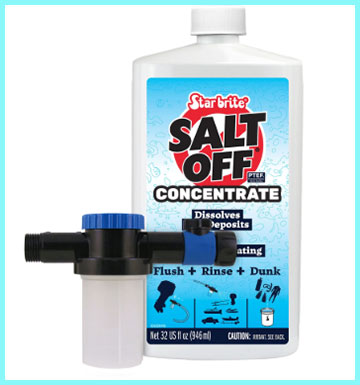
I picked up my first bottle of Star Brite Salt Off when I was looking for a more affordable alternative to the big blue bottle everyone else was using.
I own a bay boat that sees a lot of brackish and saltwater, and I noticed the trailer was starting to show signs of early corrosion despite my best efforts with fresh water.
Star Brite is a massive name in marine care, so I figured their “Salt Off” with PTEF was worth a shot.
The first thing I noticed was the marketing around the PTEF polymers, which essentially claimed to leave a protective coating behind after the salt was gone.
Using it felt very familiar if you have used any marine wash.
I hooked up the applicator to my garden hose and started spraying down the hull and the trailer. The foaming action was decent, though not as thick as some snow foams I have used for cars. What impressed me, however, was the finish after rinsing. Because of those added polymers, the water beaded up nicely on the cowling and the gel coat. It didn’t just strip the salt; it felt like it was adding a sacrificial layer against the next trip. I also used it in a spray bottle for my fishing reels, and it didn’t gum up the drag, which was a major relief. It felt like a “two-in-one” product: a salt remover and a light wax.
Read More: My Thoughts On Clack WS1 Water Softener
Pros Of Salt Off
- Includes PTEF Protective Polymers: This is the single biggest advantage that Salt Off holds over many competitors. Most salt removers are strictly designed to dissolve salt crystals and wash them away, leaving the surface bare. Star Brite formulated this product with PTEF, which is a high-tech polymer similar to Teflon. When you wash your boat or trailer with this, you are not just cleaning it; you are depositing a slick, non-stick barrier on the surface. In my experience, this makes subsequent cleanings significantly easier. Dirt, fish blood, and future salt spray have a harder time sticking to the gel coat because of that polymer layer. It acts like a light wax that refreshes every time you wash the boat. For someone who doesn’t have the time to do a full wax job every month, this “wash and protect” feature is a massive time saver and adds a layer of UV protection that other simple salt removers lack.
- Cost-Effective Solution: Boating is an expensive hobby, often humorously defined as a hole in the water you throw money into. When you compare the price per ounce, Star Brite Salt Off generally comes in at a lower price point than Salt-Away. For anglers and boaters on a budget, this adds up over a season. If you are flushing your engine and washing a 24-foot boat every weekend, you go through gallons of this stuff a year. Finding a product that is highly effective but costs 15% to 20% less makes a tangible difference in your annual operating costs. I found that I could be a little more liberal with my usage—spraying down the trailer bunks and the truck brakes—without feeling like I was spraying liquid gold down the drain. It offers excellent value for the performance it delivers.
- Versatility For Fishing Gear: While both products can be used on gear, I found Salt Off to be particularly friendly towards smaller equipment like rod guides, reels, and pliers. The formula seems slightly less aggressive in terms of “stripping” oils, and the PTEF coating is fantastic for fishing rod guides. Salt build-up in the guides can corrode the metal frames and fray your expensive braided line. I started keeping a diluted spray bottle of Salt Off in the truck to mist my rods immediately after getting off the water. The protective coating keeps the ceramic inserts smooth and prevents that green corrosion from forming on the reel seats. It is gentle enough that I never worried about it damaging the monofilament or the rubber grips on my rods, making it a great all-around maintenance spray.
- Widely Available In Retail Stores: You can find Star Brite products in almost every marine supply store, big-box outdoor retailer, and even some well-stocked hardware stores. This accessibility is a huge “pro” when you realize on a Sunday afternoon that you are out of flush and need to clean the boat before the work week starts. You don’t always have to wait for an Amazon delivery. Being able to drive down the street to a local shop and grab a gallon is convenient. Star Brite has a massive distribution network, so whether you are in a major coastal city or a smaller lakeside town, you are likely to find Salt Off on the shelf. This reliability is comforting when you are meticulous about your maintenance routine and hate skipping a flush.
Cons Of Salt Off
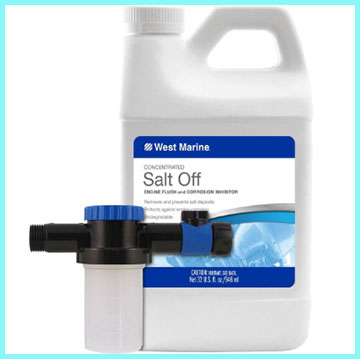
- Applicator Quality Issues: While the liquid itself is fantastic, the applicator mixing unit that sometimes comes with the kit leaves something to be desired. In my time using it, I found the plastic fittings to be a bit more brittle than I would like. On one occasion, the selector switch that toggles between “Rinse” and “Salt Off” became stiff and difficult to turn with wet hands. There were also times when the seal between the hose and the unit wasn’t perfect, leading to water spraying back onto my hand. While you can certainly buy a higher-quality aftermarket mixer or just use a garden sprayer, the “out of the box” experience can be frustrating if the provided tool feels cheap. It is annoying to have a premium liquid limited by a budget plastic dispenser.
- Can Leave Streaks If Not Rinsed Thoroughly: Because Salt Off contains those PTEF polymers and other protective agents, it has a slightly heavier consistency than pure salt dissolvers. If you let it dry on the boat without a thorough freshwater rinse, it can leave behind white streaks or a cloudy haze, particularly on dark-colored hulls or clear isinglass curtains. I learned this the hard way on a hot summer day. You cannot just spray it on and walk away; you have to chase it with plenty of fresh water. This requires a bit more effort and attention to detail during the wash down. If you are in a rush and do a sloppy rinse job, you might come back the next day to find your shiny engine cowling looking a bit spotted, requiring a quick wipe down with a detailer spray to fix.
- Scent Is Chemical-Heavy: This is a minor gripe, but valid for those sensitive to smells. Salt Off has a distinct chemical odor. It isn’t necessarily offensive, but it smells like a cleaning product. Unlike some boat soaps that might have a pleasant citrus or tropical scent, this smells industrial. When you are misting it into the air to cover a T-top or a tower, you are going to inhale some of it, and it can be a bit sharp. It doesn’t have that “fresh” scent that makes washing the boat feel therapeutic. It smells like work. While this doesn’t impact the performance, the user experience is slightly less pleasant compared to products that mask the chemical smell more effectively.
- Less “Cult Following” For Engine Flushing: While Star Brite says Salt Off is perfectly safe for engine flushing, it doesn’t have the same decades-long reputation for internal engine care that its competitor does. Most mechanics I talk to swear by the other brand for the internal cooling passages. As a result, I always felt a tiny bit of hesitation using Salt Off for the critical engine flush. I knew it worked, but the psychological factor of using the “industry standard” wasn’t there. If you are the type of person who loses sleep worrying about salt crystallization inside your water jackets, you might find yourself second-guessing if the “wash and wax” product is truly aggressive enough to clean the inside of a hot engine block as effectively as a dedicated flushing agent.
My Experience With Salt-Away
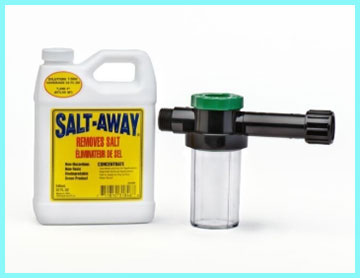
Salt-Away is practically a religion in the saltwater boating community.
When I bought my first brand-new outboard, the dealer literally handed me a bottle of this stuff and said, “Use this every single time, or don’t come crying to me when your thermostat clogs.”
That kind of endorsement sticks with you. I switched to Salt-Away specifically for my engine flushing routine.
I kept the Star Brite for the hull, but the engine got the blue stuff.
Using Salt-Away feels like performing a medical procedure on your boat. You attach their proprietary mixer, which feels surprisingly substantial, load the reservoir, and watch the deep blue liquid turn into a foamy solution exiting your tell-tale. There is a specific satisfaction in seeing that foam drift out of the prop exhaust, knowing it is hunting down salt deposits deep in the cooling jacket. I noticed that after months of use, my thermostats were cleaner during regular service intervals compared to when I just used fresh water. It gave me peace of mind, which is worth a lot when you are 20 miles offshore. It feels like a specialized tool rather than a general cleaner.
Pros Of Salt-Away
- The Industry Standard For Engine Flushing: Salt-Away has earned its reputation as the go-to product for internal engine protection. It is formulated specifically to dissolve salt buildup in the cooling passages of marine engines, which is a critical maintenance task. Salt crystals can form “hot spots” in an engine block, leading to overheating and catastrophic failure. Salt-Away breaks down these crystals and flushes them out. When you talk to marine mechanics, a vast majority will recommend this specific brand. This level of professional trust is its greatest asset. When I use it, I feel confident that I am doing everything possible to prolong the life of my outboard. It is not just cleaning; it is insurance for your engine.
- High Concentration Formula: The liquid in the Salt-Away bottle is incredibly concentrated. A little bit goes a very long way. The mixing unit dilutes it at a specific ratio (usually 1:512), meaning a quart bottle can last for many, many flushes. While the upfront cost is higher, the efficiency of the product balances it out. You aren’t buying a watered-down solution. You are buying the pure active ingredient. This makes storage easier since you don’t need to keep gallons upon gallons on the boat. One small bottle tucked in a hatch is enough for a week-long trip to the Bahamas. This density speaks to the quality of the chemical engineering behind the product.
- Excellent Mixing Unit Design: Unlike many competitors, the Salt-Away mixing unit is widely regarded as the best on the market. It includes a receptacle for the liquid and a well-engineered 3-way valve (Off, Rinse, Salt-Away). This allows you to flush the engine with fresh water first to get the bulk of the salt out, then seamlessly switch to the treatment without disconnecting hoses. It withstands high water pressure without blowing apart, which is a common failure point for cheaper mixers. The O-rings are durable, and the threads generally fit standard hoses perfectly. Having a reliable delivery system is half the battle, and Salt-Away nailed this hardware aspect.
- Safe For All Surfaces: Despite being tough on salt, Salt-Away is remarkably safe for virtually every material on a boat. It is safe for use on magnesium, aluminum, titanium, fiberglass, steel, rubber, plastic, and vinyl. You don’t have to worry about overspray damaging your upholstery or eating into your wiring harnesses. This safety profile allows you to be aggressive with your washing. You can spray the entire engine block (under the cowling) to prevent corrosion on electrical contacts without fear. I have used it on delicate isinglass enclosures and expensive electronics covers, and it never caused clouding or brittleness. It is a pH-neutral formula that attacks salt, not your boat.
Cons Of Salt-Away
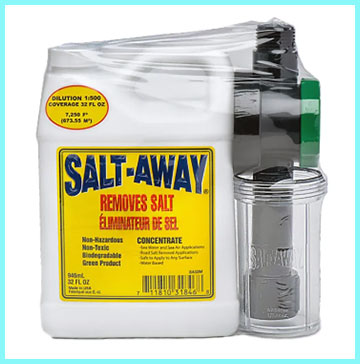
- Premium Price Tag: There is no denying that Salt-Away is expensive. It is consistently one of the priciest options on the shelf. You are paying for the brand name, the marketing, and the proprietary formula. For a weekend warrior on a budget, dropping $50 or $60 on a gallon refill can feel painful, especially when you see generic alternatives for half the price. It creates a “tax” on your boating experience. You might find yourself rationing it, using slightly less than recommended to make the bottle stretch, which defeats the purpose. The cost of entry is a barrier for many new boaters who are already overwhelmed by the expenses of ownership.
- Can Remove Wax If Used Too Heavily: While it is safe for surfaces, Salt-Away is a cleaner. In my experience, if you use it in high concentrations or scrub too vigorously, it can strip away some of the wax protection on your hull. It is not designed to be a “wash and wax” product like Salt Off. Its primary job is to strip contaminants. This means that if you use it to wash your hull every single time, you might find yourself needing to re-wax your boat more frequently than if you used a gentler, wax-fortified soap. It requires a balance in your maintenance routine—using it for the engine always, but perhaps using a softer soap for the gel coat.
- Sticky Residue Potential: If you do not rinse Salt-Away off completely, or if you let it pool in certain areas, it can leave a slightly tacky or sticky feel. Unlike Salt Off which leaves a slick PTEF feeling, Salt-Away’s residue can feel a bit gummy. While the manufacturer claims you can leave it on for protection, I found that on walking surfaces or handrails, this texture is unpleasant. It attracts dust and dirt if the boat is stored in a dry stack or a yard. I always felt the need to do a final fresh water mist just to knock down that sticky feeling, which adds an extra step to the process.
- Proprietary Mixer Dependency: While the mixer is good, you are somewhat locked into their ecosystem. The product is designed to work best at the specific dilution ratio provided by their mixer. If you try to use a generic garden sprayer or a foam cannon, it can be difficult to get the concentration right. You might end up using too much product (wasting money) or too little (reducing effectiveness). If you lose their mixer or break it, you feel compelled to buy another official Salt-Away mixer rather than a generic one. This lack of flexibility can be annoying for users who prefer to customize their washing setup with their own foam guns or pressure washer attachments.
Also Read: My Thoughts On Matrixx Water Softener
Frequently Asked Questions (FAQ)
For engine flushing, Salt-Away is generally considered better due to its proven track record and specific dissolving formula. For washing the hull and trailer, Star Brite Salt Off is often preferred because it adds a PTEF protective coating and is more affordable.
Salt-Away is widely regarded as the best pure salt remover, especially for internal engine components. However, for general exterior washing, a “wash and wax” style salt remover like Star Brite Salt Off offers better finish protection.
Yamaha (and other manufacturers) officially recommend flushing with fresh water. While they may not explicitly endorse a specific aftermarket brand like Salt-Away in the manual, most certified mechanics and dealers highly recommend using it to prevent corrosion, and it does not void warranties when used correctly.
Conclusion
When the day is done and the boat is on the trailer, the choice between these two products comes down to what you value most: engine longevity or exterior finish.
If your primary concern is the internal health of your engine and ensuring every crystal of salt is dissolved from your cooling system, Salt-Away is the investment you should make. It is the gold standard for a reason. The peace of mind it provides for your mechanical components is worth the premium price. It is a specialized tool for a critical job.
However, if you are looking for an all-around workhorse to keep your hull, trailer, and fishing tackle shining and protected, Star Brite Salt Off is the superior choice. The addition of PTEF polymers makes it a fantastic dual-action product that cleans and protects in one step. It saves you money and time on exterior maintenance.
For many of us, the best solution is actually a hybrid approach: use Salt-Away for the engine flush to keep the mechanics running smooth, and use Salt Off for the wash down to keep the boat looking brand new. Both are excellent weapons in the war against corrosion, so pick the one that fits your battle plan.