
Juicing has evolved from a niche hobby for health enthusiasts into a mainstream lifestyle choice for anyone looking to boost their energy and immune system. If you have been scrolling through social media feeds filled with glowing jars of green liquid, you have almost certainly encountered the Nama J2 Cold Press Juicer. It is touted as the “hands-free” revolution that takes the hassle out of making fresh juice, promising to save you time while delivering nutrient-dense results. But with a price tag that rivals a monthly mortgage payment for some, you are right to pause and ask if the hype is real.
In this comprehensive review, I am going to peel back the marketing layers and give you the honest truth about the Nama J2. We will look at its “batch juicing” technology, the quality of the juice it produces, and whether it really creates less mess than its competitors. I will also compare it to other heavyweights in the industry like Hurom and Kuvings so you can see where it stands. My goal is to help you decide if this sleek appliance is the key to your wellness routine or just another expensive gadget destined for the back of your cupboard.
For those ready to invest in their health, I always recommend buying directly from the official Nama Well website. This ensures you receive the full 15-year warranty coverage and access to their customer support, which can be tricky if you purchase through unauthorized third-party sellers.
My Experience With Nama J2 Juicer
I have used my fair share of juicers over the years, starting with a loud, terrifying centrifugal machine that sounded like a jet engine and ending with a traditional slow juicer that required me to chop every carrot into tiny coins. When I first heard about the Nama J2 and its “load and walk away” promise, I was skeptical. It sounded too good to be true—a juicer that does the prep work for you?
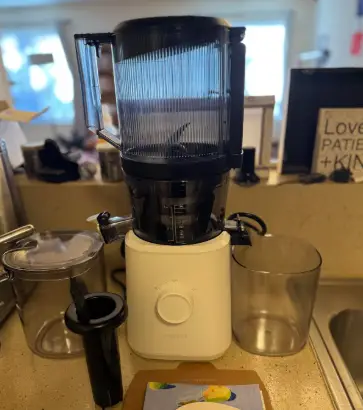
When the box arrived, the unboxing experience felt premium. Everything was packed securely with minimal plastic waste, and the machine itself is undeniably gorgeous.
It has a modern, matte finish that looks great on the counter, although it is quite tall.
I had to rearrange my cabinets slightly to make sure it fit under the upper cupboards, so that is something to keep in mind if you have low clearance in your kitchen.
The first time I used it, I decided to test its limits with my “kitchen sink” green juice: kale, celery, cucumber, green apples, lemon, and ginger.
With my old juicer, this would have taken me ten minutes of chopping and feeding ingredients one by one.
With the J2, I just roughly chopped the apples and cucumber to fit into the hopper, threw the kale and celery in whole, closed the lid, and turned the dial.
Watching the machine work is actually quite mesmerizing. The internal blade at the top of the hopper spins and slices the produce, feeding it down into the auger automatically. I literally stepped away to make my morning coffee while it was juicing. This “multitasking” aspect is not a gimmick; it completely changes the workflow of your morning. You are not tethered to the machine, pushing a plunger down every five seconds.
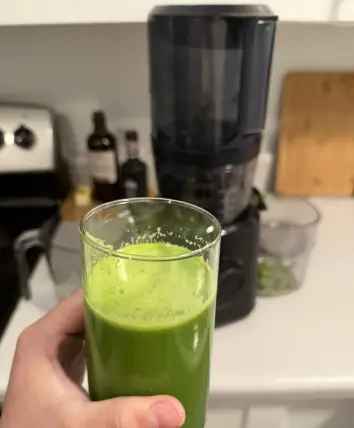
The juice quality was exceptional. It was smooth, vibrant, and had very little foam compared to centrifugal juices. The pulp came out surprisingly dry, which is the gold standard for extraction efficiency. I was particularly impressed with how it handled the leafy greens; usually, kale just spins around without getting juiced, but the J2 grabbed it and processed it perfectly.
However, my experience wasn’t entirely without hiccups. I learned the hard way that you can’t just stuff the hopper until it’s bursting. If you overpack it with dense roots like beets or carrots without mixing in softer items, it can squeak or struggle slightly. It relies on a mix of textures to feed smoothly. Also, cleaning, while easier than some models, is still a chore. The “easy clean” claim is true in the sense that the parts are designed well, but you still have to scrub the screen and rinse multiple components. It is not a magical self-cleaning robot.
Overall, the Nama J2 has earned its spot on my counter because it removes the friction from juicing. The fact that I can load it up and do the dishes or check emails while it runs means I actually juice more often. It turned a 20-minute active chore into a 5-minute active task, and for a busy lifestyle, that time saving is the real value proposition.
Read More: My Thoughts On Hamilton Beach Big Mouth Juicer
Pros Of Nama J2 Juicer
When evaluating the Nama J2 against the vast market of cold press juicers, several distinct advantages make it a standout choice, particularly for families and busy professionals. Here are the specific benefits that justify its premium status.
- Revolutionary Hands-Free Batch Juicing: The defining feature of the J2 is its massive hopper with “Pure Press” technology. Unlike traditional slow juicers that require you to feed ingredients through a narrow chute one by one, the J2 allows you to load an entire recipe at once. You can fill the hopper with whole apples, long stalks of celery, and handfuls of spinach, close the lid, and walk away. The internal blade system chops the ingredients for you and feeds them into the auger at the optimal speed. This “load and go” workflow allows you to multitask in the kitchen, significantly reducing the active time you spend standing in front of the machine. It removes the bottleneck of manual feeding, making the process feel less like manual labor and more like using a blender.
- Exceptional Juice Yield and Quality: The J2 is a true cold press masticating juicer, meaning it uses slow compression to extract liquid rather than high-speed blades that create heat. This method minimizes oxidation, preserving the delicate enzymes and vitamins in your produce. The result is a juice that is vibrant in color, rich in flavor, and can be stored in the fridge for up to 72 hours without separating or turning brown. Furthermore, the extraction rate is impressive; the pulp that comes out is very dry, meaning you are getting the maximum amount of money’s worth out of your expensive organic produce. Over time, the savings on grocery bills from high yield can actually help offset the cost of the machine.
- Versatility Beyond Just Liquid Juice: While it is primarily a juicer, the J2 is surprisingly capable of creating other textures. It handles nut milks beautifully; you can simply ladle in soaked almonds and water to create a creamy, preservative-free milk base. With the addition of the smoothie strainer (often sold separately or in bundles), you can make thicker beverages that retain more fiber. It is also excellent for making sorbets from frozen fruit, giving you a healthy dessert option. This versatility means it earns its keep as a multi-functional appliance rather than a “unitasker” that only does one thing. You can switch from green juice to oat milk to frozen banana treat in the same session.
- Kid-Friendly and Safety-Conscious Design: Safety is a major design priority for the J2, which is great for households with curious children. The machine will not operate unless the lid is securely closed and locked in place. This eliminates the risk of fingers getting anywhere near the moving blade or the crushing auger. Because you load the hopper and close it, there is no need to use a pusher near an open chute during operation. This design makes it safe to let kids help with the “cooking” process; they can drop the fruit in, close the lid, and flip the switch. Turning juicing into a family activity can encourage children to drink more vegetables, and the J2 makes that safe and fun.
Cons Of Nama J2 Juicer
Despite the glowing reviews and viral fame, the Nama J2 is not a perfect machine. There are engineering trade-offs and practical limitations that you need to be aware of before dropping hundreds of dollars.
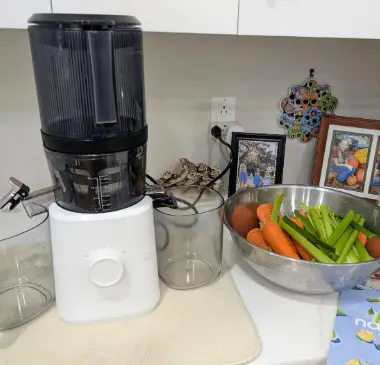
- Significant Vertical Height Clearance Issues: The sleek, tall design that makes the J2 look modern is also its Achilles’ heel in some kitchens. Standing at nearly 18 inches tall, it may not fit under standard overhead cabinets, especially if you have under-cabinet lighting or lower shelving. This means you might have to store it on a kitchen island or pull it forward every time you want to use it. If you have a small apartment kitchen with limited counter space, the footprint combined with the height can feel overwhelming. You cannot simply slide it back into a corner; it demands a dedicated vertical space that not all layouts can accommodate.
- Complex Assembly with Multiple Parts: While the “juicing” part is hands-free, the assembly and disassembly are definitely hands-on. The machine consists of several nested components: the base, the chamber, the spinning brush, the screen, the auger, and the hopper. Aligning the screen into the chamber requires precision; you have to line up specific grooves or the hopper won’t lock. For the first few uses, this can feel like solving a puzzle, and if you force it, you risk damaging the parts. Cleaning involves taking all these pieces apart, scrubbing the screen, and rinsing the gaskets. It is not a “rinse and repeat” device; it requires a dedicated 5-minute cleanup session after every use.
- Struggles with Certain Soft Textures: While it is a beast with leafy greens and hard roots, the J2 can sometimes get clogged with “mushy” fruits. Ingredients like mealy apples, overripe pears, or soft cucumbers can create a thick sludge that doesn’t eject easily. Instead of dry pulp, you might get a backlog of mush inside the chamber that stops the flow of juice. To prevent this, you have to follow a specific “sandwiching” technique, alternating hard and soft ingredients. You cannot just throw in a hopper full of soft pineapple and expect perfect results; the machine requires you to be strategic about the order of ingredients. This learning curve can be frustrating for beginners who just want to dump everything in at once.
- Premium Price Point and Accessory Costs: There is no getting around the fact that the Nama J2 is an investment piece. At over $500, it is significantly more expensive than entry-level slow juicers and exponentially more than centrifugal models. For casual users who only juice on weekends, this cost per use might be hard to justify. Additionally, replacement parts (like screens or seals) and extra accessories (like the sorbet strainer if not included) are also priced at a premium. You are paying for the brand engineering and the warranty, but for budget-conscious shoppers, the barrier to entry is high. It is a luxury appliance, not a budget-friendly staple.
Maintenance Tips For Nama J2 Juicer
Protecting your investment means treating the machine with care. Cold press juicers are durable, but they are also precision instruments that can be ruined by neglect or improper cleaning.
- Immediate Rinse is Mandatory: The golden rule of juicing with the J2 is to never let the pulp dry on the screen. Once fruit fibers dry into the tiny micro-perforations of the steel mesh, they effectively turn into cement. You should disassemble the machine and rinse the parts under warm water immediately after you finish juicing. If you are in a rush and can’t do a full scrub, at least submerge the chamber and screen in a bowl of water to keep the pulp wet. This simple habit will save you hours of frustrated scrubbing later. Dried celery strings are notoriously difficult to remove once they harden.
- Deep Clean the Silicone Seals: The J2 relies on several silicone gaskets and seals to prevent leaks and ensure pressure. These seals can trap juice residue and bacteria over time if not removed and cleaned. Once a week, you should physically pull out the pulp ejection plug and the silicone ring around the spinning brush. Wash them separately with soapy water and let them air dry completely. If you neglect this, you might start to notice a funky smell or mold growth in the hidden crevices. Keeping these seals clean also ensures they stay flexible and maintain a watertight seal for years.
- Handle the Hopper Lid Gently: The locking mechanism on the hopper lid involves a plastic tab that engages a safety sensor. While the plastic is high quality (Tritan), it is not indestructible. Do not slam the lid shut or try to force it open while the machine is still spinning. Always wait for the motor to come to a complete stop before attempting to unlock the hopper. Forcing the lid can snap the small plastic engagement tab, rendering the machine useless until you buy a replacement hopper. Treat the latch with the same delicacy you would a laptop lid.
- Address Mineral Scale Buildup: Over time, minerals from tap water and the produce itself can build up a cloudy white film on the plastic chamber and the screen. This scale can eventually clog the fine mesh of the filter. To combat this, perform a deep soak every month using a mixture of warm water, baking soda, and white vinegar (or citric acid). Let the parts soak for a few hours or overnight to dissolve the mineral deposits. Scrub them gently with the provided brush afterwards. This will keep the screen clear and the plastic looking crystal clear rather than foggy and old.
Comparison with Other Brands
The Nama J2 does not exist in a vacuum. It faces stiff competition from established Korean manufacturers. Here is how it stacks up against the top contenders in the vertical juicer market.
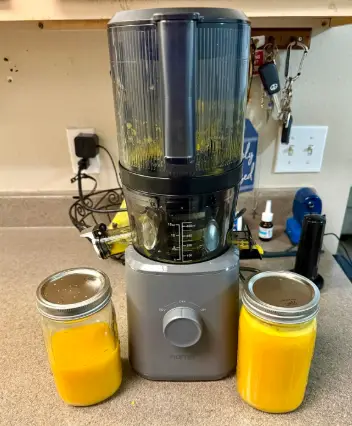
- Hurom H400 Easy Clean Slow Juicer: Hurom is actually the manufacturer behind Nama, so the DNA is similar, but the H400 takes a different approach to cleaning. Comparison: The Hurom H400 features a revolutionary “strainer-free” design that uses two nesting plastic pieces to crush juice, completely eliminating the metal mesh screen. This makes the Hurom H400 significantly easier and faster to clean than the Nama J2. However, the trade-off is often slightly pulpier juice with the Hurom compared to the cleaner liquid from the J2’s metal screen. The H400 also has an opaque hopper, so you can’t see the juicing process, whereas the J2 is clear. If you hate scrubbing screens and don’t mind a bit of texture, the Hurom H400 is the better convenience choice. If you want the smoothest possible juice and hands-free tech, the Nama J2 wins.
- Kuvings REVO830 Whole Slow Juicer: Kuvings is known for power and commercial-grade motors. Comparison: The REVO830 features a unique dual-feed chute: one wide opening for whole fruits and a separate dedicated narrow hole for long veggies like carrots and celery. This “auto-cut” chute for long veggies means you don’t even have to chop celery, whereas the Nama J2 works best if celery is chopped or broken to fit the hopper. The Kuvings is a continuous feed machine (you drop things in as it runs), while the Nama J2 is a batch machine (load, close, run). If you prefer to stand there and feed ingredients continuously for large volumes, the Kuvings is faster and more powerful. If you want to walk away and do something else, the Nama J2 is the only option that offers true multitasking.
- Nama J3 Compact Juicer: This is the “little brother” to the J2, designed for smaller spaces. Comparison: The J3 uses the exact same “Pure Press” technology and batch hopper concept but in a scaled-down body. It produces the same high-quality juice but has a smaller capacity (34oz hopper vs 70oz on the J2). This means you might have to run two batches to make juice for a family, whereas the J2 can do it in one go. The J3 is shorter (15 inches), solving the cabinet clearance issue mentioned in the cons. If you are a single person or have a tiny kitchen, the J3 saves you money and counter space. For families or couples who juice daily, the J2’s larger capacity is worth the extra bulk to avoid reloading constantly.
Also Read: Comparison Of Kuvings REVO830 And AUTO10
Frequently Asked Questions (FAQ)
Yes, you can put whole fruits like apples, lemons (peeled), and oranges (peeled) into the hopper. The internal blade automatically slices them as they are fed into the auger. However, for very hard pits (like peaches or mangoes) or thick rinds (like pineapple), you must remove them first to prevent damaging the screen. Large roots like beets should be quartered to ensure they don’t jam the blade.
No, the Nama J2 parts are not dishwasher safe. The high heat and harsh detergents of a dishwasher can warp the plastic components and damage the silicone seals. You must hand wash all parts with warm, soapy water. Using a dishwasher will void your warranty and likely ruin the precise fit of the juicing chamber.
Yes, it handles celery very well, but there is a trick to it. While the hopper chops ingredients, long stringy fibers from celery can still wrap around the auger if you put in huge whole stalks. It is recommended to chop celery into 1-2 inch pieces or layer it with other hard ingredients to help push it through. The yield is excellent, and the pulp comes out very dry.
The main difference is the hopper system. The J1 (Vitality 5800) is a traditional cold press juicer where you have to feed ingredients manually one by one. The J2 features the “batch hopper” that allows you to load the entire recipe at once and walk away. The J2 saves significantly more active prep time, although the actual juicing mechanism and juice quality are similar between the two.
Conclusion
The Nama J2 Juicer effectively redefined the home juicing experience by addressing the biggest complaint people have: the time commitment. By engineering a hopper that handles the prep work for you, it transforms juicing from a tedious chore into a seamless part of a morning routine. While the price is steep and the height can be a logistical challenge for some kitchens, the value lies in the behavioral change it supports. You are paying for consistency; the easier it is to make juice, the more likely you are to actually drink it.
If you are serious about integrating fresh, nutrient-dense juice into your life and can afford the upfront investment, the Nama J2 is arguably the best “lifestyle” juicer on the market today. It strikes the perfect balance between juice quality, yield, and convenience. However, if you are on a tight budget or have zero tolerance for hand-washing parts, you might want to look at simpler options. Ultimately, the J2 is for the person who values their time as much as their health.