
If you are staring at the wall of red tools in Home Depot or browsing online, wondering whether to invest in the iconic Milwaukee Sawzall or its younger, nimbler sibling, the Hackzall, you are not alone. It is a debate that rages on job sites and DIY forums alike. You want a tool that rips through material without bogging down, but you also don’t want to lug around a beast of a machine if you are just cutting PVC under a sink.
I have spent years using both tools on everything from full-gut kitchen renovations to simple weekend plumbing repairs. My goal is to cut through the marketing noise and tell you exactly how these tools perform when the rubber meets the road. I will break down the differences in ergonomics, power, vibration, and “get-it-done” ability to help you decide which one (or maybe both?) deserves a spot in your arsenal.
A Brief Comparison Table
| Feature | Milwaukee Sawzall (M18 FUEL) | Milwaukee Hackzall (M18 FUEL) |
| Primary Design | Two-handed, heavy-duty inline saw | One-handed, compact pistol-grip saw |
| Stroke Length | 1-1/8″ (Aggressive cut) | 7/8″ (Controlled cut) |
| Strokes Per Minute | Up to 3,000 SPM | Up to 3,000 SPM |
| Best For | Heavy demolition, thick metal, structural lumber | Tight spaces, PVC, conduit, pruning, overhead work |
| Weight (Bare) | ~7.4 lbs | ~4.1 lbs |
| Vibration | High (Requires bracing against shoe) | Low to Moderate (Dual Gear Counter Balance) |
| Blade Clamp | QUIK-LOK™ Universal | QUIK-LOK™ Universal |
| Price | Mid-High Range (~$199+ tool only) | Mid Range (~$169+ tool only) |
| The “Vibe” | “I need to destroy this house.” | “I need to surgically remove this pipe.” |
My Experience With The Milwaukee Sawzall
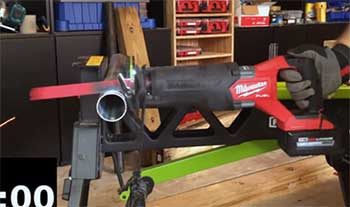
The Sawzall is the Kleenex of reciprocating saws—it is the name everyone uses, regardless of the brand, for a reason.
When I pick up my M18 FUEL Sawzall, I feel like I am holding a weapon of mass construction.
It is substantial. It is heavy. And it commands respect.
I remember a specific project where I had to remove an old cast-iron tub and the surrounding stud framing. This is where the Sawzall shines. I engaged the shoe against the wood, pulled the trigger, and it ate through 2x4s embedded with ancient, hardened nails as if they were balsa wood. The longer stroke length (1-1/8″) means it clears chips faster and cuts deeper with every push.
However, that power comes with a physical cost. You must use two hands. If you try to one-hand a full-sized Sawzall, it will likely kick back, chatter, or twist your wrist. It vibrates significantly more than the Hackzall, especially if you don’t have the shoe firmly pressed against the material. After an hour of continuous demolition, my arms felt like jelly. It is a brute force tool designed for brute force work. It doesn’t care about finesse; it cares about separation.
Read more: Comparison of Planet Fitness And Crunch Gym
Pros Of Milwaukee Sawzall
- Unstoppable Demolition Power: If your job involves destroying things, the Sawzall is the undisputed king. Its inline design allows you to put your entire body weight behind the cut. Whether you are cutting through roof trusses, thick steel pipes, or performing vehicle extrication (fire/rescue), the Sawzall has the raw torque and stroke length to keep cutting where other saws stall.1
- Faster Cut Speeds on Thick Material: The 1-1/8″ stroke length is critical for clearing debris from the kerf (the cut slit).2 On thick wood, this prevents the blade from gumming up and overheating. This physics advantage means you finish heavy cuts significantly faster than with a shorter-stroke tool.
- Durability and Longevity: The Sawzall is built like a tank. The gear case is typically more robust, designed to handle the shock of the blade binding up or hitting unexpected steel. It is a tool designed to be abused, dropped, and covered in drywall dust day in and day out.
- Adjustable Shoe: Most full-sized Sawzalls feature an adjustable shoe (the metal guard at the front). You can extend or retract it to use different parts of the blade. This is a huge money saver—when the teeth near the base of the blade wear out, you extend the shoe and use the fresh teeth further up. The Hackzall typically has a fixed shoe, meaning you wear out one spot on the blade quickly.
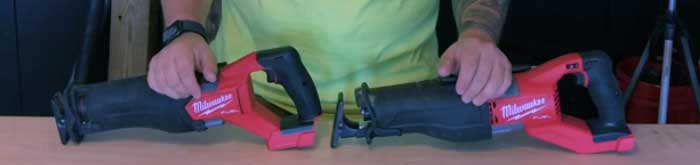
Cons Of Milwaukee Sawzall
- Requires Two Hands: This is the biggest limitation. You cannot safely hold the material you are cutting. You must clamp the workpiece or have it secured. If you are on a ladder or in a tight spot where you need one hand for stability, the Sawzall is dangerous and impractical.
- Heavy and Fatiguing: Weighing in at over 7 lbs (plus a heavy battery), the Sawzall is physically draining to use, especially for overhead work.3 “Sawzall fatigue” is a real thing, and it can lead to sloppy cuts or accidents as the day wears on.
- High Vibration: Despite anti-vibration technology, the sheer force of the reciprocating mass creates a lot of shaking. If you are not bracing the tool correctly, it can chatter violently, potentially damaging the surface you are trying to cut or bruising your hands.
- Size Constraints: It simply does not fit in tight spaces. If you need to cut a pipe inside a vanity cabinet or between closely spaced studs, the Sawzall is often too long to maneuver.
My Experience With The Milwaukee Hackzall
Switching to the Hackzall was a revelation for my workflow. The first time I used the M18 FUEL Hackzall, I was under a crawlspace trying to cut a 3-inch PVC drain pipe. There was no room to fit a full-sized Sawzall, and certainly no room to leverage two hands.
The Hackzall’s pistol-grip design allowed me to hold the pipe steady with my left hand while I sliced through it with my right. It was balanced, controlled, and surprisingly powerful. While the stroke length is shorter (7/8″), the motor speed is still high, so it zips through conduit, threaded rod, and PVC almost instantly.
I also found myself reaching for the Hackzall for yard work. Trimming tree branches while on a ladder is infinitely safer with a one-handed tool than trying to balance a heavy reciprocating saw. The vibration is noticeably lower—Milwaukee uses a dual-gear counter-balance system in the Hackzall that makes it feel much smoother. It doesn’t “fight” you the way the Sawzall does. However, when I tried to use it to cut through a thick 6×6 pressure-treated post, it struggled. It eventually got through, but it took twice as long as the Sawzall would have. It lacked that aggressive “bite.”
Pros Of Milwaukee Hackzall
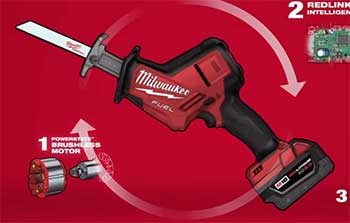
- One-Handed Operation: This is the Hackzall’s killer feature. The center of gravity is located right above the handle, allowing you to use it like a large pistol. This frees up your other hand to hold the pipe, move a wire out of the way, or stabilize yourself on a ladder. For electricians and plumbers, this alone makes it the superior choice.
- Superior Access in Tight Spaces: The compact length (usually around 11-14 inches) allows it to fit into joist bays, under sinks, and inside engine bays.4 It goes where the Sawzall cannot.
- Smoother Cutting Action: The shorter stroke length and internal counter-balancing result in a much smoother cut. It is easier to start a cut precisely on a marked line without the blade jumping around (“walking”) as much as it does with a Sawzall. This makes it better for “surgical” demo where you want to cut one pipe without destroying the one next to it.
- Versatility (The “Everything” Tool): It is not just for construction. The Hackzall is an incredible gardening tool for pruning. It is great for cutting up cardboard boxes for recycling. It is less intimidating for DIYers who might be scared off by the violent shaking of a full-sized recip saw.
Cons Of Milwaukee Hackzall
- Slower on Large Material: The 7/8″ stroke length means it removes less material per stroke.5 If you are cutting a 4-inch cast iron pipe or a thick tree stump, you will feel the difference. It requires more patience.
- Fixed Shoe Limitation: Most Hackzall models have a fixed shoe. You cannot adjust the depth to utilize the full length of the blade. This means you often end up throwing away blades that are dull near the tang but still sharp at the tip, which increases your consumable costs over time.
- Less “Lean-In” Power: Because of the pistol-grip shape, you cannot leverage your body weight behind the tool as effectively as the inline Sawzall. Pushing too hard on a Hackzall can actually feel awkward and strain your wrist because the force is not aligned with your arm.
M12 vs. M18: Choosing Your Platform
Within the Hackzall and Sawzall debate, there is a secondary debate: 12-volt (M12) or 18-volt (M18)?
- M12 Hackzall: This is the ultimate lightweight tool.6 It is tiny, weighs practically nothing, and fits in a tool belt. It is perfect for electricians cutting conduit or homeowners doing light pruning. However, it lacks the grunt for serious demo. If you push it hard, it will stall.
- M18 Hackzall: This is the sweet spot for many pros. It has near-Sawzall power but retains the one-handed form factor. It can handle 90% of what a full-size Sawzall can do, just slightly slower.
- M18 Sawzall: The standard for heavy duty. There is no M12 Sawzall (only Hackzalls), because the 12V battery simply cannot sustain the energy needed for a full-size inline reciprocating saw.
Recommendation: If you are a pro, get the M18 FUEL Hackzall. It covers the widest range of tasks. If you are a homeowner doing light repairs, the M12 FUEL Hackzall is a joy to use. Only get the M18 Sawzall if you know you have major demolition in your future.
Also read: Comparison of Ritfit And Major Fitness
Maintenance Tips For Your Reciprocating Saw
- The “Stick” Fix: Both tools use the Quik-Lok blade clamp. Over time, dust and metal shavings can mix with grease inside the clamp, causing it to stick open or refuse to lock.
- Tip: Periodically spray a dry lubricant (like PTFE spray) into the blade clamp mechanism. Avoid heavy oils that attract more dust. If it gets jammed, turn the collar and tap the nose gently against a piece of wood to dislodge debris.
- Shoe Care: If you have the Sawzall, ensure the shoe adjustment lever remains tight. If it becomes loose, the shoe can slide during a cut, which is dangerous. Check the Allen screws or locking lever periodically.
- Motor Venting: These tools suck in a lot of air to cool the motor. If you are cutting drywall or masonry, the vents can clog with fine dust, overheating the tool.
- Tip: After a dusty job, use compressed air to blow out the vents at the back of the tool body. This extends the life of the electronics significantly.
- Battery Contacts: The vibration of these saws can sometimes cause micro-arcing on the battery terminals, leading to carbon buildup. If your tool cuts out intermittently, clean the battery contacts and the tool terminals with an electrical contact cleaner and a cotton swab.
Comparison with Other Brands
- Milwaukee Hackzall vs. DeWalt Atomic Recip Saw: The DeWalt Atomic is their compact, one-handed answer. It is a fantastic tool, lighter than the M18 Hackzall. However, Milwaukee generally has a better vibration reduction system in the FUEL Hackzall. The DeWalt feels a bit more “shaky” in the hand.
- Milwaukee Sawzall vs. Makita XRJ05: The Makita is often cited as having a smoother mechanism than the Milwaukee Sawzall, with a unique vertical crank system. However, the Milwaukee Sawzall is generally considered to be faster and more aggressive. If you want speed, go Red. If you want comfort, the Teal (Makita) is a strong contender.
- Hackzall vs. Oscillating Multi-Tool: Sometimes people confuse these use cases. An oscillating tool (multi-tool) is for precision plunge cuts and flush cuts. A Hackzall is for rougher separation cuts. You can’t use a Hackzall to undercut a door jamb cleanly, and you shouldn’t use a multi-tool to cut a 2-inch pipe (it will take forever). They are complementary tools, not competitors.
Frequently Asked Questions (FAQ)
Yes. Both tools use the standard universal reciprocating saw blade shank. You can put a 12-inch demolition blade in a tiny M12 Hackzall (though it might look ridiculous and vibrate heavily), and you can put a small scroll blade in a massive Sawzall.
The Hackzall is superior for pruning. The one-handed grip allows you to hold the branch steady with your other hand, preventing it from shaking back and forth with the blade.
Absolutely. “Fuel” is Milwaukee’s brushless motor line. Brushless motors run cooler, last longer, and provide significantly more power and runtime. For reciprocating saws, which are high-drain tools, the difference is night and day. The non-Fuel brushed versions will bog down much easier under load.
Yes, easily. With a quality bi-metal or carbide-teeth metal cutting blade (like the Milwaukee Torch or Diablo Steel Demon), an M18 Hackzall can cut through rebar, Unistrut, EMT conduit, and black iron pipe.
This is usually the “Redlink Plus” overload protection. If you push too hard and the motor draws too much current, the battery cuts power to prevent the tool from melting. Release the trigger, wait two seconds, and try again with less pressure. Let the blade do the work.
Conclusion
The decision between the Milwaukee Sawzall and Hackzall ultimately comes down to the scale of your work.
If you are a Remodeler, Demolition Specialist, or Framer, the Sawzall is non-negotiable. You need the stroke length, the two-handed leverage, and the sheer destructive capability to tear houses apart efficiently. It is the sledgehammer of saws.
However, if you are a Plumber, Electrician, HVAC Tech, or DIY Homeowner, the M18 FUEL Hackzall is almost certainly the better buy. It offers 80% of the power in a package that is 50% more usable. It fits in your tool bag, it doesn’t tire you out, and it cuts virtually everything you will encounter in a standard day. I have found that since owning both, my Sawzall gathers dust 300 days a year, while my Hackzall is used almost weekly.