
We have all been there: it is the first warm Saturday of spring, the grass is getting long, and you pull the cord on your lawnmower. Nothing. You pull again. Nothing. The gas sitting in the tank has turned into a gummy, varnish-smelling mess over the winter.
This is the exact moment the debate begins. Do you need a “medic” to bring the dead engine back to life, or did you just need a “bodyguard” to protect it in the first place? You are likely looking at Mechanic in a Bottle (the curative fix) and STA-BIL (the preventative shield). My goal is to break down exactly when to use which, so you don’t waste $10 on a bottle that can’t solve your specific problem.
A Brief Comparison Table
| Feature | Mechanic in a Bottle (MIB) | STA-BIL (Storage / Red) |
| Primary Purpose | Curative (Fixes bad fuel & non-starting engines) | Preventative (Keeps fresh fuel fresh) |
| Best Use Case | Engine won’t start, idles rough, or has old gas | Winterizing equipment that runs fine |
| Action on Varnish | Dissolves existing varnish and sludge | Prevents varnish from forming |
| Ethanol Treatment | “Revitalizes” rubber components damaged by ethanol | Inhibits corrosion caused by ethanol water absorption |
| Wait Time | Requires 4-8 hours of “soaking” to work | Works immediately upon mixing |
| Shelf Life of Fuel | Reconditions old fuel to be burnable | Keeps fuel fresh for up to 24 months |
| Concentration | High (solvent-heavy smell) | Low (Standard petroleum distillate smell) |
My Experience With Mechanic in a Bottle
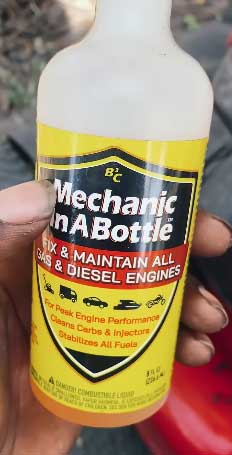
I first bought Mechanic in a Bottle (MIB) out of desperation. My pressure washer had sat for two years with half a tank of ethanol gas.
Unsurprisingly, it wouldn’t start. I was dreading the idea of taking the carburetor apart to clean the tiny brass jets.
A local small engine shop recommended MIB as a “Hail Mary” before paying for a service.
The instructions were different from standard additives.
I poured a heavy dose (about 2 ounces) directly into the tank, pressed the primer bulb a few times to force the liquid into the carburetor bowl, and then—this is the key—I walked away.
You have to let it sit. I left it overnight. The next morning, I topped it off with fresh gas, pulled the cord, and it sputtered to life on the second pull.
It smoked white smoke for about a minute (which is normal as it burns off the solvents), but then it smoothed out. I was genuinely impressed. It saved me two hours of wrenching. However, I learned later that it isn’t magic; on a different trimmer with a completely solidified “rock hard” diaphragm, MIB couldn’t fix it. It works on gunk, not broken parts.
Read more: Comparison Of Kendall Oil And Mobil 1
Pros Of Mechanic in a Bottle
- It actually dissolves varnish: Unlike standard stabilizers that just mix with gas, MIB contains strong solvents (Safe-T-Fresh technology) designed to break down the sticky orange “gum” that clogs carburetor jets. If your mower is “surging” (revving up and down), this can often clear the jet without you needing to use a screwdriver.
- Dual-Action (Fuel & System): It claims to revitalize the rubber gaskets and plastic parts that ethanol dries out.1 While hard to prove without a lab, I have noticed that primer bulbs feel slightly more pliable after running a tank of this through the system.
- High Concentration: You don’t need much. One small 4-ounce bottle treats a lot of fuel, but for “fixing” a problem, you use a higher concentration. It is potent stuff.
- Works on 2-Cycle and 4-Cycle: You can safely use it in your gas/oil mix for chainsaws and weed eaters, as well as straight gas for mowers and generators.2 It doesn’t interfere with the lubrication properties of the 2-stroke oil.
- Avoids Carburetor Disassembly: For the average homeowner who is intimidated by taking apart an engine, this is the best “first step” to try. It costs less than a carb rebuild kit and takes zero skill to use.
Cons Of Mechanic in a Bottle
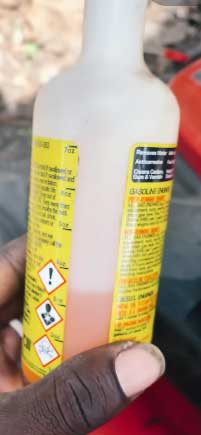
- The Smell: This stuff smells potent. It has a chemical, solvent-heavy odor that lingers on your hands if you spill it. It is much stronger than standard gas treatments.
- Not a Miracle Worker for Rust: If your carburetor bowl has rust flakes or dirt inside, MIB cannot fix that. It is a chemical cleaner, not a physical vacuum. It dissolves varnish, but it won’t make physical debris disappear.
- Requires Patience: You cannot pour it in and start the engine immediately.3 The chemical reaction needs time (usually 4 to 8 hours) to soften the gunk.4 If you are in a rush to mow the lawn right now, this won’t help you.
- Cost Per Treatment: If you used this as a daily stabilizer, it would get expensive. It is priced as a “repair” fluid, not a bulk storage fluid.
- The “White Smoke” Scare: When you first start an engine after a heavy dose of MIB, it will often blow a cloud of white smoke. This can panic some users who think they blew a head gasket, but it is just the additive burning off carbon deposits.
Maintenance Tips For Mechanic in a Bottle
- The “Primer Bulb” Trick: When treating a non-starting engine, don’t just pour it in the tank.5 You must press the primer bulb (if equipped) repeatedly. This forces the concentrated MIB into the carburetor bowl where the clog actually is. If you don’t do this, the cleaner just sits in the tank doing nothing.
- Drain First for Best Results: If the gas in the tank is old and smells like varnish (rotten eggs), drain that liquid out first. Then add 2-4 ounces of straight MIB and prime it. Let the concentrated cleaner attack the carb directly without being diluted by bad gas.
- Annual “Deep Clean”: Even if your equipment is running fine, I run a tank with MIB through my equipment at the start of every season just to clean out any carbon deposits on the valves. It acts like a “tune-up in a bottle.”
- Don’t Over-Soak Indefinitely: While 8 hours is good, don’t leave high concentrations in a vintage engine with old rubber fuel lines for months. The strong solvents are powerful and meant for cleaning, not permanent storage.
- Shake Well: The bottle contains different chemical agents that can settle. Give it a good shake before pouring.
My Experience With STA-BIL (Red / Storage)
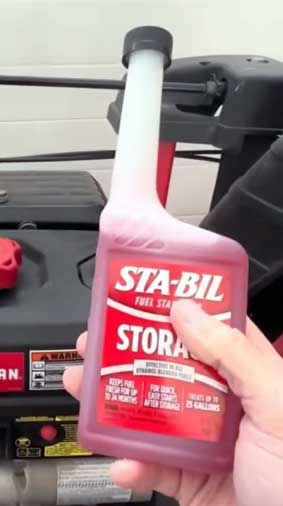
If Mechanic in a Bottle is the “emergency room,” STA-BIL (the red liquid) is the daily multi-vitamin.
It is arguably the most recognizable bottle in any American garage.
I have used it religiously for over a decade in everything from my lawn tractor to my classic motorcycle.
My “aha” moment with STA-BIL came years ago when I bought a cheap generator.
For three years straight, I did the same routine: I filled the tank with fresh gas in November, added the recommended amount of STA-BIL, ran it for 5 minutes to get the treated fuel into the carburetor, and then shut it off.
Every single spring, that cheap generator started on the first or second pull.
The gas smelled fresh, not like that tell-tale “varnish” or rotten egg smell. It is boring, but it works. It buys you peace of mind. When I forgot to use it one winter on a snowblower, I spent the next season rebuilding the carburetor. That $10 bottle protects thousands of dollars of equipment.
Pros Of STA-BIL
- The Industry Standard for Prevention: STA-BIL is proven to keep fuel fresh for up to 24 months. If you know you aren’t going to use your mower from November to April, this is the cheapest insurance you can buy to ensure it starts next season.
- Preventing Phase Separation: Modern gas contains ethanol (E10), which loves to attract water from the air. Over time, this water sinks to the bottom of your tank and corrodes the metal. STA-BIL contains water absorbers and corrosion inhibitors that prevent this “phase separation” from destroying your tank and fuel lines.
- Extremely Cost-Effective: You only need 1 ounce for every 2.5 gallons of gas. A single large bottle lasts the average homeowner years. Compared to the repair bill for a clogged carburetor ($100+ at a shop), it pays for itself immediately.
- Versatility: You can use it in literally anything that burns gas: cars, boats, motorcycles, chainsaws (2-stroke), and snowblowers. It is safe for all gasoline engines, including fuel-injected ones.
- Widely Available: You can find this at every gas station, hardware store, and supermarket. You don’t have to special order it.
Cons Of STA-BIL
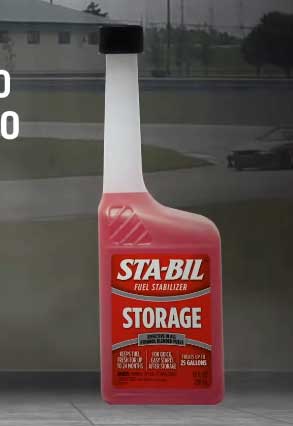
- It Won’t “Fix” Bad Gas: This is the biggest misconception. If your gas is already bad (dark, smelly, or gummy), STA-BIL cannot reverse time. It preserves fresh gas. Adding it to bad gas is like putting a band-aid on a broken leg—it won’t help.
- Shelf Life of the Bottle: Once you open the bottle of STA-BIL, the clock starts ticking. The liquid itself has a shelf life of about 2 years after opening. After that, it turns into a brownish, flaky sludge that you definitely do not want to pour into your engine. You have to monitor the bottle itself.
- Easy to Over-Pour: The bottle design (with the squeeze-to-measure neck) is clever but can be messy. It is easy to accidentally squirt too much or spill it on your paint.
- No Heavy Solvent Action: Unlike Mechanic in a Bottle, STA-BIL doesn’t contain aggressive solvents to clean out existing gunk. It is a preservative, not a cleaner.
Maintenance Tips For STA-BIL
- Mark the Date: When you crack the seal on a new bottle of STA-BIL, take a permanent marker and write the date on the side. If you pick it up 3 years later, throw it out and buy a new one. Old stabilizer can actually form flakes that clog your system.
- Run the Engine: Pouring it into the tank isn’t enough. You must run the engine for at least 5 to 10 minutes afterwards. This circulates the treated fuel through the fuel pump and into the carburetor bowl. If you don’t do this, the gas in the carb remains untreated and will gum up over winter.
- Fill the Tank Full: When storing equipment for winter, fill the gas tank to the very top after adding STA-BIL. A full tank leaves less room for air, which means less condensation can form inside the tank walls.
- Use in Your Gas Can: I make it a habit to add STA-BIL to my 5-gallon jerry can immediately when I buy gas at the station. That way, I never have to remember if the gas in my mower is treated—I know all my gas is treated from the start.
Read more: Comparison Of Free All And Kroil
Comparison with other brands
- STA-BIL vs. Sea Foam: Sea Foam is a hybrid—it cleans and stabilizes. However, Sea Foam is much more expensive per ounce if used just for storage. STA-BIL is a dedicated stabilizer and is chemically superior for long-term storage (12+ months). Use Sea Foam to clean a running engine; use STA-BIL to store a sleeping one.
- STA-BIL vs. Star Tron: Star Tron uses enzymes to break down water particles, which is fantastic for marine environments (boats) where water moisture is high. For a boat, I prefer Star Tron. For a lawnmower in a dry garage, STA-BIL is cheaper and works perfectly fine.
- STA-BIL vs. Pri-G: Pri-G claims to restore old fuel, similar to Mechanic in a Bottle. STA-BIL is purely for fresh fuel. Pri-G is industrial strength and great, but harder to find in local stores compared to the ubiquitous red bottle.
Frequently Asked Questions (FAQ)
Yes. They are compatible. A common strategy is to use Mechanic in a Bottle to clean the system at the start of the season (to remove any winter varnish) and use STA-BIL in your gas can throughout the year to keep the fuel fresh.
Yes. It is safe to add to your gas/oil mixture for chainsaws, weed eaters, and leaf blowers. It does not break down the lubrication properties of the 2-stroke oil.
No. STA-BIL keeps good gas good; it does not make bad gas good. If your gas smells like rotten varnish, drain it. Do not try to “save” it with STA-BIL. Use Mechanic in a Bottle to clean the empty tank/carb, then refill with fresh gas.
It is not instant. For a non-starting engine, you need to prime it into the carburetor and let it sit for 4 to 8 hours (or overnight). The solvents need time to dissolve the hardened varnish.
Yes. An opened bottle is generally good for 2 years. An unopened bottle is good for about 5 years. If the red liquid turns brown or has floating flakes in it, discard it.
Conclusion
The decision between Mechanic in a Bottle and STA-BIL comes down to the current state of your engine.
If your engine is running fine and you want to keep it that way, buy STA-BIL. It is the proactive choice. Use it every time you fill your gas can, and especially before winter storage. It is the cheapest way to prevent carburetor headaches. It is your engine’s “preservation shield.”
If your engine won’t start, runs rough, or has been sitting with untreated gas for a year, buy Mechanic in a Bottle. It is the reactive choice. It has the chemical muscle to dissolve the varnish that STA-BIL can’t touch. It is your “mechanic in a can” that saves you from taking the carburetor apart.
My advice? Keep a bottle of STA-BIL on the shelf for every fill-up, and keep a bottle of Mechanic in a Bottle in the drawer for when you (or your neighbor) forget to use the STA-BIL.