
If you have ever spent a Saturday afternoon wrestling with a stubborn bolt or trying to seat a tire bead with a manual pump, you know the value of good pneumatic power. Walking into Harbor Freight, it is impossible to miss the towering wall of bright red and gray tanks labeled “McGraw.” They promise to be the modern, quieter, and more reliable replacements for the rattling Central Pneumatic beasts of the past. But with so many options ranging from tiny pancake units to massive vertical tanks, you might be wondering if these budget-friendly machines can actually hold up to real-world abuse.
In this review, I am going to walk you through everything you need to know about the McGraw air compressor lineup, focusing on build quality, noise levels, and actual performance. I will break down the pros and cons based on hands-on usage and compare them directly to the big-box store competitors like Husky and Kobalt. My goal is to help you decide if a McGraw compressor is the right power source for your garage or just a noisy paperweight. For those ready to buy, the only place to get these is in-store at Harbor Freight or through their official website, where you can often snag a coupon to sweeten the deal.
My Experience With McGraw Air Compressors
I picked up the McGraw 21-Gallon Oil-Free Vertical Air Compressor last year when my trusty old compressor finally kicked the bucket in the middle of a suspension overhaul. I needed something that wouldn’t wake the neighbors on a Sunday morning but still had enough grunt to run a 1/2-inch impact wrench without constantly waiting for the tank to recharge. The price point was hard to ignore—significantly cheaper than similar specs at the home improvement stores down the street.
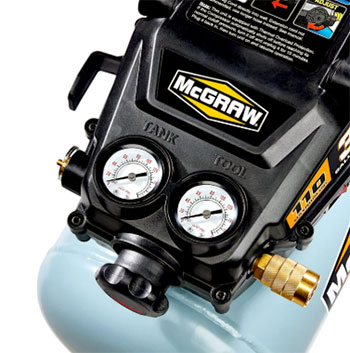
Getting it home and set up was surprisingly painless.
The unit came mostly assembled; I just had to bolt on the wheels and the rubber footpad.
The first thing that struck me was the “break-in” procedure listed in the manual.
Unlike some plug-and-play tools, McGraw insists on running the unit with the drain valve open for 30 minutes to seat the piston rings properly.
It felt a bit old-school, but I followed it to the letter.
Once that was done and I closed the valve, the tank filled up from 0 to 175 PSI in about six minutes, which is respectable for a 120V unit.
The noise level—or rather, the lack of it—was the biggest surprise. I was used to compressors that sounded like a jackhammer in a metal trash can. This McGraw unit hummed at a level where I could actually have a conversation in the garage without shouting. It is not “silent” by any means, but at around 77 decibels, it is a massive improvement over the older generation of air tools. I put it to the test immediately with an air ratchet and an impact gun. For intermittent bursts, it performed flawlessly. I removed lug nuts, zipped off caliper bolts, and even used a die grinder for a bit of cleanup work.
However, the experience wasn’t without a few hiccups. While the compressor motor is great, the regulator knob felt a bit cheap and plasticky in my hand. Adjusting the output pressure wasn’t as smooth as I would have liked, and the gauge needle had a tendency to flutter a bit more than high-end brands. Also, I noticed that when using high-consumption tools like a sander, the 4.0 SCFM (Standard Cubic Feet per Minute) limit became apparent very quickly. The motor would kick on frequently, and I had to pause to let the pressure build back up. It is a warrior for short bursts, but it struggles if you try to treat it like an industrial rotary screw compressor.
Overall, my time with the McGraw has been positive. It sits in the corner of my shop, holding pressure for days without leaking down, which is a testament to the seal quality. It hasn’t given me a single mechanical issue in over a year of weekend warrior duty. It might not be the tool for a professional body shop running paint guns 8 hours a day, but for the average guy fixing cars or building furniture, it punches well above its weight class.
Read More: My Thoughts On Smaco Air Compressor
Pros Of McGraw Air Compressors
When evaluating Harbor Freight’s attempt to capture the mid-tier market, it is clear they put some thought into these machines. They are not just repainted junk; they offer genuine value propositions for the DIY enthusiast. Here are the specific benefits that stand out.
- Exceptional Price-to-Performance Ratio: The most obvious advantage is the cost savings compared to big-name brands. You can often pick up a McGraw unit for 20% to 30% less than a comparable DeWalt or Porter-Cable model, especially if you time your purchase with a sale or coupon. This frees up budget for what actually matters—the air tools themselves. Despite the lower price, you aren’t sacrificing essential specs like maximum PSI or tank size, making it an incredibly efficient use of your garage budget. For a hobbyist who isn’t making money with their tools, this value proposition is unbeatable.
- Significant Noise Reduction Technology: One of the primary selling points of the McGraw line is that they are designed to be quieter than their predecessors. The oil-free pump designs have been optimized to reduce the high-pitched “clatter” typical of cheap compressors. While they aren’t as whisper-quiet as the premium “Fortress” line, they are significantly more tolerable than the old Central Pneumatic pancake compressors that would make your ears ring. This makes them viable for basement workshops or attached garages where noise bleed into the house is a concern. You can run it late at night without fearing a noise complaint from the neighbors.
- Variety of Configurations for Every User: McGraw covers the entire spectrum of needs, from small 3-gallon hot dog tanks to large 29-gallon vertical tanks. Whether you just need to inflate tires and run a brad nailer, or you need to power an impact wrench for automotive work, there is a model specifically sized for you. They offer both oil-free models for low maintenance and oil-lube models for longer lifespan and heavier duty cycles. This flexibility allows you to buy exactly as much compressor as you need without overspending on a massive tank that takes up half your floor space.
- Improved Form Factor and Portability: The design of these compressors is noticeably more modern and user-friendly than older generic units. The vertical models feature a slim footprint that tucks easily into the corner of a crowded garage. The handles are often integrated into the roll cage or shroud, protecting the vital components like the pump and gauges from accidental tip-overs. The wheels on the larger units are typically rugged rubber rather than cheap plastic, making it easier to roll them over cracks in the driveway or extension cords. They look and feel like a cohesive, well-engineered product rather than a tank with a motor slapped on top.
Cons Of McGraw Air Compressors
Despite the shiny paint and improved specs, these are still budget-oriented machines. There are compromises made to hit that price point, and you need to be aware of them before you load one into your truck.
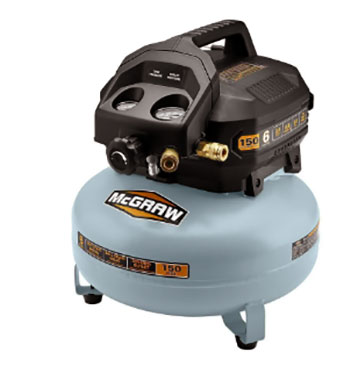
- Short and Restrictive Warranty: The biggest downside to buying a McGraw compressor is the standard Harbor Freight warranty. Out of the box, you typically only get a 90-day guarantee against defects. Compare this to brands like Husky or Kobalt, which often come with a 2-year or even 3-year limited warranty included in the price. If your motor burns out on day 91, you are out of luck unless you paid extra for the extended service plan. This “hidden cost” of the extended warranty brings the price much closer to the name brands, diminishing the initial value proposition.
- Included Accessories Are Often Low Quality: While the compressor itself is solid, the peripheral components can feel cheap. The regulators are often made of plastic and can be “sticky” or imprecise when trying to dial in a specific PSI. The drain valves on some smaller models are the old-school petcock style that are hard to open with gloves on, rather than the easier ball-valve levers found on premium units. You might find yourself spending extra money and time upgrading the fittings, couplers, and hoses immediately to get a reliable, leak-free setup. It is a classic case of the “weakest link” affecting the overall experience.
- Limited CFM for High-Demand Tools: While the PSI numbers look impressive (often 175 PSI), the airflow volume (CFM) is often just average. For continuous-use tools like DA sanders, die grinders, or paint spray guns, a McGraw compressor will struggle to keep up. You will likely hit the “duty cycle” limit, meaning the compressor has to run constantly to maintain pressure, leading to heat buildup and potential automatic shut-offs. They are designed for “burst” tools like nailers and impact guns, not for tools that require a constant stream of high-volume air. Professionals will find this limitation frustrating very quickly.
- Availability of Replacement Parts: While Harbor Freight is getting better at stocking parts, finding a specific replacement valve plate or capacitor for a McGraw unit can still be a treasure hunt. Unlike a brand like Ingersoll Rand or Campbell Hausfeld where you can order parts from a dozen online suppliers, McGraw parts are proprietary to HF. If a specific model is discontinued (which happens frequently with store brands), you might be left with a machine you can’t fix. You are largely dependent on Harbor Freight’s internal supply chain, which can be hit-or-miss depending on the season and stock levels.
Maintenance Tips For McGraw Air Compressors
A compressor is a machine that literally shakes itself every time it runs, so maintenance is non-negotiable. Treating your McGraw unit right will effectively double its lifespan. Here is how to keep it purring.

- Drain the Tank After Every Use: This is the golden rule of air compressor ownership. Compressing air squeezes out moisture, which pools at the bottom of the steel tank. If you leave this water inside, the tank will rust from the inside out, eventually leading to pinhole leaks or, in extreme cases, a dangerous rupture. Open the drain valve at the bottom of the tank after you are done for the day and let all the air (and water) hiss out. If you have a larger unit, consider installing an automatic drain valve or a ball-valve extension kit to make this chore easier so you don’t skip it.
- Perform the Break-In Procedure: Do not skip the instructions on the first page of the manual. New piston rings need to seat against the cylinder walls to create a tight seal. Running the compressor with the drain valve open and no pressure in the tank allows the parts to wear in gently without load. Skipping this step can lead to premature wear, oil consumption (in lube models), and permanently reduced compression. It only takes 30 minutes, and it sets the stage for the rest of the machine’s life.
- Check and Change Air Filters: The intake filter is your compressor’s only defense against drywall dust, sawdust, and paint overspray. If the filter gets clogged, the motor has to work twice as hard to pull air in, leading to overheating. Check the little black plastic filter housing on the side of the head every month. If the foam or paper element looks gray or caked with dirt, clean it with compressed air or replace it immediately. Running a compressor without a filter is a death sentence for the cylinder walls.
- Monitor Oil Levels (For Lube Models): If you bought the 29-gallon or another oil-lubricated model, you have an engine to take care of. Check the sight glass before every startup to ensure the oil is in the “safe” zone (usually the red dot). Change the oil after the first 50 hours of use (break-in) and then every 3-6 months depending on usage. Use non-detergent synthetic compressor oil; do not put standard 10W-30 motor oil in there, as it will foam up and cause carbon buildup on the valves. Oil-free models are sealed for life, so this step only applies to the heavy-duty units.
Comparison with Other Brands
The red tanks of McGraw are often staring you down from across the aisle, but how do they compare to the blue and black tanks at the other stores? Here is a breakdown.
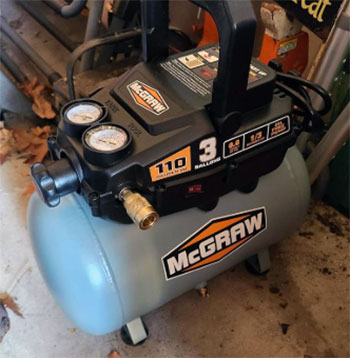
- Husky (Home Depot): Husky is the direct equivalent to McGraw, catering to the exact same DIY demographic. Comparison: Husky compressors generally feel very similar in build quality, often coming from the same overseas factories. The major difference is the warranty; Husky usually offers a 2-year warranty standard, whereas McGraw is 90 days. However, McGraw units are often priced $20-$50 cheaper to offset this. Husky also tends to have slightly better “Silent” models in their lineup recently. If warranty peace of mind is your top priority, Husky wins; if upfront cost is king, McGraw wins.
- Kobalt (Lowe’s): Kobalt’s “Quiet Tech” line is the benchmark for affordable, quiet compressors. Comparison: Kobalt units are famously quiet, often registering a few decibels lower than even the “quiet” McGraw models. Kobalt tanks also tend to have a slightly better finish and higher-quality regulators out of the box. However, Kobalt units are almost always more expensive than McGraw. If you live in an apartment or need the absolute quietest machine for indoor trim work, the extra money for a Kobalt is worth it. For a detached garage where noise matters less, the McGraw offers better bang for the buck.
- Fortress (Harbor Freight): This is the “civil war” comparison—Harbor Freight’s mid-tier vs. their top-tier. Comparison: Fortress is marketed as a professional-grade, ultra-quiet competitor to California Air Tools. Fortress compressors are significantly quieter and have much better build quality (metal gauges, better roll cages) than McGraw. However, the price jump is massive; a Fortress unit can cost double what a McGraw unit costs for the same tank size. McGraw is the “everyman” tool, while Fortress is for the pro or the person who demands silence. If you are just inflating tires, Fortress is overkill; stick with McGraw.
- California Air Tools: This brand started the “ultra-quiet” revolution. Comparison: California Air Tools (CAT) compressors are legendary for being whisper-quiet and having incredibly long lifespans. Their motors are generally rated for more hours than a McGraw motor. However, CAT units are often ugly, utilitarian, and harder to find locally (mostly online). McGraw copies a lot of the CAT technology but puts it in a nicer-looking, more available package. If you want the original reliable quiet tech, buy CAT; if you want convenience and local returns, buy McGraw.
Also Read: Comparison Of Jackery 3000 Pro And EcoFlow Delta Pro
Frequently Asked Questions (FAQ)
McGraw is a private label brand owned by Harbor Freight Tools. While the specific manufacturer is not publicly disclosed, they are produced in China by large OEMs that likely manufacture compressors for other major retail brands as well. They are designed to replace the older “Central Pneumatic” line with updated technology and better noise insulation.
The standard break-in procedure involves opening the drain valve at the bottom of the tank completely. Plug the unit in and turn it on, letting it run for 30 minutes with zero pressure building up in the tank. This allows the piston rings to seat and the bearings to lubricate (if oiled) without the stress of compression. After 30 minutes, close the valve and let it fill normally.
It is generally not recommended to use an extension cord with air compressors as the voltage drop can cause the motor to overheat or fail to start. If you absolutely must use one, use a heavy-gauge cord (12-gauge or 10-gauge) and keep it as short as possible (under 25 feet). A better solution is to buy a longer air hose rather than a longer power cord.
It can handle small painting projects like body panels or trim, but it is not ideal for painting an entire car. Paint guns require a high volume of air (CFM) continuously. The 21-gallon McGraw will likely run out of air volume quickly, causing the pressure to drop and the paint to splatter. For serious painting, you typically need a 60-gallon tank with a much higher CFM rating.
Conclusion
McGraw Air Compressors represent a significant leap forward for Harbor Freight, shedding the “cheap and loud” reputation of their predecessors. They offer a compelling mix of performance, reduced noise levels, and unbeatable pricing that makes them the perfect choice for homeowners, DIY mechanics, and hobbyists. While they lack the long warranties of the big-box brands and aren’t suited for industrial production lines, they are more than capable of handling weekend projects.
If you are looking to outfit your garage without emptying your bank account, a McGraw compressor is a smart buy. Just remember to follow the break-in procedure, drain the tank religiously, and maybe grab a better hose while you are at the store. For the price, it is hard to find a harder-working machine.