
If you are tired of plastic Bluetooth speakers that look like toys and want a sound system that doubles as a piece of sophisticated furniture, you should buy the Klipsch The One Plus. It is the perfect entry point for someone who values the “Heritage” aesthetic—real wood veneer and tactile switches—but demands modern conveniences like USB-C playback and app control.
While it lacks the portability of battery-powered units, its acoustic performance punches far above its weight class, making it an ideal choice for a home office, kitchen, or bedroom where style and sound quality are non-negotiable.
My Experience With Klipsch The One Plus
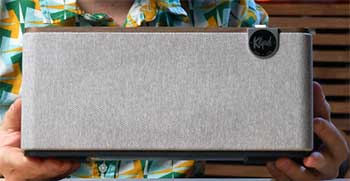
I have always been a sucker for that mid-century modern look, so unboxing the Klipsch The One Plus felt less like opening a gadget and more like unwrapping a premium decor piece.
The first thing that grabbed me was the weight; at nearly 8 pounds, it feels dense and substantial.
I chose the Walnut finish, and the real wood veneer is gorgeous—it doesn’t have that cheap, shiny laminate look you see on budget “retro” speakers. The grey fabric grille feels durable, and the metal control dial on top has a satisfying resistance when you turn it, reminiscent of old-school hi-fi receivers.
Setting it up was refreshingly simple but came with a slight reality check: there is no battery. I had to find a spot near an outlet, which limited my initial plan to use it on my center coffee table. I settled on my bookshelf. Once plugged in, pairing via Bluetooth 5.3 was instant. I didn’t need the app to get sound coming out, but I downloaded the Klipsch Connect App anyway to check for firmware updates.
The sound immediately caught me off guard. For a box this size—roughly the size of a shoebox—the bass is surprisingly authoritative. I put on some Daft Punk to test the low end, and the 4.5-inch woofer kicked in with a tightness that didn’t muddy the vocals. It’s a 2.1 stereo system, meaning it has separate drivers for left and right channels plus the woofer, and you can hear that separation. It doesn’t sound “boxy” like many mono Bluetooth speakers do.
One feature I found myself using more than expected was the USB-C port on the back. I have a high-res audio player (DAP) that I usually use with headphones, but plugging it directly into the The One Plus allowed me to play lossless files without Bluetooth compression. It also charges your phone, which is a nice bonus if you are using it on a nightstand.
However, it wasn’t all perfect. I noticed that if I placed the speaker too deep into a corner, the bass became a bit booming and overwhelming. I had to go into the app’s EQ settings and dial the bass down by -2dB to get it sounding balanced in my small room. Also, the lack of a remote control was a minor annoyance; you have to use your phone or get up to change the volume if you aren’t streaming via Bluetooth. But overall, the experience felt premium, tactile, and incredibly musical.
Aslo Read: My Thoughts On Monster X6 Speaker
Pros Of Klipsch The One Plus
- Exceptional 2.1 Stereo Sound: Unlike many competitors that rely on a single full-range driver, The One Plus utilizes a true 2.1 architecture. It features two 2.25-inch full-range drivers for crisp highs and mids, and a dedicated 4.5-inch high-excursion woofer for the low end. This bi-amplified design ensures that the bass doesn’t bleed into the vocals. The result is a sound signature that is dynamic, clear, and loud enough to fill a medium-sized room without distortion, even at 80% volume.
- Premium Build Quality and Aesthetics: This is arguably the biggest selling point. The use of real wood veneer (Walnut or Ebony) and tactile metal knobs sets it apart from the sea of plastic smart speakers. It looks expensive. The fit and finish are superb, with no visible seams or cheap glue lines. It is designed to be displayed prominently on a credenza or bookshelf, blending seamlessly with mid-century or modern interior design rather than clashing with it.

- Modern Connectivity Options: While it looks retro, the tech inside is current. Bluetooth 5.3 provides a stable connection with good range and lower latency than older standards. The inclusion of a USB-C port is a standout feature; it supports both audio playback and reverse charging (10W). This means you can plug in a streaming dongle (like a WiiM Mini) to turn it into a Wi-Fi speaker, or just charge your phone while you listen. It also has a standard 3.5mm Aux input for turntables (with a preamp) or legacy devices.
- Broadcast Mode Functionality: If you plan on expanding your system, the “Broadcast Mode” is a game-changer. It allows you to wirelessly link up to 10+ Klipsch speakers (including The Three Plus and other compatible models) to play the same music simultaneously. While this isn’t a multi-room Wi-Fi solution like Sonos, it is fantastic for parties where you want to fill a large open space with sound without running wires everywhere.
- Klipsch Connect App Customization: The companion app is actually useful, which is rare for Bluetooth speakers. It allows you to tweak a 3-band equalizer (Bass, Mid, Treble) to suit your room acoustics or personal taste. It also enables “Night Mode,” which cuts the dynamic range so you can listen at low volumes without waking up the house with sudden loud bass hits. Firmware updates are handled seamlessly through the app, ensuring the speaker stays up to date.
Cons Of Klipsch The One Plus
- Not Portable (No Battery): This is the most common misconception about this speaker. It requires a constant AC power connection. You cannot take it to the park or the beach. It is strictly a tabletop home speaker. If you are looking for something to move from the kitchen to the patio effortlessly, this is not the product for you. You are tethered to the nearest wall outlet, which restricts placement options.
- No Wi-Fi or AirPlay Support: For the price, the omission of Wi-Fi is a significant drawback. It does not support Apple AirPlay 2, Google Chromecast, or Spotify Connect natively. You are relying entirely on Bluetooth compression for wireless streaming, which is fine for most listeners but might annoy audiophiles who want lossless transmission. To get Wi-Fi streaming, you have to purchase a separate streamer and plug it into the USB-C or Aux port.
- Limited Stereo Separation: Although it is technically a stereo system, the drivers are housed in a single compact box that is only about 12 inches wide. You physically cannot get a wide soundstage from a single unit. While the imaging is decent, you won’t get that immersive “left vs. right” experience you get from two separate bookshelf speakers. It creates a “wall of sound” rather than a precise holographic stage.
- Bass Can Be Overpowering: Out of the box, the Klipsch sound signature is known for being lively and dynamic, but The One Plus can be a bit heavy-handed with the bass in small rooms. If you place it near a wall or in a corner (corner loading), the low frequencies can become boomy and drown out the midrange detail. You will almost certainly need to use the App to adjust the EQ if you have it in a tight space.
- No Optical or Phono Input: Unlike its bigger brother, The Three Plus, The One Plus lacks an Optical input (for TV connection) and a dedicated Phono stage (for turntables without a preamp). If you want to use this with a TV or a record player, you will need to buy adapters or ensure your turntable has its own built-in preamp. It is designed primarily for digital streaming, not as a hub for analog gear.
Maintenance Tips For Klipsch The One Plus
- Care for the Wood Veneer: Since this speaker uses real wood, it is susceptible to environmental damage. Do not use harsh chemical cleaners, furniture polish, or wet rags on the veneer, as this can warp or discolor the finish. Instead, use a dry, soft microfiber cloth to dust it regularly. If you absolutely must clean a spot, use a slightly damp cloth and dry it immediately. Keep the speaker out of direct sunlight, as UV rays can fade the wood finish over time.
- Grille Cleaning: The fabric grille can trap dust and pet hair. Do not use a vacuum with a high-suction hose directly on the fabric, as you might stretch it or damage the drivers underneath. The best method is to use a sticky lint roller to gently lift off surface dust. For deeper cleaning, you can use a can of compressed air to blow dust out from the corners, but hold the can upright and at a distance.
- Manage Your Firmware: Klipsch releases firmware updates to fix bugs and improve connectivity. Open the Klipsch Connect App at least once a month to check for updates. When updating, ensure the speaker is plugged into a stable power source and do not unplug it until the process is 100% complete. A failed update can “brick” the device, requiring a factory reset or service.
- Proper Placement for Acoustics: To get the best sound and prolong the life of the drivers, give the speaker some breathing room. Avoid placing it inside a closed cabinet where heat can build up. Also, try to keep it at least 6 inches away from the wall behind it. This allows the rear passive radiators (if applicable) or the bass ports to function correctly without creating muddy resonance.
- Cable Management and Safety: Since it is corded, ensure the power cable is not under tension or bent at a sharp angle where it connects to the back of the unit. Repeated stress on the AC port can cause the connection to loosen over time. If you use the USB-C port frequently, be gentle when inserting and removing cables to avoid damaging the internal pins.
Aslo Read: Comparison Of JBL Xtreme 2 And Xtreme 3.
Comparison with Other Brands
Klipsch The One Plus vs. Marshall Acton III
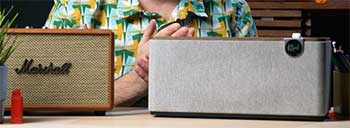
The Marshall Acton III is the direct rival in the “retro” category. Aesthetics: Marshall screams “rock and roll” with its amp-like vinyl covering and script logo, while Klipsch feels more “mid-century modern furniture.” Controls: Marshall has physical knobs for Bass and Treble right on top, which is much more convenient than digging into an app like you have to with Klipsch. Sound: Marshall tends to have a grittier, punchier midrange that favors guitar rock. Klipsch is smoother with deeper sub-bass extension. If you want tactile EQ control, go Marshall. If you want a more refined look and sound, go Klipsch.
Klipsch The One Plus vs. Sonos Era 100
This is a battle of smarts vs. style. Connectivity: Sonos wins hands down with Wi-Fi, AirPlay 2, and seamless multi-room integration. It is a “smart” speaker; Klipsch is a “dumb” speaker. Sound: The One Plus actually sounds bigger and fuller than a single Era 100, thanks to the dedicated woofer. Use Case: If you are already in the Sonos ecosystem or want voice assistants (Alexa/Sonos Voice), buy the Era 100. If you strictly want a Bluetooth speaker that looks beautiful and sounds great without needing Wi-Fi, Klipsch is the winner.
Klipsch The One Plus vs. Klipsch The Three Plus
The Three Plus is the larger version of The One Plus. Inputs: The Three Plus adds an Optical input (for TV) and a Phono input (for turntables). The One Plus has neither. Size and Power: The Three Plus is physically larger and louder, capable of filling a large living room. Verdict: If you want a speaker for your TV or turntable, you must upgrade to The Three Plus. If you just want to stream music in a bedroom or office, save the money and stick with The One Plus.
Frequently Asked Questions (FAQ)
No, it is not portable in the sense of being battery-operated. It comes with a detachable power cord but must be plugged into a standard wall outlet to function. It is designed to be a stationary tabletop speaker.
Yes, you can. Using the Klipsch Connect App, you can pair two The One Plus units together. One will act as the Left channel and the other as the Right channel, creating a true stereo separation that sounds significantly better than a single unit.
You can connect it to a TV using the 3.5mm Aux input, provided your TV has a headphone jack or analog audio output. However, it does not have an Optical or HDMI ARC input, so you won’t get digital audio quality or volume control via your TV remote. For TV use, The Three Plus is a better option.
No, The One Plus does not have a built-in microphone. It cannot be used as a speakerphone for calls, nor does it have built-in voice assistants like Siri or Google Assistant. It is purely a playback device.
Conclusion
In conclusion, you should buy the Klipsch The One Plus if you want a Bluetooth speaker that prioritizes audio fidelity and interior design over portability. It is a beautiful piece of hardware that brings warmth and clarity to your music collection, wrapped in a package that looks as good as it sounds. While the lack of Wi-Fi and battery limits its versatility compared to some competitors, the sheer quality of the materials and the acoustic engineering make it a worthy investment for anyone building a stylish, high-fidelity home audio setup.