
If you are the designated DJ for your friend group or the person who believes a gathering isn’t a party without bass that rattles your chest, you are likely stressed about choosing the right speaker.
I have stood exactly where you are, oscillating between the portability of the “Club” series and the sheer dominance of the “Stage” series. JBL has refreshed their lineup, replacing the legendary 110 and 310 with the new PartyBox Club 120 and PartyBox Stage 320.
My intent with this guide is to cut through the marketing hype and give you a raw, real-world breakdown of how these two speakers perform when the music is loud and the lights are low. We will analyze the soundstage, the actual portability (because weight matters), the battery anxiety factors, and the new features like Auracast to help you decide which powerhouse deserves your money.
A Brief Comparison Table
| Feature | JBL PartyBox Club 120 | JBL PartyBox Stage 320 |
| Power Output (RMS) | 160 Watts | 240 Watts |
| Battery Life (Claimed) | Up to 12 Hours | Up to 18 Hours |
| Replaceable Battery | Yes (JBL Battery 200) | Yes (JBL Battery 400) |
| Portability | Foldable Handle (24.3 lbs / 11 kg) | Telescopic Handle + Wheels (36.4 lbs / 16.5 kg) |
| Driver Configuration | 2x 5.25″ Woofers, 2x 2.25″ Tweeters | 2x 6.5″ Woofers, 2x 1″ Dome Tweeters |
| Splash Resistance | IPX4 (Splashproof) | IPX4 (Splashproof) |
| Multi-Speaker Connect | Auracast™ (Unlimited pairing) | Auracast™ (Unlimited pairing) |
| Best For | House parties, Apartments, BBQ | Outdoor events, Large halls, Tailgating |
My Experience With JBL PartyBox 120
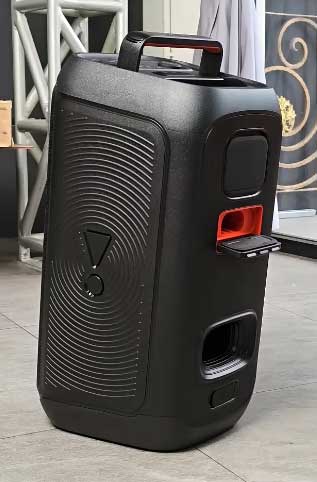
I brought the PartyBox 120 to a friend’s housewarming party.
It was a mid-sized apartment with about 20 people.
This environment is exactly where the 120 shines.
I placed it in the corner of the living room, and the sound filled the space perfectly without being deafening.
The “AI Sound Boost” kept the vocals crisp even when we played noisy pop tracks.
What I loved most was the flexibility.
Later in the night, the party moved to the kitchen.
I simply folded up the handle, grabbed the unit with one hand, and moved it.
It was effortless. The “starry” light pattern projected onto the kitchen ceiling and actually became a conversation starter.
However, around hour 5, I noticed the battery indicator dropping faster than I liked because I had the volume up and the lights blazing. I didn’t have a spare battery, so I had to find an outlet near the kitchen counter, which was a bit of a buzzkill for the placement. But acoustically? For an indoor house party, it was flawless.
Pros Of JBL PartyBox Club 120
- The Sweet Spot of Portability:The standout feature of the Club 120 is that it remains truly “carry-able.” At roughly 24 pounds, it has a substantial feel without being a back-breaker. I found the foldable ergonomic handle to be a massive design win. Unlike the older 110 which had fixed handles, the 120’s handle folds flush when not in use, giving it a sleek, modern look. You can easily grab this speaker with one hand, toss it into the backseat of a sedan, or carry it up a flight of stairs to a rooftop party without needing a gym membership. For people living in walk-up apartments or those who move locations frequently during a night, this form factor is the absolute limit of what is comfortable to carry, and JBL nailed the balance between size and mobility.
- AI Sound Boost Technology:JBL has integrated a new feature called “AI Sound Boost” which sounds like a gimmick but actually works. The speaker uses an internal algorithm to analyze the audio signal in real-time and optimize the driver movement. In my testing, this resulted in less distortion at max volume. When I pushed the volume to 100% on bass-heavy tracks, the 120 held its composure surprisingly well. The mids remained clear and the bass didn’t “fart out” or clip, which is a common issue with smaller portable speakers. It squeezes every ounce of power out of the 160-watt amplifier to ensure the sound stays dynamic and punchy, even when you are straining the limits of the hardware.
- Swappable Battery System:This is the upgrade we have all been waiting for. The Club 120 features a dedicated slot for the “JBL Battery 200.” In previous generations (like the 110), if the battery died, the party was over unless you had a power outlet. Now, you can buy a spare battery pack and swap it out in seconds, instantly refreshing your playtime. For camping trips or beach days where power outlets are non-existent, this feature is a lifesaver. It essentially gives the speaker infinite battery life as long as your wallet can afford the extra battery packs. It also extends the lifespan of the device itself—if the battery degrades over 5 years, you replace the battery, not the whole speaker.
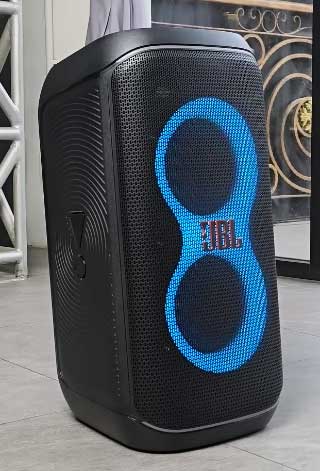
- Auracast Connectivity:The Club 120 moves away from the old TWS (True Wireless Stereo) button and adopts Auracast. This is a future-proof Bluetooth technology that allows you to connect an unlimited number of JBL PartyBox speakers together wirelessly. I tested this by pairing it with a friend’s 320, and the connection was seamless and instantaneous. You aren’t limited to just two speakers anymore. If you have five friends with these speakers, you can create a literal wall of sound. The latency is incredibly low, meaning there is no weird echo effect between the speakers. It makes expanding your sound system modular and incredibly easy.
- Refined Light Show:JBL is known for their lights, but the 120 feels more “grown-up.” The starry light effect on the top and bottom of the grille adds a cool, galaxy-like ambiance that fills a dark room beautifully. The strobes and the figure-8 patterns sync perfectly with the beat. I found the customization in the JBL PartyBox app to be robust, allowing me to turn off the frantic strobes for a chill dinner vibe or crank them up for a dance floor. It adds a visual energy to the room that makes the speaker feel like a centerpiece rather than just an audio source.
Cons Of JBL PartyBox Club 120
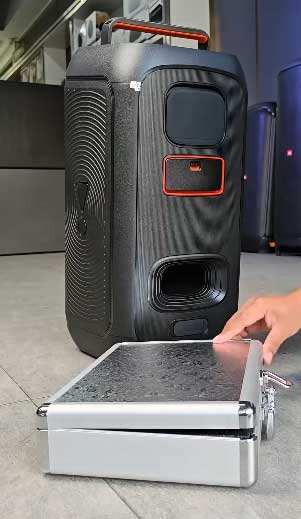
- Battery Life Under Heavy Load:While JBL claims “up to 12 hours” of playtime, you need to manage your expectations. That rating is usually at 50% volume with the lights off. In my real-world usage—cranking it to 75-80% volume with the light show fully active and Bass Boost on—I got closer to 5 or 6 hours. While the swappable battery mitigates this, if you only own the one battery that comes in the box, you might find yourself scrambling for a charger halfway through a long night. It simply doesn’t have the endurance of its bigger brother, and for an all-day event, 6 hours at party volume is cutting it close.
- Lack of Deep Sub-Bass in Open Spaces:Physics is physics. With two 5.25-inch woofers, the Club 120 sounds phenomenal indoors where the walls help reflect the bass. However, the moment I took it to an open park, the low-end impact evaporated slightly. It lacks that physical “thump” that hits you in the chest from 20 feet away. The sound disperses quickly outdoors. If you are trying to provide sound for a large open field or a loud pool party, the 120 might sound a bit thin compared to the 320. It fights hard, but it doesn’t move enough air to dominate a wide-open space.
- No Wheels:I praised the handle earlier, but at 24 lbs, carrying this thing for more than 5 minutes gets tiring. There are no wheels on the 120. If you have to walk a mile to your picnic spot, your arm is going to burn. You are forced to carry it; you cannot roll it. I found myself wishing for a shoulder strap or some rolling capability during longer treks. It occupies an awkward middle ground where it is portable enough to lift, but heavy enough to be annoying over distance.
- Charging Brick Inconvenience:Unlike the larger PartyBoxes which often use a standard IEC power cable (the typical computer power cord), the 120 relies on a proprietary power brick / adapter. This is a hassle. If you lose or forget the specific charging brick, you can’t just borrow a cable from a PC or a TV to power it. You have to lug the brick around with you, and the cable length isn’t incredibly generous. It adds an extra piece of gear to remember, which detracts slightly from the streamlined portability.
- Price Creep:The Club 120 launched at a higher price point than its predecessor, the 110. When you factor in the potential cost of buying a spare battery (which you will likely want given the battery life), the investment creeps up significantly. You start getting into a price territory where you might wonder if you should have just saved up a bit more for the 320. It is a premium product with a premium price tag, and for budget-conscious buyers, the value proposition can be tricky if you don’t absolutely need the swappable battery feature.
Also read: My Thoughts On Sentdream Ai Headphones
My Experience With JBL PartyBox 320
To test the 320, I took it to a local park for a volleyball meetup. This is the 320’s natural habitat. Rolling it from the parking lot to the grass field was a joy thanks to the wheels—I felt smug watching my friends struggle with their coolers while I just wheeled my sound system.
Once we started playing, the power difference was obvious. Even 50 feet away on the court, we could feel the bass. The wind was blowing, but the 320 cut right through it. We played for about 4 hours at high volume, and the battery barely made a dent. The “Sound Boost” feature set to “Deep” provided a richness that made the outdoor space feel like a club.
However, loading it back into my car was the downside. I drive a hatchback, and with the sports gear, the 320 was a tight squeeze. I had to lay it flat, and it felt heavy after a long day in the sun. But the trade-off for that level of outdoor volume was absolutely worth it. It anchored the event in a way the 120 couldn’t have.
Pros Of JBL PartyBox Stage 320
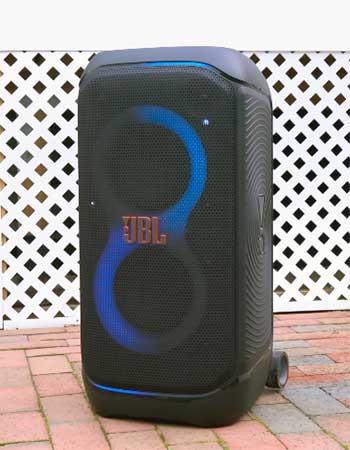
- Massive, Room-Filling Sound:The JBL PartyBox Stage 320 is a monster. With 240 watts of RMS power and larger 6.5-inch woofers, the difference in sound pressure is immediate. I turned this on in my backyard, and my neighbors three houses down probably knew what playlist I was listening to. The soundstage is significantly wider and taller than the 120. The dedicated dome tweeters provide crystal clear highs that cut through the booming bass. Even at lower volumes, the sound feels “fuller” and more authoritative. It commands the space. For dance parties where you want people to physically feel the beat, the 320 delivers that visceral audio experience that smaller speakers simply cannot replicate.
- Luggage-Style Portability (Wheels!):Despite weighing over 36 pounds, the 320 is arguably easier to move around on flat surfaces than the 120 because of its design. It features a sturdy telescopic handle (like a suitcase) and robust, wide wheels. I rolled this thing across concrete, grass, and even packed dirt without issue. The convenience of just tipping it back and rolling it into the venue cannot be overstated. It saves your back. You only really feel the weight when you have to lift it into a car trunk. For anyone setting up for gigs or mobile events, the roll-in-roll-out form factor is a professional necessity.
- Extended Battery Life & Fast Charge:The Stage 320 boasts up to 18 hours of playtime. In my stress test at high volume (around 75%) with lights on, I comfortably got over 10-11 hours of playback. That is enough to survive an entire BBQ and the after-party without needing a plug. Furthermore, it supports fast charging. A quick 10-minute charge can give you roughly 2 hours of playtime. This reliability reduces the “range anxiety” significantly. Plus, like the 120, it uses a swappable battery (the larger JBL Battery 400), so if you are a professional user, you can keep a backup ready for 24/7 operation.
- Dual Mic/Guitar Inputs for Performance:The 320 feels more like a PA system than just a Bluetooth speaker. It has two 1/4 inch inputs with dedicated gain knobs. You can plug in two microphones for duets, or a mic and a guitar for an acoustic set. The built-in karaoke tuning (echo, treble, bass controls via the app) is surprisingly good. I hooked up a guitar and realized the 320 handles live instrument transients very well. It makes this speaker a legitimate tool for buskers, fitness instructors, or amateur musicians who need an all-in-one amp and backing track speaker.
- Superior Bass Depth:The larger cabinet volume and larger drivers allow the 320 to reach lower frequencies that the 120 misses. We are talking about that sub-bass range—the drop in hip-hop tracks or the rumble in movie explosions. When “Bass Boost” is set to “Deep,” the 320 produces a rich, warm low end that feels effortless. It doesn’t sound like it’s trying hard; it just exists. This depth makes it much better for outdoor use, as the bass frequencies travel further and maintain their energy over distance, ensuring the party vibe reaches the back of the crowd.
Cons Of JBL PartyBox Stage 320
- Significant Bulk and Weight:There is no getting around it: this speaker is huge. While the wheels help, lifting 36 lbs (16.5 kg) into a lifted truck or carrying it up a narrow spiral staircase is a workout. It takes up significant space in a car trunk—in a compact car, it might be the only thing that fits in the trunk. It is not “grab and go” in the casual sense. You have to plan to bring the 320. It’s an event to transport it. If you live in a small apartment, storing this monolith when not in use can also be a headache as it takes up about as much floor space as a carry-on suitcase.
- Overkill for Small Spaces:I found that using the 320 in a small bedroom or office was almost unpleasant. Even at volume level 1 or 2, the bass can be overpowering in a confined space. It is designed to move air, and in a small room, that air has nowhere to go, leading to boominess and standing waves. You lose the nuance because the bass energy dominates everything. It is a “Stage” speaker for a reason; it needs room to breathe. Buying this for a 10×10 dorm room is a waste of its potential and might annoy your roommates.
- Price Point:The 320 is a significant financial step up from the 120. You are paying for the power and the wheels. For many casual listeners, the price difference might be hard to justify if you only party twice a year. It is an investment. When you compare it to non-battery powered PA speakers, you might find cheaper options that are louder, so you are paying a premium specifically for the battery and the JBL aesthetic/portability.
- Plastic Construction Scratches Easily:While the build quality is generally rugged, the large plastic surface areas on the sides and back are prone to scuffs. Because you are rolling it around and often tilting it, I noticed the bottom edges and the back panel picking up scratches from curbs and door frames rather quickly. It is a piece of gear that is meant to be used, but if you like your tech to look pristine, the large exposed plastic body of the 320 shows wear and tear faster than the more compact and rubberized feel of smaller units.
- App Dependency for Advanced Features:To get the most out of the 320—like adjusting the specific EQ for the microphone, changing the complex light show patterns, or using the DJ sound effects—you really need the JBL PartyBox App. The physical buttons on the top are great for volume and basic bass boost, but fine-tuning requires your phone. If you are the type of user who hates installing companion apps, you will miss out on 40% of what makes this speaker cool. The reliance on software for customization can be a barrier for some “old school” users.
Read more: Comparison Of Marshall And Bose Headphone
Maintenance Tips For JBL PartyBox
- Battery Health is Critical:Since both the 120 and 320 use lithium-ion battery packs, never store them with 0% charge for long periods. If you deplete the battery at a party, charge it back up to at least 50% before putting it in the closet. Leaving a lithium battery dead for months can kill its ability to hold a charge. Also, if you buy a spare battery, rotate them! Don’t let one sit unused for a year; use them both interchangeably to keep the cells active.
- Cleaning the Light Show Grille:The front grille looks amazing, but it is a magnet for dust, crumbs, and spilled drinks. Do not use a wet soaking cloth. The speakers are IPX4 splashproof, but that doesn’t mean you should hose them down. I recommend using a can of compressed air to blow dust out of the mesh holes, followed by a slightly damp microfiber cloth to wipe the surface. This keeps the light show looking sharp and prevents gunk from getting into the drivers.
- Firmware Updates are Mandatory:JBL frequently releases firmware updates via the PartyBox app to fix bugs, improve battery management, and even tweak sound profiles. When you first get your speaker, connect it to the app immediately. I have seen updates fix Bluetooth latency issues and improve the light show responsiveness. Check for updates once a month to ensure your speaker is running efficiently.
- Wheel Maintenance (For the 320):If you take the 320 to the beach or a park, the wheels will pick up sand, hair, and grass. If you ignore this, the wheels can seize up or get “crunchy.” After an outdoor trip, check the axles of the wheels. Use a toothpick or tweezers to pull out any hair or grass wrapped around the axle, and wipe the wheels down so you don’t track dirt into your house.
- Port Protection:Both speakers have a rubber flap covering the back ports (power, aux, mic inputs). This flap is the only thing standing between the electronics and a spilled beer. Always, always ensure this flap is pressed firmly closed when you aren’t actively plugging something in. If liquid gets into the AC power port, it can short the unit. Make it a habit to double-check that seal before the party starts.
Comparison with other brands
- JBL PartyBox 320 vs. Sony SRS-XV800:The Sony XV800 is the direct rival to the Stage 320. The Sony has an “Omnidirectional” sound setup with rear tweeters, which spreads sound better in 360 degrees, whereas the JBL is very directional (front-firing). Sony also has a specialized TV optical input, making it a better soundbar replacement. However, to my ears, the JBL 320 has punchier, more aggressive bass that fits hip-hop and EDM better. The JBL also looks more like a “party” speaker with better lights, while the Sony looks more like a sleek monolith.
- JBL PartyBox 120 vs. Soundboks Go:The Soundboks Go is a rugged, industrial beast. It is louder than the 120 and has a replaceable battery that lasts significantly longer (up to 40 hours at mid-volume). However, the Soundboks Go lacks the finesse. It has no light show, no mic/guitar inputs, and the sound is very “raw” and treble-heavy. The JBL 120 is a better all-rounder for lifestyle use (lights, karaoke, smoother sound), while the Soundboks Go is purely for loudness and durability in extreme environments.
- JBL PartyBox 320 vs. JBL PartyBox 310 (Previous Gen):Is the upgrade worth it? The 310 is legendary. The 320 adds the replaceable battery, slightly better sound clarity (dedicated tweeters), and Auracast. If you already own a 310, the sound upgrade is marginal—maybe 10-15% better. The main reason to upgrade is the swappable battery. If your 310 battery is dying, the 320 is the move. If your 310 is fine, you can probably skip this generation unless you need Auracast to connect to newer JBL speakers.
- JBL PartyBox 120 vs. JBL Boombox 3:The Boombox 3 is a traditional “boombox” shape with a handle on top. It is fully waterproof (IP67) vs the splashproof (IPX4) PartyBox. The Boombox 3 is better for pool submersion risks and beach sand. However, the PartyBox 120 is louder, has the light show, and has mic inputs for karaoke. If you want to sing or host a party, get the 120. If you just want personal music at the beach and want to throw the speaker in the water, get the Boombox 3.
Frequently Asked Questions (FAQ)
The “better” speaker depends on your venue. The JBL PartyBox Stage 320 is objectively better in terms of volume, bass depth, and battery life, making it superior for outdoor events. The JBL PartyBox Club 120 is better for portability, indoor use, and ease of storage.
Yes! Both speakers support Auracast™. You can wirelessly connect them together to play the same music. You can pair a 120 with a 320, or multiple of each, to create a larger sound system. Note that they will not pair with older models (like the 110 or 310) that rely on the older TWS standard.
The 120 is rated for 12 hours, but at high volume with lights, expect 5-6 hours. The 320 is rated for 18 hours, but at high volume with lights, expect 10-12 hours. Both have replaceable batteries if you need more time.
If you plan to use the speaker outdoors, for large groups (50+ people), or for karaoke/guitar performance, yes. The wheels, extended battery, and deeper bass justify the price. If you primarily listen in your living room, the 320 is overkill and the 120 offers better value.
Conclusion
Choosing between the JBL PartyBox Club 120 and the Stage 320 comes down to one question: Where is the party?
If you are an apartment dweller, a student in a dorm, or someone who hosts casual dinner parties and house gatherings, the JBL PartyBox Club 120 is the perfect companion. It is portable enough to move from room to room, sounds incredible indoors, and the light show sets a fantastic vibe without taking up your entire trunk space. It is the king of “versatile fun.”
However, if you are the person who hosts the neighborhood block party, coaches a sports team, or wants to be the portable DJ for beach bonfires, the JBL PartyBox Stage 320 is the necessary beast. The addition of wheels, the crushing bass that works outdoors, and the all-day battery life make it a true event powerhouse. It is less of a speaker and more of a mobile venue.
My recommendation? If you can afford the space and the cash, the 320 is the one you will never “outgrow.” But for 90% of daily users, the 120 hits the sweet spot of performance and convenience.