
If you have ever tried to provide the soundtrack for a beach day or a backyard BBQ, you know the panic of wondering if your little speaker can actually cut through the wind and chatter. That was me a few summers ago, juggling different Bluetooth speakers, trying to find that sweet spot between “portable enough to toss in a bag” and “loud enough to actually hear.” This brings us to the showdown between two absolute heavyweights in the portable audio game: the JBL Flip 6 and the JBL Charge 4.
While they might look like siblings from the same rugged, cylindrical family, they are built for two very different types of listeners. One is a modern, ultra-portable powerhouse designed for clarity on the go, while the other is an older, beefier tank built to last all weekend and charge your phone while doing it.
In this article, I am going to compare JBL Flip 6 vs Charge 4 based on my time testing them in the wild—from sandy beaches to quiet office desks. I’ll break down the sound quality, the battery reality (versus the claims), and the crucial connectivity issues that might make or break your decision. Whether you need a lightweight travel buddy or a stationary party starter, I’ll help you figure out which one deserves your money.
A Brief Comparison Table
| Feature | JBL Flip 6 | JBL Charge 4 |
| Driver Configuration | 2-way (Woofer + Tweeter) | Mono (Single Racetrack Driver) |
| Best For | Hiking, cycling, personal travel, clarity | Camping, outdoor parties, long durations |
| Key Benefits | Crystal clear highs, dustproof (IP67), light | Massive battery, Powerbank feature, deep bass |
| Battery Life | Up to 12 Hours (Real world: ~8-9h) | Up to 20 Hours (Real world: ~16h) |
| Durability | IP67 (Waterproof & Dustproof) | IPX7 (Waterproof only) |
| Connectivity | Bluetooth 5.1, PartyBoost | Bluetooth 4.2, Connect+ |
| Sound Profile | Balanced, crisp, distinct instrument separation | Bass-forward, warm, slightly muddier highs |
| Portability | High (fits in bottle holder/pocket) | Medium (requires a backpack/tote) |
| Price Point | Moderate (~$130) | Moderate/Variable (~$150, often discounted) |
My Experience With JBL Flip 6

I picked up the Flip 6 right before a hiking trip where I knew weight would be a factor, but I refused to suffer through tinny phone speaker audio.
The first thing that struck me was how deceptively premium it feels.
The “big logo” design is bold, and the rubberized end caps feel sturdy enough to survive a drop on a rock (which, spoiler alert, happened).
When I first fired it up at the campsite, the difference in sound architecture was immediately obvious.
JBL separated the tweeter and the woofer in this model, and my ears thanked them for it.
Listening to acoustic tracks, the guitar plucks were crisp and distinct, sitting perfectly on top of a punchy bass line.
It didn’t sound like a “small” speaker trying too hard; it sounded like a well-engineered piece of audio equipment. I loved that I could toss it into the water bottle mesh pocket of my backpack and forget it was there until we stopped for lunch.
However, the battery life did give me a bit of anxiety. On a day where we had the volume pushed past 70% to combat the sound of a nearby river, the “12-hour” claim felt optimistic. I got closer to 7 or 8 hours before the red light started flashing. It’s perfect for a day trip, but for a multi-day camping excursion without a power source, I found myself rationing my music time. It is a brilliant sprinter, but maybe not a marathon runner.
Pros Of JBL Flip 6
- Superior Sound Separation and Clarity: The two-way speaker system is a game changer: The most significant upgrade in the Flip 6 is the introduction of a separate tweeter and woofer configuration. In previous models (and in the Charge 4), a single driver handled everything, which often led to muddy vocals when the bass kicked in. With the Flip 6, the high frequencies—like cymbals, vocals, and lead guitars—are handled by a dedicated 16mm tweeter, while the bass and mids are driven by the racetrack-shaped woofer.1 This results in a soundstage that is surprisingly detailed. You can hear the breath in a singer’s voice even when the bass is thumping. For audiophiles or anyone who listens to complex genres like jazz, rock, or classical, this clarity makes the listening experience significantly less fatiguing over time. You aren’t straining to hear the details; they are projected right at you.
- Ultimate Portability and Ergonomics: Designed to go anywhere you do: The form factor of the Flip 6 is arguably the perfect size for a portable speaker. It weighs just over a pound (550g), making it light enough to hold in one hand comfortably. It fits perfectly into standard car cup holders, bike bottle cages, and the side pockets of backpacks. This encourages you to actually take it with you rather than leaving it behind because it’s “too much hassle.” The included carrying strap is a simple but effective addition, allowing you to hang it from a showerhead, a tree branch, or a carabiner on your belt. It removes the friction of bringing high-quality audio into awkward spaces.
- IP67 Dust and Water Resistance: Built for the beach and the trail: While many speakers are waterproof (IPX7), the Flip 6 adds the crucial “6” rating for dust protection.2 This means the unit is completely sealed against solid particles like sand, dirt, and dust. If you have ever taken a speaker to the beach and spent months trying to get the gritty sand out of the fabric mesh, you will appreciate this. You can drop this speaker in the mud, rinse it off in the river, and keep playing without worrying about internal grit destroying the drivers. It gives you the confidence to use the device in truly rugged environments, not just poolside.
- Modern Bluetooth 5.1 Connectivity: Stronger connection, less lag: Being a newer device, the Flip 6 utilizes Bluetooth 5.1, which offers better range and stability compared to the older 4.2 standard found in the Charge 4.3 In my testing, this meant I could walk further away with my phone without the music stuttering or cutting out. It also improves pairing speed—the speaker connects to my phone almost instantly when turned on. While latency is rarely an issue for music, if you watch movies or YouTube videos with the speaker, the newer Bluetooth standard helps keep the audio synced with the video lips, reducing that annoying delay.
- PartyBoost Compatibility: Future-proofing your multi-speaker setup: The Flip 6 uses JBL’s current “PartyBoost” protocol to link with other speakers.4 This allows you to pair it with other modern JBL units (like the Flip 5, Xtreme 3, or Charge 5) for stereo sound or “party mode.”5 Since PartyBoost is the standard JBL is moving forward with, buying a Flip 6 means you are investing in an ecosystem that is likely to be supported for years to come. You can easily expand your sound system by adding another Flip 6 later for true left/right stereo separation.
Also Read: Differences Between Bose SoundLink Flex And JBL Flip 6
Cons Of JBL Flip 6
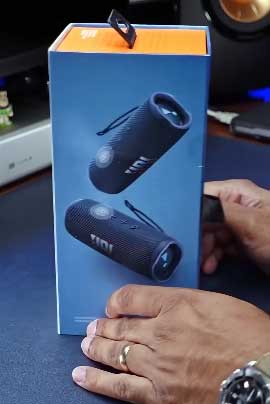
- Underwhelming Battery Life at High Volume: Physics limits the performance: While JBL advertises 12 hours, the reality of a smaller battery driving separate woofer and tweeter units is that it drains quickly when pushed. If you crank the volume past 75%—which you often need to do outdoors—you might see that playtime drop to 5 or 6 hours. This is significantly less than the Charge 4. It requires you to be more diligent about charging. It lacks the “weekend warrior” stamina, meaning you almost always need to bring a charging cable with you if you plan to be out all day.
- Lack of Auxiliary Input: Wireless or nothing: The Flip 6 has completely ditched the 3.5mm aux jack.10 If you have an older device without Bluetooth, or if you want to hook it up to a monitor or projector that doesn’t support wireless audio, you are out of luck. This limits the speaker’s versatility. It is strictly a Bluetooth streamer. This removal simplifies the design and waterproofing, but it alienates users who rely on wired connections for specific setups or better audio fidelity.
- No Power Bank Feature: It takes power, but doesn’t give it: Unlike the Charge series, the Flip 6 cannot charge your phone. Its USB-C port is for input only. Given its smaller battery size, this makes sense, but it means you lose that utility. If you are packing light for a hike, you still need to bring a separate power bank for your phone, which somewhat negates the weight savings of choosing the smaller speaker.
My Experience With JBL Charge 4
My relationship with the Charge 4 started out of necessity during a long weekend at a cabin with limited power outlets. I needed a speaker that could double as a survival tool, and the Charge 4’s massive 7500mAh battery was the selling point. It is significantly larger and heavier than the Flip series—holding it feels like holding a small football.
Musically, the Charge 4 is a brute. It uses a single “racetrack” driver rather than separate tweeters, which gives it a very specific sound signature: thick, warm, and loud. When I played hip-hop or electronic tracks, the bass response was satisfyingly thumpy for its size. It fills a room with a “wall of sound” rather than the precise imaging of the Flip 6. However, at lower volumes, I did notice it sounded a bit muffled compared to newer models, lacking that sparkle in the vocals.
The “Charge” feature is not a gimmick; it’s a lifesaver. I plugged my dying iPhone into the USB-A port on the back of the speaker while streaming Spotify, and it kept the party going. I didn’t have to choose between music and having a working phone. While it lacks the dustproofing of the Flip 6 (sand is a nightmare for the fabric mesh), the sheer endurance of this thing won me over. I could leave it playing on the porch from breakfast until late at night, and it just kept going. It feels less like an accessory and more like a piece of utility gear.
Pros Of JBL Charge 4
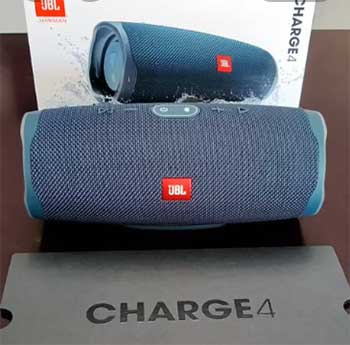
- Massive Battery Life and Reliability: The endurance king of its class: The headline feature of the Charge 4 is its 7500mAh battery, which JBL claims offers 20 hours of playtime.6 In real-world usage, this holds up remarkably well. Even at moderate-to-high volumes, you can easily get through a full weekend of camping or a long all-day beach party without reaching for a cable. This reliability changes how you use the device; you stop constantly checking the battery indicator. For users who hate the “low battery” anxiety or who often forget to charge their devices, the Charge 4 offers a buffer that smaller speakers simply cannot match. It is a set-it-and-forget-it device.
- Built-In Power Bank Functionality: Dual-purpose utility for travelers: The USB-A output port on the back allows the speaker to share its massive battery reserves with your other devices.7 This turns the speaker into a portable charger. If you are at the beach and your phone is dying from searching for a signal, the Charge 4 can top it up. This eliminates the need to carry a separate portable battery bank, saving weight and space in your bag. It is an incredibly practical feature for outdoor enthusiasts who rely on their phones for maps or emergency calls. You are essentially carrying a backup power source that also happens to play loud music.
- Deep, Powerful Bass Response: Physicality you can feel: Due to its larger physical volume and bigger passive radiators on the ends, the Charge 4 pushes more air than the Flip 6. This results in a deeper, more resonant bass extension. When you play bass-heavy genres like EDM, hip-hop, or reggae, the Charge 4 provides a satisfying “thump” that can fill a larger room or an open outdoor space more effectively. It has a presence that smaller speakers lack. The sound feels “bigger” and warmer, which many people prefer for outdoor parties where fine detail gets lost in the wind but the beat needs to be felt.
- Legacy Connect+ Support: Great for those with older collections: If you or your friends already own older JBL speakers like the Charge 3, Flip 4, or Boombox 1, the Charge 4 is compatible with them via the “Connect+” protocol.8 You can link up to 100 of these older speakers together. For people who have invested in the previous generation of JBL gear, the Charge 4 is the bridge that keeps that ecosystem alive. It allows you to add a powerful new speaker to your existing setup without rendering your old speakers obsolete (which the PartyBoost-only Flip 6 would do).
- Auxiliary Input Option: The lost art of the wired connection: The Charge 4 retains a 3.5mm auxiliary input jack, a feature that has been aggressively removed from newer models like the Flip 6.9 This is a massive pro for users who want to connect non-Bluetooth devices like older MP3 players, portable projectors, or even a laptop for lag-free audio. It also allows for higher quality audio transmission than Bluetooth if you are using high-res files. Having the option to go wired is a flexibility that is becoming increasingly rare and valuable.
Cons Of JBL Charge 4
- Outdated Charging Speed and Port Tech: Slow to refill the tank: While the Charge 4 uses USB-C, it does not support modern fast-charging speeds. Refilling that massive 7500mAh battery can take upwards of 4 to 5 hours. If you forget to charge it before a trip, you can’t just plug it in for 20 minutes and get a meaningful amount of playtime. Additionally, because it is an older model, the Bluetooth 4.2 standard is less energy-efficient and has shorter range than the 5.1 found in the Flip 6, leading to occasional dropouts if you wander too far with your phone.
- Mono Sound and “Muddier” Highs: A step back in clarity: The Charge 4 uses a single driver to handle both left and right audio channels (mono output) and all frequency ranges.11 Compared to the Flip 6’s dedicated tweeter, the Charge 4 can sound a bit “veiled” or muffled in the high end. The vocals don’t pop as much, and instruments can blur together during complex tracks. If you are listening critically in a quiet room, the lack of stereo separation (unless you pair two) and the roll-off in the treble frequencies is noticeable. It prioritizes power and bass over fidelity.
- Incompatibility with Newer JBL Speakers: Stranded on an old island: The biggest frustration for JBL users is the “Connect+” vs. “PartyBoost” divide. The Charge 4 uses Connect+.12 It cannot pair with the Flip 6, Charge 5, or Xtreme 3. If you buy a Charge 4 today, you cannot link it with your friend’s new JBL speaker. You are locked into the older ecosystem. As time goes on, fewer and fewer people will have compatible speakers to link with, making the “party chain” feature less useful.
Also Read: Differences Between Jbl Charge 5 And Jbl Xtreme 3
Maintenance Tips
- Rinse After Saltwater or Pool Exposure: Corrosion is silent but deadly: Both speakers are waterproof, but salt and chlorine are corrosive. If you take your Flip 6 or Charge 4 into the ocean or a chlorinated pool, do not just let it dry in the sun. The salt can crystallize in the mesh and corrode the charging port contacts. Rinse the speaker thoroughly with fresh tap water immediately after use. Shake it out gently to remove excess water and let it air dry completely before charging. This simple step will double the lifespan of your charging port.
- Care for the Passive Radiators: Don’t puncture the bass: The vibrating circles on the ends of both speakers are the passive bass radiators. They look cool, but they are the most vulnerable part of the device. Avoid throwing the speaker into a bag with sharp keys, pens, or loose tools. If you puncture the rubber surround of the radiator, the airtight seal is broken, and the speaker will sound like a blown-out rattle. When packing the Charge 4 (which is heavier), ensure the ends aren’t being pressed against hard objects that could deform the rubber over time.
- Battery Health Management: Avoid the 0% and 100% extremes: Lithium-ion batteries degrade if left fully discharged or fully charged for long periods. If you are storing the Charge 4 for the winter season, do not leave it at 0% battery, as it might fall into a deep discharge state and never wake up. conversely, keeping it plugged in at 100% 24/7 can swell the battery. Store them at around 50-60% charge in a cool room. This is especially important for the Charge 4, as replacing the battery in these sealed waterproof units is difficult and compromises the waterproofing.
- Clean the Fabric Mesh: Unclog the sound: Over time, the fabric mesh on both speakers can trap dust, sand, and lint, which can subtly muffle the sound. Use a soft-bristled toothbrush or a vacuum with a brush attachment to gently clean the weave of the fabric. For the Flip 6, which is dustproof, you can even run it under the tap while brushing. For the Charge 4, be a bit more careful with water pressure. Keeping the mesh breathable ensures the high frequencies can escape clearly.
Comparison with other brands
- Ultimate Ears (UE) Wonderboom 3: The 360-degree rival: The UE Wonderboom 3 is often cross-shopped with the Flip 6. It offers true 360-degree sound, meaning it sounds the same from every angle, whereas the Flip 6 is directional. The Wonderboom is also floatable (it doesn’t sink!), which makes it better for boaters or kayakers. However, the Flip 6 generally has better instrument separation and clearer vocals.13 The Wonderboom is more rugged and “fun,” but the Flip 6 sounds more “hi-fi.”
- Sony SRS-XB23: The budget bass option: Sony’s competitor to the Flip series brings the “Extra Bass” branding. It is a taller, slimmer cylinder that fits in cup holders easily. The Sony app offers more EQ customization than JBL’s, and it supports a “Stamina Mode” to extend battery life significantly. However, many users find the Sony sound signature to be a bit hollow or processed compared to the warm, punchy JBL sound. The Flip 6 gets louder and stays clearer at max volume than the XB23.
- Anker Soundcore Motion+: The audiophile budget king: If you don’t care about the brand name, the Soundcore Motion+ is often cited as having better sound than both the Flip 6 and Charge 4. It supports aptX (high-quality Bluetooth codec) and has a wider frequency response. It is larger and uglier—looking like a wedge—but for pure sound-per-dollar, it wins. However, it lacks the extreme durability and rugged “tossability” of the JBLs. It feels more like indoor gear than outdoor gear.
- Bose SoundLink Flex: The premium alternative: The Bose SoundLink Flex competes directly with the Flip 6.14 It has a surprising amount of bass and a very sophisticated, smooth sound signature that Bose is known for. It also has a built-in microphone for calls, which the Flip 6 lacks. However, it is more expensive and has a silicone body that attracts dust like a magnet. The Flip 6 feels more rugged for dirtier adventures, while the Bose is better for a clean picnic or office use.
Frequently Asked Questions (FAQ)
If you value sound clarity and portability, the Flip 6 is better due to its separate tweeter.15 If you value battery life and bass, the Charge 4 is superior.
No, they cannot connect wirelessly. The Flip 6 uses PartyBoost, while the Charge 4 uses the older Connect+ system.16 They are incompatible technologies.
Yes, if you can find it at a discount. Its 20-hour battery and power bank feature are still top-tier, even if the sound is slightly less detailed than newer models.
No, the Flip 6 cannot charge other devices.17 It only has a USB-C port for charging itself.18 You need the Charge series for the power bank feature.
Conclusion
After living with both speakers, the decision comes down to where you are going and how long you plan to stay there.
If you are a hiker, cyclist, or traveler who needs music that fits in a small space, you should buy the JBL Flip 6. The upgrade in sound quality is real—the separate tweeter brings a level of detail to vocals that the Charge 4 simply cannot match. It is light, dustproof, and loud enough for any small group. It feels like the modern choice for the active person.
However, if you are a camper, beach-goer, or student looking for a dorm speaker, the JBL Charge 4 is the workhorse you need. The ability to charge your phone is a feature you will use more than you think, and the 20-hour battery life eliminates the stress of constantly finding an outlet. It may not sound quite as crisp as the Flip 6, but it hits harder in the bass and lasts longer in the night.
For me, the Flip 6 stays in my backpack for daily adventures, but the Charge 4 is the first thing I pack for a weekend away.