
If you own outdoor power equipment, you have likely heard the horror stories about modern gasoline. The 10% ethanol (E10) at the pump is a silent killer for small carburetors. It attracts water, corrodes plastic, and dries out rubber gaskets.1
To fight this, you have two champions: the old-school defender, STA-BIL, and the modern specialist, Ethanol Shield. While they both claim to “keep fuel fresh,” they function very differently chemically. One is designed to lock fuel in a time capsule; the other is designed to chemically manage the water and alcohol that destroys your engine. Below, I break down which one belongs in your gas can.
A Brief Comparison Table
| Feature | Ethanol Shield (B3C) | STA-BIL (Storage / Red) |
| Primary Philosophy | Conditioner (Manages water & rubber protection) | Stabilizer (Prevents oxidation & varnish) |
| Action on Water | “Bonds” water to fuel to burn it off (Phase Prevention) | Demulsifies/Suspends water (prevention mostly) |
| Rubber Protection | Contains rubber/plastic conditioners | Protects via corrosion inhibition |
| Best Use Case | Daily use in 2-cycle equipment (Chainsaws, trimmers) | Long-term winter storage (Mowers, boats, RVs) |
| Storage Time | Up to 12 months | Up to 24 months |
| Dosage (Standard) | 1 oz per 2.5 gallons (Maintenance) | 1 oz per 2.5 gallons (Storage) |
| Fuel Type | Optimized for Ethanol Blends (E10, E15, E85) | Works on all, but king of Non-Ethanol/Standard Gas |
My Experience With Ethanol Shield
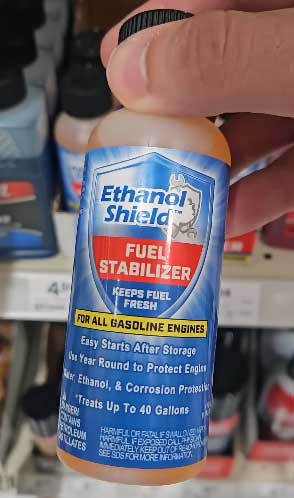
I started using Ethanol Shield after a local small engine mechanic scolded me.
I had brought in a Stihl weed eater with “stiff” fuel lines that cracked when you touched them.
He told me, “STA-BIL keeps the gas fresh, but Ethanol Shield protects the rubber.”
To test this, I switched to Ethanol Shield for my 2-cycle mix cans (chainsaw and blower) for a full season.
The most immediate difference is the visual. Ethanol Shield is a clear/bluish liquid, unlike the red STA-BIL.
The “bonding” technology they market is fascinating: instead of letting water drop to the bottom of the tank (phase separation),
Ethanol Shield claims to envelope water molecules so they pass through the engine and burn off without killing the combustion.
After a year of use, I pulled the fuel line on my blower. Usually, after a season of E10 gas, the yellow Tygon tubing gets brittle or milky. This time, it was still flexible and clear. It seems to act almost like a “moisturizer” for the internal rubber components. However, I did find that for pure storage—like leaving a generator untouched for 18 months—it didn’t seem to hold the “fresh gas smell” quite as strongly as the heavy dose of STA-BIL.
Read more: Comparison Of Free All And Kroil
Pros Of Ethanol Shield
- Rubber & Plastic Conditioning: This is its superpower. Ethanol dries out rubber gaskets, O-rings, and fuel lines, leading to leaks. Ethanol Shield contains conditioners that keep these soft parts pliable. If you have expensive handheld equipment (blowers, trimmers), this extends the life of the fuel system significantly.
- Water Management (Phase Separation): It is chemically designed to prevent the ethanol and gas from separating. By keeping the water suspended and bonded to the fuel, it prevents that deadly layer of “watery alcohol” from sinking to the bottom of the tank where the fuel pickup is.
- Vapor Lock Prevention: I noticed my backpack leaf blower started easier on hot days. Ethanol Shield claims to reduce the vapor pressure of the fuel, which prevents the gas from boiling in the carburetor on hot days—a common issue with modern ethanol blends.
- Safe for 2-Cycle Mix: It mixes perfectly with 2-stroke oil. In fact, B3C (the manufacturer) sells it as part of a “Mechanic in a Bottle” ecosystem that is highly trusted by dealership mechanics.
- Concentrated Options: You can buy small “shot” bottles that are perfect for 1-gallon cans, eliminating the need to measure or guess.
Cons Of Ethanol Shield
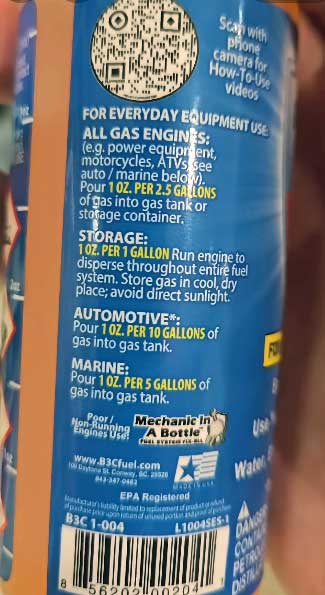
- Shorter Storage Life: While it stabilizes fuel, it is generally rated for 1 year of storage, whereas STA-BIL Storage is rated for 2 years. It is more of a “daily driver” additive than a “deep sleep” preservative.
- Harder to Find: You can buy STA-BIL at literally any gas station or grocery store. Ethanol Shield is usually found at Home Depot, Lowes, or specialized mower shops. It’s not as ubiquitous.
- Confusing Dosage Instructions: The bottle lists different ratios for “daily use” vs “storage.” It can be easy to under-dose if you aren’t reading the fine print for long-term storage (which requires a double dose).
- Price: It tends to be slightly more expensive per treated gallon than the bulk jugs of STA-BIL, primarily because it offers the extra rubber protection features.
Maintenance Tips For Ethanol Shield
- Use Year-Round: Unlike STA-BIL which people often only use in winter, Ethanol Shield is designed to be used in every tank of gas, all summer long. This provides constant protection against the ethanol eating your fuel lines.2
- Double Dose for Winter: If you are putting your equipment away for the winter, the instructions usually recommend doubling the dosage (1 oz per gallon instead of per 2.5 gallons). Don’t skip this step.
- Shake the Can: Because it bonds water, it’s a good habit to give your gas can a vigorous shake before filling your equipment, ensuring the additive is evenly distributed.
- The “Test Swab”: B3C (the maker of Ethanol Shield) sells inexpensive test swabs that turn red if your gas has gone bad or has oxidized. It’s a great companion tool to see if your old gas is actually safe to use.
My Experience With STA-BIL (Red / Storage)
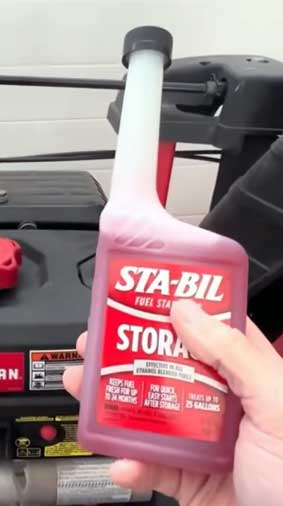
While Ethanol Shield is the modern specialist, STA-BIL (Red) is the old reliable.
I have used STA-BIL for over 15 years, primarily because it was the only option on the shelf for a long time.
But even now, with newer “ethanol-specific” competitors, I still reach for the red bottle for one specific purpose: long-term deep storage.
My experience with STA-BIL is defined by my generator. It sits for 11 months of the year, untouched.
I have always followed the ritual: fill the tank with fresh gas, add the recommended dose of STA-BIL, run it for 10 minutes, and shut it off.
Every single year, it starts. The gas smells like gas, not like turpentine.
However, I have noticed a difference in rubber components compared to Ethanol Shield. On an older riding mower where I used only STA-BIL for years, I eventually had to replace the fuel line because it cracked. STA-BIL kept the gas burnable, but it didn’t seem to actively moisturize the rubber hoses the way Ethanol Shield claims to.
Pros Of STA-BIL
- Longer Shelf Life (24 Months): This is the main reason to buy STA-BIL over Ethanol Shield. STA-BIL Storage is rated to keep fuel fresh for 2 years. Ethanol Shield is generally rated for 1 year. If you have a classic car that might sit for 18 months, or a generator you hope you don’t have to use for two years, STA-BIL is the stronger preservative.
- Corrosion Inhibition: STA-BIL forms a protective coating on metal surfaces inside the tank and carburetor. While it doesn’t “bond” water like Ethanol Shield, it is excellent at stopping the rust that water causes.
- The “Gold Standard” for Storage: There is a reason almost every engine manufacturer mentions STA-BIL by name. It is chemically stable and predictable. It effectively stops oxidation, which is the chemical process that turns gas into that sticky orange varnish.
- Cost & Availability: You can find a gallon of STA-BIL for a fraction of the price of Ethanol Shield per ounce. If you have a boat with a 50-gallon tank, treating it with Ethanol Shield gets expensive fast. STA-BIL is the budget-friendly choice for bulk fuel.
Read more: Comparison Of Kendall Oil And Mobil 1
Cons Of STA-BIL
- Does Not Remove Water: STA-BIL does not “remove” water. If you already have phase-separated fuel (water at the bottom), STA-BIL cannot fix it. It can only try to prevent corrosion from that water. Ethanol Shield attempts to emulsify that water so it can pass through the engine; STA-BIL just tries to keep the fuel stable around it.
- Less Rubber Protection: As noted in my experience, standard STA-BIL doesn’t have the heavy conditioners for plastic and rubber that Ethanol Shield boasts. In the era of cheap ethanol-sensitive fuel lines, this is a slight disadvantage.
- Red Stains: It’s a minor gripe, but the red dye in STA-BIL is potent. If you spill it on a white boat seat or your concrete floor, it stains immediately. Ethanol Shield is clear/blue and less messy.
Maintenance Tips For STA-BIL
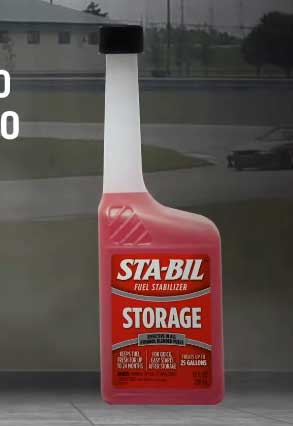
- Fresh Gas Only: I cannot stress this enough—STA-BIL stops aging, it doesn’t reverse it. You must add it to fresh gas the day you buy it. Adding it to 6-month-old gas is useless.
- Run the Carburetor Dry (Optional): Even with STA-BIL, for small carburetors (like weed eaters), I still prefer to dump the treated fuel back into the can and run the engine until it dies. STA-BIL is great, but a dry carburetor is 100% guaranteed not to gum up.
- Marine vs. Storage: If you are storing a boat or living in a very humid coastal area, skip the Red STA-BIL and buy the Blue STA-BIL (Marine). It has extra corrosion inhibitors specifically for damp environments, which brings it closer to Ethanol Shield’s performance in regards to water issues.
Comparison with other brands
- STA-BIL vs. Ethanol Shield: STA-BIL is a Stabilizer (stops chemical breakdown). Ethanol Shield is a Conditioner (manages water and rubber). Use STA-BIL for the generator you won’t touch for 2 years. Use Ethanol Shield for the weed eater you use every Saturday.
- STA-BIL vs. Sea Foam: Sea Foam is a cleaner/solvent. It is great for “waking up” a rough engine. STA-BIL is for putting an engine to sleep. They serve opposite purposes in the lifecycle of an engine.
- STA-BIL vs. Pri-G: Pri-G is an industrial fuel restorer. It claims it can restore old fuel. STA-BIL makes no such claim. If you have 50 gallons of questionable gas, try Pri-G. If you have fresh gas, stick to STA-BIL.
Frequently Asked Questions (FAQ)
Yes. There is no chemical conflict between them. In fact, some “super-users” do this to get the rubber protection of Ethanol Shield and the 2-year longevity of STA-BIL. However, for most people, it is overkill. Pick one and stick to it.
Ethanol Shield. Two-stroke engines have tiny carburetors with delicate rubber diaphragms that are highly susceptible to ethanol damage. Ethanol Shield’s rubber conditioning properties make it superior for handheld equipment.
It doesn’t make water disappear, but it uses a chemical process to “bond” or emulsify the water into the fuel so it stays suspended. This allows the water to pass through the engine and burn off as steam, rather than settling at the bottom of the tank and causing rust. STA-BIL does not do this as aggressively.
STA-BIL. In terms of cost per treated gallon, STA-BIL is almost always cheaper and easier to find in bulk sizes.
Conclusion
The choice between Ethanol Shield and STA-BIL depends on whether you are fighting Ethanol or Time.
If you are treating gas for handheld 2-cycle equipment (blowers, trimmers, chainsaws) that you use frequently, buy Ethanol Shield. These engines are most vulnerable to the rubber-drying effects of ethanol, and they benefit most from the water-bonding technology. It acts as a daily “vitamin” to keep the fuel system flexible and clean.
If you are treating gas for bulk storage or heavy equipment (classic cars, boats, RVs, generators) that will sit idle for 6 months or more, buy STA-BIL (Red). It offers a longer stabilization period (24 months vs 12) and is more cost-effective for large tanks. It is the superior “preservative” for long winters.
My Personal Strategy: I use Ethanol Shield in my 1-gallon gas can for my weed eater and chainsaw to protect their tiny carburetors. I use STA-BIL in my 5-gallon jerry cans for my generator and lawn tractor to ensure the fuel stays fresh for the long haul.