
If you’re just starting out in astronomy, tired of blurry department-store telescopes, or ready for a first scope that actually shows you real details on the Moon, planets, and brighter deep-sky objects without costing a fortune, you should seriously consider the Celestron AstroMaster 114EQ right now. This classic 114 mm Newtonian reflector delivers sharp, bright views, easy setup, and solid performance for beginners—once you point it at Saturn’s rings or the Orion Nebula and see them clearly, you’ll be hooked on stargazing for life.
My Experience With Celestron AstroMaster 114EQ
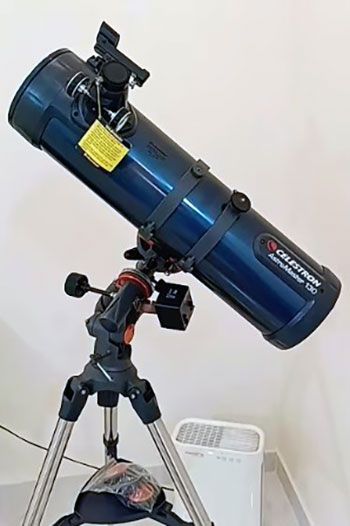
I bought the Celestron AstroMaster 114EQ about two years ago when I decided to get serious about astronomy after years of casual naked-eye stargazing.
I wanted something affordable but capable of showing more than just fuzzy dots—something I could use from my balcony in Dhaka without needing a PhD to operate.
The box arrived heavy and well-packed. Assembly took about 30 minutes: attach the tripod legs, mount the equatorial head, slide the optical tube in, add the finder scope, and insert the eyepieces.
The instructions were clear, though the tripod felt a bit wobbly at first until I tightened everything properly.
The first night out was a revelation. I pointed it at the nearly full Moon and was stunned—craters, mountain ranges, and the dark maria looked sharp and three-dimensional through the 10 mm eyepiece. No chromatic aberration like cheaper refractors; just crisp, high-contrast detail. I could easily see the Straight Wall and the Alpine Valley. Switching to the 20 mm eyepiece gave a wider view that felt immersive.
Jupiter came next. Even with the stock 10 mm eyepiece (115×), I could clearly see the two main equatorial cloud bands, the Great Red Spot (on good nights), and all four Galilean moons as tiny bright dots. Saturn was even more impressive—the rings were sharp and separated from the planet, with the Cassini Division visible on steady nights. I could see the shadow of the rings on the planet’s disk and Titan as a bright point nearby.
For deep-sky objects, the 114 mm aperture gathers enough light to show real detail. The Orion Nebula (M42) looked like a glowing cloud with hints of the Trapezium stars resolved inside. The Andromeda Galaxy (M31) appeared as a large, elongated smudge with a brighter core—my first time seeing something beyond the solar system. Star clusters like the Pleiades filled the field with sparkling points, and open clusters like M44 (Beehive) looked rich and detailed.
The equatorial mount took some getting used to. Polar alignment is basic (point the polar axis north and tilt to your latitude), but once set, tracking was smooth with gentle nudges on the slow-motion cables. The red-dot finder is simple but effective—align it during the day on a distant object and nighttime finding becomes quick. The tripod is sturdy enough for visual use but wobbles slightly in wind; I eventually added a small weight bag to the center hook for stability.
Over two years and hundreds of nights, the scope has been reliable. No collimation issues yet (the mirror cell is stable), the focuser is smooth, and the optics still look sharp. I’ve taken it camping, used it from balconies, and shared views with friends and family—everyone is amazed at how much you can see with a modest aperture. The only real frustrations are the mount’s occasional vibrations when touched and the fact that it’s not ideal for deep-sky astrophotography (short exposures are possible with a smartphone adapter, but tracking isn’t precise enough for long shots).
Analytically, the AstroMaster 114EQ isn’t perfect—it’s a beginner scope with some compromises—but it punches well above its price. The 114 mm aperture gathers about 2.5 times more light than a 70 mm refractor, giving brighter, more detailed views of planets and deep-sky objects. The spherical mirror has minor edge distortion at high magnifications, but it’s negligible at typical powers (50–150×). For anyone starting out or wanting a portable, no-fuss reflector, it delivers real astronomy without overwhelming complexity or cost.
Read More: My Experience with Celestron Astromaster 130 Telescope Review
Pros Of Celestron AstroMaster 114EQ
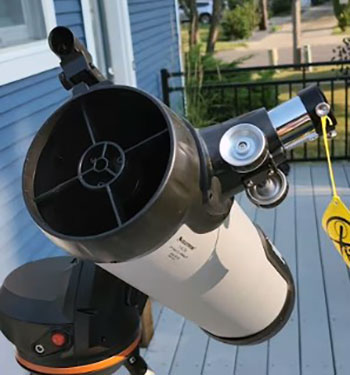
- Excellent Light-Gathering Power For The Price: The 114 mm parabolic primary mirror collects significantly more light than smaller refractors or reflectors in the same price range—delivers brighter, more detailed views of the Moon, planets, star clusters, and brighter nebulae/galaxies. You can see real structure in M42 (Orion Nebula), resolve the Trapezium, and spot cloud bands on Jupiter clearly.
- Sharp, High-Contrast Planetary Views: The optics provide crisp images of Saturn’s rings (including Cassini Division on steady nights), Jupiter’s cloud bands and moons, and lunar craters/mountains with excellent definition. Minimal chromatic aberration compared to cheap refractors—colors stay natural and focused.
- Very Affordable Entry Into Reflector Astronomy: At its price point, you get a true parabolic mirror, equatorial mount with slow-motion controls, and two decent eyepieces (10 mm and 20 mm)—far better performance than department-store “department store” telescopes that promise high magnification but deliver blurry views.
- Easy To Set Up And Use For Beginners: Assembly takes 30–45 minutes with clear instructions. The red-dot finder aligns quickly, the mount moves smoothly, and the equatorial design helps track objects with gentle nudges—beginners can be observing within an hour of opening the box.
- Portable Enough For Quick Sessions: The optical tube detaches easily from the mount, and the whole setup breaks down into manageable pieces—fits in a car trunk or large backpack for trips to darker sites outside the city.
- Good Range Of Magnifications Out Of The Box: The included 10 mm (115×) and 20 mm (57.5×) eyepieces give useful powers for planets and deep-sky objects. The focuser accepts standard 1.25″ eyepieces, so upgrading later is easy.
- Stable Views With Proper Setup: Once the tripod legs are tightened and balanced, vibrations dampen quickly—steady enough for high-magnification lunar and planetary observing on calm nights.
Cons Of Celestron AstroMaster 114EQ
- Spherical Aberration At High Magnifications: The primary mirror is spherical rather than perfectly parabolic—causes slight edge distortion and softness at the highest powers (above ~150×). Fine for typical use but noticeable when pushing magnification on planets or double stars.
- Tripod And Mount Feel A Bit Wobbly: The aluminum tripod is lightweight and can vibrate when touched or in wind—requires careful tightening and sometimes a weight bag on the accessory tray for stability during high-power viewing.
- Red-Dot Finder Is Basic: The included finder is functional but not as precise or bright as aftermarket options—aligning on faint objects can take extra time, especially for beginners.
- Limited Accessories Included: Comes with only two eyepieces (no Barlow) and a basic red-dot finder—most users upgrade to better eyepieces (e.g., 6–8 mm for planets) and a better finder within the first few months.
- Not Ideal For Serious Astrophotography: Short exposures with a smartphone adapter are possible, but the equatorial mount lacks precise tracking—images of deep-sky objects are limited to basic snapshots.
- Collimation Can Drift Over Time: Like most reflectors, the mirror alignment may need occasional adjustment (especially after transport)—requires a collimation cap or laser tool, which isn’t included.
Maintenance Tips For Celestron AstroMaster 114EQ
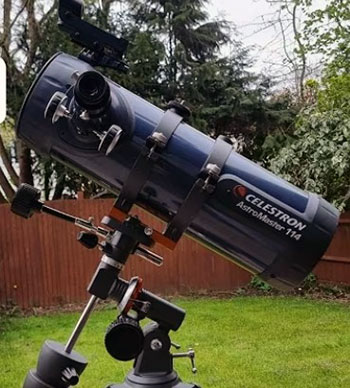
- Collimation Check Every 3–6 Months: Use a collimation cap (or cheap laser collimator) to ensure the mirrors are aligned—slightly misaligned optics cause blurry or distorted views. Takes 5–10 minutes once you learn the process.
- Clean The Primary Mirror Carefully Once A Year: If dust buildup affects contrast, remove the mirror cell (easy screws), rinse gently with distilled water and a drop of dish soap, then rinse and air dry—no wiping needed. Avoid touching the surface.
- Keep Dust Cover On When Not In Use: Always cover the tube opening and eyepiece port after observing—prevents dust settling on mirrors and inside the tube.
- Tighten Tripod Screws And Mount Bolts Regularly: Check and tighten all screws and wingnuts every few months—prevents wobble and ensures smooth slow-motion control.
- Store In A Dry, Cool Place: Keep the telescope indoors in a closet or garage—avoid damp basements or hot attics to prevent mirror fogging or tube warping.
- Clean Eyepieces And Finder Lens Gently: Use a lens brush or blower to remove dust, then microfiber cloth with lens cleaner if needed—never wipe dry or use paper towels.
- Protect The Tube During Transport: Use the original box or a padded bag—prevents bumps that can knock mirrors out of alignment.
- Avoid Dew By Bringing Inside Or Using Dew Shield: In humid climates, dew can fog mirrors—bring the scope inside after use or add a simple dew shield to slow condensation.
Comparison With Other Brands
Versus Celestron PowerSeeker 127EQ: The PowerSeeker 127EQ has a larger 127 mm aperture for brighter views but uses a spherical mirror with more aberration and a weaker mount. The AstroMaster 114EQ has better optics (parabolic mirror), sturdier equatorial mount, and higher-quality accessories—superior performance for the price despite smaller aperture.
Versus Orion StarBlast 4.5: Orion StarBlast 4.5 is a tabletop Dobsonian with similar aperture and great views. The AstroMaster 114EQ offers equatorial tracking (easier to follow objects) and portability but less aperture. StarBlast wins for simplicity and raw light-gathering; AstroMaster is better for learning tracking and planetary detail.
Versus Sky-Watcher Heritage 130P: Sky-Watcher Heritage 130P is a tabletop Dob with more aperture and brighter images. The AstroMaster 114EQ has equatorial mount for easier following and better accessories—better for beginners learning to track; Heritage wins for pure light-gathering and simplicity.
Versus Meade Infinity 102 Refractor: Meade Infinity 102 is a refractor with no collimation needed and sharp views. The AstroMaster 114EQ gathers more light (114 mm vs 102 mm) and shows more detail on deep-sky objects—reflector wins for value and aperture; refractor is better for planets and no maintenance.
Versus Celestron AstroMaster 130EQ: The 130EQ has more aperture for brighter images but a weaker mount and spherical mirror. The 114EQ offers better optics (parabolic), sturdier mount, and higher-quality accessories—114EQ is the better overall beginner reflector despite smaller aperture.
Also Read: My thoughts on Telescope Patio Furniture Review
Frequently Asked Questions (FAQ)
Yes—very good for beginners. It delivers sharp, bright views of the Moon, planets, and brighter deep-sky objects with solid optics and an equatorial mount—excellent first telescope for learning the sky.
You can see detailed craters and mountains on the Moon, Jupiter’s cloud bands and moons, Saturn’s rings (including Cassini Division on good nights), bright star clusters (Pleiades, Beehive), Orion Nebula with structure, Andromeda Galaxy core, and many double stars.
The AstroMaster 114EQ strikes the best balance—good aperture, parabolic mirror, equatorial mount, and quality accessories. The 130EQ has more light but weaker mount/optics; smaller refractors are easier but dimmer.
Yes—the AstroMaster series (especially 114EQ) is one of the best beginner reflectors available—affordable, capable, and easy to use for real astronomy without the frustration of toy telescopes.
Conclusion
After hundreds of nights under the stars, the Celestron AstroMaster 114EQ remains one of the best beginner telescopes you can buy. If you want sharp, bright views of the Moon, planets, and deep-sky objects without spending a fortune or dealing with poor optics, get one—you’ll see things you never thought possible from your own backyard. Your nights will never be the same once you start exploring the sky with real clarity and confidence.