
I’ve been grinding coffee at home for over eight years, and I recently upgraded from my old Baratza Encore to the new Encore ESP while also testing the popular DF54 side-by-side for several months. The main intent of this article is to share my honest, hands-on perspective on how these two grinders perform in real daily use—especially for people who want great espresso without spending a fortune, but also enjoy filter coffee. After hundreds of shots and countless pour-overs, here’s everything I’ve learned.
A Brief Comparison Table
| Feature | Baratza Encore ESP | DF54 |
|---|---|---|
| Price (approx. street) | $200–$230 | $220–$250 |
| Burr Size & Type | 40 mm steel conical | 54 mm flat steel |
| Espresso Range | Excellent (new 1–6 range dedicated to espresso) | Very good |
| Single-Dosing Friendly | Decent, but some retention (~2–3 g) | Excellent (low retention ~0.2–0.5 g) |
| Grind Adjustment Steps | 40 total (30 macro + 10 micro) | Stepless |
| Grind Speed | Moderate (~1.5–2 g/s) | Faster (~2.5–3 g/s) |
| Build Quality | Very solid, made in USA | Solid, made in China |
| Noise Level | Moderate | Noticeably quieter |
| Weight | 3.2 kg (7 lbs) | 4.9 kg (10.8 lbs) |
| Warranty | 1 year (extendable) | 1 year |
| Best For | Versatile home use, pour-over + espresso | Espresso-focused users who single-dose |
My Experience With Baratza Encore ESP
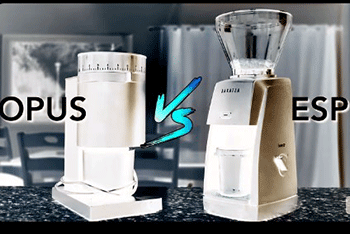
I bought the Encore ESP the week it launched because I wanted a reliable machine that could finally handle decent espresso without forcing me to buy a separate grinder.
The old Encore was fantastic for drip and pour-over, but espresso was always a compromise—too coarse even at the finest setting.
The ESP changed that completely. Baratza added a dedicated fine-tune ring (positions 1–6) specifically for espresso, and they completely redesigned the lower burr carrier to allow much finer grinds.
I can now pull 18 g in, 36 g out shots in 28–32 seconds with a medium roast, and the extraction tastes clean and sweet. For pour-over I still use the original 40-step macro dial and it behaves exactly like my old Encore—consistent, fluffy grinds that bloom beautifully.
The grinder feels exactly as sturdy as the classic Encore. The hopper still holds 250 g, the dosing cup is the same, and the switch still has that satisfying click. I appreciate that Baratza kept the repairable, modular design. I’ve already replaced the burrs once (after about 8 kg of coffee) and it took me less than ten minutes.
Where I notice the biggest difference compared to the DF54 is versatility. With the ESP I switch between V60 in the morning and espresso in the afternoon without touching any tools. The DF54, on the other hand, feels more locked into espresso territory for me.
Pros Of Baratza Encore ESP
- Fantastic espresso performance for the price: The new fine-tune range delivers repeatable shots with good body and clarity that rival grinders costing twice as much.
- Outstanding versatility: Handles everything from French press to espresso with ease thanks to the dual-range adjustment system.
- Built like a tank and repairable: Made in the USA with a long history of parts availability; I’ve seen Encore models still running after 10+ years.
- Consistent grind quality: The 40 mm steel conical burrs produce uniform particles that shine in both immersion and percolation brewing.
- Reasonable retention for daily use: About 2–3 g of retention is fine if you’re not single-dosing multiple times a day.
- Simple macro + micro adjustment: 30 coarse steps plus 10 micro steps give you enough precision without being overwhelming.
- Quiet enough for early mornings: Not silent, but noticeably quieter than my old Encore due to better motor mounting.
- Great customer support: Baratza’s US-based team has helped me troubleshoot minor issues over the phone in under five minutes.
- Compact footprint: Fits neatly under most kitchen cabinets (13.8” height with hopper).
- Long burr life: I’ve ground roughly 8–10 kg before noticing any drop in performance—impressive for steel burrs.
Cons Of Baratza Encore ESP
- Retention can frustrate single-dosers: 2–3 g of stale grounds remain after grinding; I always run a few grams of the next bean through to purge.
- Not stepless: While the micro steps are very fine, some espresso obsessives still prefer infinite adjustment.
- Grind speed is only average: Takes about 20 seconds for a double shot—slower than larger flat-burr machines.
- Plastic components: The hopper, lid, and dosing cup are plastic; they work well but don’t feel as premium as metal alternatives.
- No bellows included: Unlike some competitors, you have to buy the optional bellows separately if you want to reduce retention.
- Still a bit noisy: Fine for most homes, but you’ll hear it in a very quiet apartment at 6 a.m.
- Espresso range is still limited compared to dedicated machines: It can’t quite reach the super-fine settings needed for some very light roasts.
- Weight distribution: The motor is heavy so the grinder can feel a little front-heavy when you move it.
My Experience With DF54
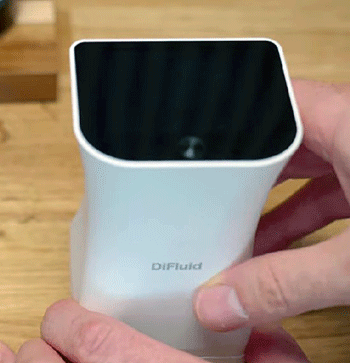
The DF54 entered my kitchen because a friend swore it was the best budget espresso grinder he’d ever owned.
I was skeptical—another Chinese flat-burr grinder with big marketing claims—but after three months of daily use I understand the hype.
The 54 mm flat burrs produce noticeably sharper, more uniform espresso grinds than the Encore ESP’s conical burrs.
My shots have cleaner separation of sweetness and acidity, and I can taste more detail in the cup.
The stepless dial is a dream; I can nudge the grind by tiny fractions and see the shot time change by 1–2 seconds.
Single-dosing is where the DF54 shines. Retention is practically nonexistent—maybe 0.3 g after a thorough purge. I can grind 18 g of one bean, then switch to another without worrying about flavor mixing.
The build quality surprised me. The aluminum body feels solid, the dial has a nice clicky feel, and the anti-popcorn device actually works. It’s heavier than the Encore ESP, which adds stability during grinding.
For filter coffee, though, I find the DF54 less forgiving. The flat burrs create a narrower particle distribution, which can lead to faster extractions and more bitterness in V60 if you’re not dialed in perfectly.
Also read: Comparison of LiftMaster 98022 And 8500W
Pros Of DF54
- Exceptional espresso clarity: The 54 mm flat burrs produce sharp, uniform particles that extract beautifully balanced shots.
- Extremely low retention: Usually under 0.5 g, making single-dosing effortless and flavor-safe.
- Stepless adjustment: Infinite control lets you hit exact shot times without compromise.
- Faster grind speed: Grinds 18 g in about 7–8 seconds—much quicker than the Encore ESP.
- Very quiet operation: One of the quietest 54 mm grinders I’ve heard; perfect for early mornings.
- Solid, heavy build: 4.9 kg aluminum body stays planted on the counter even at high RPM.
- Effective anti-popcorn device: Almost no beans get stuck or jump around.
- Magnetic catch cup: Holds firmly and aligns perfectly every time.
- Good value for flat-burr performance: Hard to find 54 mm flats at this price point.
- Easy to mod: Popular bellows, portaholder alignment tools, and other upgrades are readily available.
Cons Of DF54
- Not ideal for filter coffee: Narrow particle distribution can make pour-over taste flat or bitter if not dialed perfectly.
- Larger footprint and height: At 14.6” tall and heavier, it takes up more counter space than the Encore ESP.
- Made in China quality control: Some units have had alignment issues or burr rub reported (though most are fine).
- No macro/micro separation: Stepless is great for espresso but can feel finicky when switching to coarse grinds.
- No official US warranty support network: Repairs depend on the seller; Baratza’s ecosystem is stronger.
- Static buildup: Some users report more static than conical grinders (mitigated with RDT).
- Burr seasoning takes longer: Flat burrs need 5–10 kg to fully open up compared to conicals.
- Noisier at coarse settings: Still quiet overall, but coarse grinds for French press create more vibration noise.
Maintenance Tips For Baratza Encore ESP
- Clean the burr chamber monthly: Remove the upper burr carrier (one screw) and brush out chaff with a dry brush.
- Run water through the grinder: Every 3–4 kg, grind a tablespoon of rice or Grindz cleaner to remove coffee oils.
- Replace burrs at 10–15 kg: Steel burrs start to taste flat around this point; replacement sets are affordable.
- Vacuum the motor area: Every six months, remove the bottom plate and vacuum dust from the motor vents.
- Lubricate the adjustment ring: A drop of food-grade lubricant on the threads every 6 months keeps it smooth.
- Store beans in the hopper only short-term: Long-term storage causes stale grinds to build up in the chute.
- Use RDT for espresso: A quick spritz of water reduces static and retention when single-dosing.
Maintenance Tips For DF54
- Wipe the chute daily: A quick brush after each use prevents oil buildup in the low-retention path.
- Season burrs properly: Grind 5–10 kg of cheap beans before dialing in for espresso to remove manufacturing residue.
- Clean bellows regularly: If you add bellows, disassemble and wash them every month to prevent mold.
- Check burr alignment every 3 months: Flat burrs are sensitive; a slight misalignment ruins shot consistency.
- Use a vacuum cleaner: Attach a shop vac to the chute monthly to remove trapped fines.
- Avoid over-tightening dial: The stepless mechanism is delicate; never force it past the chirp point.
Read more: Comparison of Midea And hOmeLabs Dehumidifier
Comparison With Other Brands
- Baratza Sette 270: Much faster and lower retention, but louder, messier, and less repairable than the ESP.
- Fellow Opus: Similar price, more modern design, but coarser espresso range and higher retention than both the ESP and DF54.
- Eureka Mignon Silenzio: Better espresso than the ESP, quieter than the DF54, but twice the price and larger.
- Timemore Sculptor 064: Excellent flat-burr espresso, stepless, but costs almost double the DF54.
- 1Zpresso J-Ultra: Hand grinder that beats both for filter coffee, but too slow for daily espresso use.
- Lagom Mini 2: Super low retention and great espresso, but much more expensive and smaller burrs.
- Niche Zero: The gold standard for flavor, but three times the price and long wait times.
Frequently Asked Questions (FAQ)
The ESP adds a dedicated fine-tune ring for espresso and a redesigned burr carrier, making it capable of true espresso grinds while retaining the classic Encore’s filter performance.
It offers the best balance of price, repairability, and versatility; only the Eureka Mignon series beats it for espresso at a higher cost.
Yes, but flat burrs produce a narrower distribution that can make French press taste muddier or more bitter compared to conical burrs.
Moderately loud—quieter than the original Encore but not as silent as the DF54 or Eureka models.
Excellent. It retains the same grind quality and adjustment range as the classic Encore, delivering fluffy, consistent grounds perfect for V60 and Kalita.
Neither is inherently better; pump pressure matters less than proper grind size, dose, and tamp. Most home machines regulate to ~9 bars at the puck anyway.
Conclusion: For Both Products
After months of switching between these two grinders, I’ve settled on a clear preference depending on your priorities.
If you want one grinder that handles everything—morning pour-over, afternoon espresso, occasional French press—without any hassle, the Baratza Encore ESP is the smarter choice. Its versatility, rock-solid build, and excellent support make it a worry-free daily driver.
If espresso is 80–90% of what you drink and you single-dose different beans every day, the DF54 edges ahead. The sharper flat-burr flavor, near-zero retention, and faster workflow make it feel more specialized and rewarding for espresso lovers.
Both are fantastic machines at their price points. I’m keeping the Encore ESP as my main grinder because I value the flexibility, but I still borrow the DF54 from my friend whenever I want to chase that extra bit of shot clarity.