
There is no sinking feeling quite like turning your car key and hearing that dreaded, hollow click. A dead battery is the universal equalizer of drivers; it does not care if you drive a beat-up sedan or a brand-new SUV. For years, the solution was waiting for a stranger with jumper cables or paying a premium for a tow truck. But the rise of lithium-ion technology has given us a third option: the portable jump starter. You have likely seen the AVAPOW Jump Starter popping up on Amazon or in auto blogs, often priced significantly lower than the big-name brands. It promises massive power in a package the size of a paperback book. But when you are stranded in a freezing parking lot at midnight, “affordable” means nothing if it doesn’t work.
In this comprehensive review, I am going to put the AVAPOW Jump Starter under the microscope. I will break down its real-world performance, the quality of its build, and whether those impressive spec sheets actually translate to starting a frozen engine. Whether you are a daily commuter, a road-tripper, or just someone who wants peace of mind in the glovebox, this guide will help you decide if AVAPOW is the reliable savior you need or just another piece of plastic e-waste.
My Experience With AVAPOW Jump Starter
I decided to purchase the AVAPOW A28 model (one of their most popular units) after my trusty, heavy lead-acid jump box finally died. I live in an area where winters can get brutal, and my older truck, a V8 pickup, is notorious for draining batteries if it sits for more than a few days. The promise of 2000A+ peak current for under a hundred bucks seemed too good to pass up, especially when compared to the $150+ price tags of competitors like NOCO.
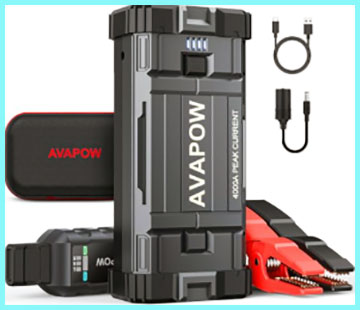
When the package arrived, my first impression was mixed.
The carrying case is a hard-shell, zippered box that feels reasonably sturdy, which is a nice touch.
Inside, the unit itself felt dense but surprisingly small.
It is compact enough to fit in my center console, a huge upgrade from the cinder-block-sized unit I used to lug around.
The plastic casing, while not feeling as “military-grade” as some premium tools, seemed durable enough to survive a drop on the asphalt.
The real test came about three weeks later. I had left my interior dome light on overnight—a classic mistake. The next morning, it was about 25°F (-4°C), and my truck was completely dead. No dash lights, no radio, just silence. I grabbed the AVAPOW, which had been sitting in my unheated truck cab for weeks. I was worried the cold might have sapped its charge, as lithium batteries are known to struggle in freezing temps. To my relief, the indicator still showed 75% charge.
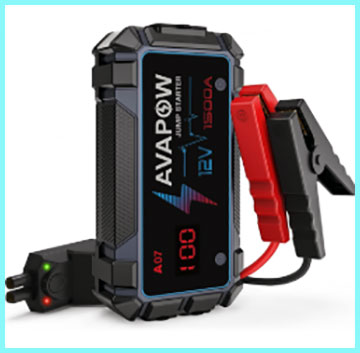
I plugged the jumper cables into the battery pack. The connector is keyed, so you literally cannot plug it in backward, which is a great safety feature for anyone who isn’t a mechanic. I clamped the red to positive and black to negative. The clamps themselves are decent; they have strong springs and copper teeth, though the plastic handles felt a little slippery in my gloved hands.
I pressed the power button, and the little LED on the cable box turned green. I hopped in the driver’s seat, said a little prayer, and turned the key. The truck didn’t just crank; it roared to life almost instantly. It felt like I had a brand-new battery installed. There was no hesitation, no slow “wub-wub-wub” sound—just immediate power. I was honestly shocked. I had expected it to struggle with the cold V8 engine, but it handled it with ease.
However, not everything was perfect. After that single jump, the battery indicator dropped from 75% to 50%. While that is plenty for a few more jumps, it suggests that the capacity might drain faster on larger engines than advertised. Also, the built-in flashlight, while bright, has a button that is easily pressed by accident in the bag. I found it turned on once when I opened the case, which could have drained the battery if I hadn’t noticed.
Overall, my experience was overwhelmingly positive where it counted: starting the car. It turned a potentially ruined morning into a minor two-minute inconvenience. It doesn’t have the fancy digital screens or rubberized armor of the top-tier brands, but for the raw purpose of getting you home, it proved its worth immediately.
Read More: My Thoughts On Gimfoom Jump Starter
Pros Of AVAPOW Jump Starter
When evaluating a tool that is meant to save you in an emergency, you need to look past the shiny marketing and focus on utility. The AVAPOW series has several standout features that make it a compelling choice for the average driver. Here is a detailed breakdown of the advantages I found.
- Incredible Power-to-Price Ratio: The most significant advantage of AVAPOW is simply how much raw power you get for your dollar. Most entry-level jump starters in the $50-$70 range struggle to hit 1000 amps, which is barely enough for a 4-cylinder sedan in winter. AVAPOW units frequently boast 2000A to 6000A ratings depending on the model (A18, A28, A68). While “Peak Amps” is often a marketing number, the real-world torque these units deliver is undeniable. You are getting the ability to start 8.0L gas engines or 6.5L diesel engines—massive powerplants—for the price of a tank of gas. This democratizes safety, allowing people on tight budgets to own a device that can start a heavy-duty work truck or an RV without spending hundreds of dollars on professional-grade gear.
- Intelligent Safety Cables (“Smart Clip”): One of the biggest fears people have about jump-starting a car is crossing the wires and causing sparks or blowing a fuse. AVAPOW includes an intelligent jumper cable module that takes the anxiety out of the process. This “Smart Clip” box has built-in protection against reverse polarity (hooking positive to negative), short circuits, over-current, and reverse charging. If you hook it up wrong, the unit will beep at you and a red light will flash; it simply won’t send power. This foolproof design makes it safe for teenage drivers, elderly parents, or anyone who doesn’t know their way around an engine bay. It protects both the user and the vehicle’s sensitive electronics from damage.
- Versatile “Force Start” Function: Sometimes a battery is so dead that it doesn’t even register as being connected. Many smart jump starters will refuse to activate if they detect less than 2 volts, leaving you stranded even though you have a jump starter. AVAPOW includes a “Boost” or “Force Start” button (usually a small recessed button on the cable box). This feature allows you to override the safety sensors and force current into the battery. This is a critical feature for reviving completely flat batteries that have been sitting for months. While you have to be careful using it (as safety protections are often disabled in this mode), having the option means the difference between driving home and calling a tow truck when your battery is at absolute zero.
- Multi-Functional Power Bank Features: It is rare that you need to jump a car every day, so having secondary uses for the brick is excellent. The AVAPOW doubles as a high-capacity portable charger with USB Quick Charge (QC 3.0) ports. You can use it to charge phones, tablets, or even run USB-powered devices like fans during a camping trip. Some models also include a 12V DC output (cigarette lighter adapter), which allows you to power tire inflators or car vacuums directly from the battery pack. This versatility means you can keep it in the car not just for dead batteries, but for emergency phone charging during a blackout or keeping the kids’ tablets running on a long road trip.
Cons Of AVAPOW Jump Starter
Despite the high praise for its power, the AVAPOW is a budget-friendly consumer product, and corners were cut to keep that price low. It is important to know these limitations so you are not disappointed or caught off guard during an emergency.
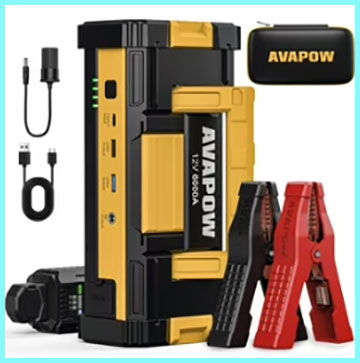
- Very Short Jumper Cables: This is the most common complaint across almost all user reviews, and I experienced it firsthand. The cables extending from the smart box to the clamps are incredibly short, often less than 10 inches long. If your car battery is buried deep in the engine bay, or if the positive and negative terminals are far apart (common on some European cars or large trucks), connecting the unit can be a struggle. You often have to balance the battery pack precariously on the engine block or air filter box because the cables won’t reach a stable surface. This lack of reach can make it difficult to get a solid connection on the terminals without the unit dangling or slipping off as the engine shakes during startup.
- Lack of Water and Dust Resistance (No IP Rating): Unlike competitors like NOCO, which feature rubberized ports and IP65 water resistance ratings, the AVAPOW is largely hard plastic with exposed ports. The USB ports and the jumper cable socket often have flimsy rubber covers or no covers at all depending on the model. This means the unit is not designed to be used in pouring rain or dropped in a puddle. If you are jump-starting a car in a storm—which is often when batteries fail—you have to be extremely careful to keep the unit dry. Dust and grime can also easily get into the charging ports if the unit is tossed into a dirty truck bed without its case, potentially leading to failure over time.
- Slow Recharging of the Unit Itself: While the unit can fast-charge your phone, charging the AVAPOW unit itself can be a test of patience. Most models charge via USB-C, but they often do not support high-wattage Power Delivery (PD) input. Charging a massive 20,000mAh+ battery at standard speeds can take 4 to 8 hours, or sometimes overnight. There is no rapid-charge technology to get the jump starter from 0% to 100% in an hour. If you use it and deplete it, you need to remember to plug it in immediately when you get home, or it will be useless for the next day. The lack of a dedicated wall charger in the box (usually just a cable is included) means you are reliant on your own phone brick, which might be slow.
- Confusing User Interface and Manual: The instruction manual included is often a victim of poor translation, with phrasing that can be vague or confusing. The LED indicators on the smart cable clamp (flashing green, solid green, red, buzzing) have specific meanings that you need to memorize or look up. For example, a flashing green light might mean “ready” on one model but “waiting for connection” on another. If you are in a panic on the side of the highway, trying to decipher a tiny blinking light without a clear text display can be stressful. Unlike premium units that might have a screen saying “READY” or “Connect Clamps,” the AVAPOW relies on beep codes and blinks that aren’t always intuitive to a first-time user.
Maintenance Tips For AVAPOW Jump Starter
A lithium jump starter is like a pet; if you ignore it for a year, it might not be there when you need it. To ensure your AVAPOW is ready to fire up your engine when the temperature drops, follow these maintenance protocols.
- The Three-Month Recharge Rule: Lithium-ion batteries suffer from self-discharge, meaning they slowly lose power even when sitting idle. You must set a recurring reminder on your phone to check and top off the charge every three months. If a lithium battery sits at 0% for too long, the internal chemistry can degrade, and it may never accept a charge again. Keeping it topped off between 80% and 100% ensures that you have maximum cranking amps available when you need them. Think of it as seasonal maintenance: check it when summer starts, and check it again before winter hits.
- Temperature Control Storage: Extreme temperatures are the enemy of battery longevity. While it is convenient to leave the jump starter in your trunk, baking heat in the summer (which can reach 140°F+ inside a car) can permanently damage the battery cells and reduce their capacity. Conversely, freezing cold increases internal resistance and makes the battery sluggish. Ideally, store the unit in your glove box or under a seat where it is insulated from direct sun. If you live in an area with extreme heat, consider bringing the unit inside your house during the hottest months and only taking it when you drive. Treating it like a laptop rather than a tire iron will double its lifespan.
- Clean the Clamps and Ports: Corrosion is a poor conductor of electricity. After every use, inspect the copper teeth of the clamps for any black soot, grease, or battery acid residue. Wipe them down with a clean, dry cloth before putting them back in the case. Check the gold pins inside the blue jumper cable port on the battery unit; if dirt gets in there, the smart cable won’t make a solid connection. Use a can of compressed air (like for a computer keyboard) to blow out any lint or dust from the USB ports and the jump start socket periodically. A clean connection ensures all 2000+ amps get to your starter motor and aren’t lost to resistance.
- Don’t Overwork the Unit: If your car doesn’t start on the first attempt, do not just hold the key down or spam the start button. Cranking an engine generates massive heat in the battery cables and the lithium cells. Allow the AVAPOW to cool down for at least 30 to 60 seconds between jump attempts. Continuous cranking can melt the plastic insulation on the smart clamps or trigger the unit’s internal thermal protection, shutting it down completely. If the car doesn’t start after 3 or 4 attempts, the issue is likely not the battery (it could be the starter, fuel, or alternator), and draining the jump starter further is pointless.
Comparison with Other Brands
The jump starter market is crowded, and while AVAPOW is a great value, it helps to see where it fits in the hierarchy. Here is how it compares to the three main competitors you will see on the shelf.
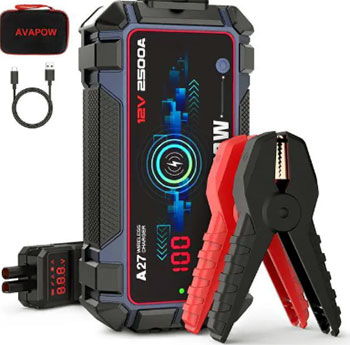
- NOCO Boost (e.g., GB40, GB70): NOCO is the undisputed heavyweight champion of this industry, known for premium quality and massive marketing. Comparison: NOCO units are significantly more rugged, usually featuring IP65 water resistance and rubberized over-molding that AVAPOW lacks. The clamps on a NOCO are generally narrower and easier to fit into tight spaces. However, you pay a “NOCO tax”; an AVAPOW with similar specs (2000A) will often cost half the price of a NOCO. NOCO batteries tend to hold their charge longer in standby, but AVAPOW offers more bang-for-your-buck if you just need raw power and don’t care about the brand name. If budget is no object and you want the absolute most reliable tool, buy NOCO. If you want 90% of the performance for 50% of the price, buy AVAPOW.
- GOOLOO (e.g., GP4000, GT4000): GOOLOO is the most direct competitor to AVAPOW, often sold at similar price points with similar specs. Comparison: These two brands are often neck-and-neck in performance tests. GOOLOO often wins slightly on standby time (holding a charge for 6+ months easily) and sometimes includes a slightly better carrying case. AVAPOW often wins on peak amperage claims per dollar, offering “6000A” models for the price of GOOLOO’s “4000A” models. Both brands suffer from the “short cable” issue. GOOLOO’s interface with a screen (on newer models) is slightly more user-friendly than AVAPOW’s LED lights. It is often a toss-up; buy whichever one is on sale, as the internal technology is very similar.
- HULKMAN (e.g., Alpha 85): HULKMAN is the “tech-bro” of jump starters, featuring massive digital screens and a very modern aesthetic. Comparison: HULKMAN’s defining feature is the huge percentage display that tells you exactly how much juice is left, whereas AVAPOW usually just has 4 small LED dots. HULKMAN also features 65W fast charging input/output, meaning the unit itself charges much faster than the AVAPOW. However, HULKMAN is significantly more expensive. If you are a gadget lover who wants a cool-looking device that charges fast, HULKMAN is superior. If you just want a utilitarian tool to toss in the trunk and forget about, AVAPOW does the same job for much less money.
Also Read: My Thoughts On ACEZUK Jump Starter
Frequently Asked Questions (FAQ)
First, plug the jumper cables into the AVAPOW unit; the indicator light will typically flash red and green. Connect the red clamp to the positive (+) terminal of the car battery and the black clamp to the negative (-) terminal or a metal ground. Once connected correctly, the light on the cable box should turn solid green. Start your car engine immediately. Once the car starts, remove the clamps within 30 seconds.
While manufacturers often claim 6 to 12 months of standby time, real-world conditions vary. In temperate climates, it can hold a charge for 6 months, but it is highly recommended to check it every 3 months. If stored in freezing cold or extreme heat, the discharge rate will be faster, so checking it seasonally is the safest bet.
A solid green light means the connection is correct and the battery is ready to jump. A flashing green light usually means the battery voltage is very low, and you may need to press the “Boost” button to engage force start mode. A solid red light with beeping indicates an error, usually reverse polarity (clamps on wrong terminals) or short circuit. No light often means the jump starter battery itself is dead or the connection is too poor to register.
Yes, but you likely need to use the “Force Start” or “Boost” feature. Standard safety sensors won’t detect a battery that is at 0 volts. By pressing the recessed “Boost” button on the cable box, you bypass these sensors and force power to the clamps. Be very careful in this mode, as safety protections like reverse polarity detection are often disabled.
Conclusion
The AVAPOW Jump Starter is not a luxury item; it is a pragmatic solution to a common problem. It strips away the hefty price tag of the premium brands and delivers raw, effective power that can handle everything from a compact sedan to a diesel truck. While it lacks the refined build quality and waterproofing of a NOCO, and the cables are frustratingly short, its performance-to-price ratio is almost unbeatable.
If you are looking for an affordable insurance policy against being stranded in a parking lot, the AVAPOW is absolutely worth the investment. It provides the independence to rescue yourself without relying on the kindness of strangers. Just remember to keep it charged, treat the plastic housing with care, and it will likely be the best fifty bucks you ever spent on your car.