
If you are reading this, you are probably staring at a checkout screen, torn between the legendary reliability of a Casio and the surprisingly premium look of an Armitron. I have been there. My intent with this article is to give you a brutally honest, hands-on breakdown of these two budget titans so you can decide which one actually deserves your hard-earned cash. We are going to look at build quality, module quirks, and that elusive “cool factor” to see if Armitron can actually dethrone the king of affordable watches.
A Brief Comparison Table
| Feature | Armitron | Casio |
| Case Material | Often Stainless Steel (even in budget) | Resin or Chrome-Plated Resin (mostly) |
| Module Logic | Can be quirky; varied button layouts | Industry standard; intuitive |
| Water Resistance | Usually 50m standard | Varies (WR splash proof to 200m) |
| Backlight | Often side-lit LED (older tech) | Illuminator / EL (superior) |
| Style Aesthetic | Retro-future, chunky, heavy | Utilitarian, classic, iconic |
| Price Point | $20 – $60 (High value for materials) | $15 – $100+ (Wide range) |
| Availability | Mostly US-based | Global ubiquity |
My Experience With Armitron
I remember stumbling upon the Armitron Rubik strictly by accident while browsing Amazon for something that looked “cyberpunk.” I saw the square steel case and the red crystal, and for $30, I impulse-bought it. When it arrived, the first thing that hit me was the cold shock of the metal. I was so used to the featherlight plastic of my other digital watches that the Armitron felt surprisingly substantial. It didn’t feel like a toy; it felt like a piece of machinery.
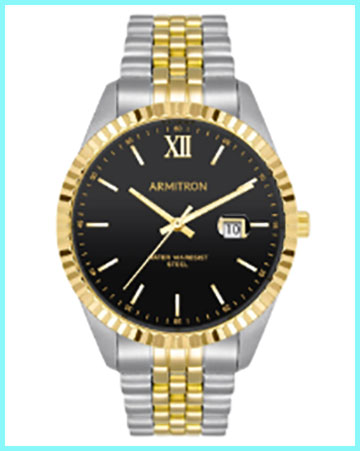
Wearing it was a different experience. I noticed people looked at it.
The “Griffy” model I bought later, which has a simpler LED display that mimics the 70s vibe, got more compliments at a bar than my expensive dive watches ever have.
There is something charmingly clunky about them. However, the honeymoon phase hit a snag when I tried to use the alarm. The interface baffled me.
I had to dig out the manual (which I had almost thrown away) just to figure out how to toggle the chime off. It wasn’t intuitive.
I also noticed the scratching on the mineral crystal.
Armitron tends to use mineral glass which is decent, but because the cases are often blocky and tall, I found myself banging the watch against door frames constantly.
The steel case took the hits like a champ—actually looking better with some scuffs—but the screen visibility outdoors wasn’t always perfect. Despite these quirks, I find myself reaching for my Armitron when I want to dress a bit “funky.” It matches a denim jacket or a retro tee perfectly. It feels less like a tool and more like a deliberate fashion accessory that happens to tell time.
Read More: Compaeison Of Gevril And GV2
Pros Of Armitron
- Superior Case Materials: One of the most shocking realizations I had when I picked up my first Armitron was the cold, heavy feel of the case. Unlike the vast majority of budget digital watches that use “chrome-plated resin” (plastic painted to look like metal), Armitron frequently uses genuine stainless steel for their cases, even in the sub-$40 range.1 This is a massive advantage for longevity. Painted plastic inevitably scratches, revealing the ugly white or grey resin underneath, whereas a solid steel Armitron case just picks up character scratches or can be polished out. If you hate the feeling of a lightweight, “toy-like” watch, Armitron offers a substantial heft that feels significantly more expensive than the price tag suggests.
- Distinct Retro-Futuristic Design: Armitron does not just copy; they lean heavily into a unique 1970s and 80s sci-fi aesthetic that stands apart from the utilitarian vibe of Casio. Models like the Griffy and the Rubik look like props from Blade Runner or Alien. They feature unique LED displays, canted screens, and boxy shapes that are bold fashion statements. While Casio has the “nerd chic” look locked down, Armitron captures the “disco era” digital funk perfectly. If you want a watch that people will actually ask you about because it looks weird and cool, Armitron is often the better conversation starter.
- Standard Water Resistance: In the budget tier, water resistance can be a gamble, but I have found that Armitron is surprisingly consistent with offering 50 meters (165 feet) of water resistance as a baseline for many of their digital sports watches. This is often better than the “WR” (splash resistant only) rating found on the base model Casios like the F91W or A158. This extra layer of security means you can wash your hands, get caught in the rain, or even take a shallow swim without immediately panicking that you have drowned your watch.
- Symmetrical Button Layouts: This might sound like a minor detail, but it drives some people crazy on other brands. Many Armitron digital watches utilize a four-button layout (two on the left, two on the right) that provides visual symmetry. Compare this to many classic Casios that have three buttons, leaving one side looking “blank” or recessed. If you are someone who values symmetry in design, the Armitron layout often looks more balanced on the wrist, making the watch feel more like a finished piece of jewelry rather than just a tool.
- Comfortable Bracelets: While they are essentially folded link bracelets just like their competitors, I have found the bracelets on models like the Armitron Rubik to be slightly more forgiving on arm hair. They tend to have a bit more flexibility and a slightly better finish on the edges. They are not luxury bracelets by any means, but in a direct side-by-side wear test, I found myself adjusting the Armitron bracelet less often throughout the day.
Cons Of Armitron
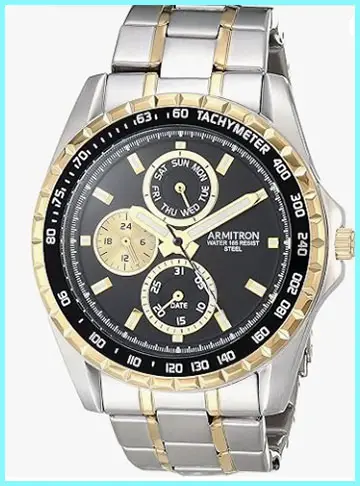
- Inconsistent Module Logic: The biggest headache I have with Armitron is that their internal software (the module) is not as standardized as the competition. On one watch, the top-left button might represent the light, while on another, it resets the stopwatch. This lack of consistency means you actually have to learn each watch individually. If you are used to the “Mode-Adjust-Start/Stop” flow that has been the industry standard for decades, picking up an Armitron can be a jarring experience. I have accidentally reset the time when I just wanted to turn on the backlight more times than I care to admit.
- Poor Viewing Angles: This is where the budget nature of the LCD screens sometimes shows. On several digital Armitron models, particularly the negative display ones (light numbers on a dark background), the viewing angles can be quite narrow. You have to look at the watch dead-on to read the time clearly. If you glance at your wrist from an angle while typing or driving, you might just see “88:88” or a washed-out blur. It is not a dealbreaker for everyone, but it is a noticeable step down in optical quality compared to the crisp, high-contrast displays found on most Casio vintage reissues.
- Weaker Backlighting Technology: While some newer models are improving, many budget Armitron watches still rely on a single, side-mounted LED that barely illuminates the screen. It often creates a “hotspot” on one side of the display while leaving the minutes or seconds in the dark. Compared to the Electroluminescent (EL) panels or the newer, brighter LED Illuminators found on competitor watches, the Armitron light can feel archaic. Checking the time in a movie theater or a dark bedroom can sometimes be a struggle, requiring you to squint to make out the digits on the far side of the screen.
- Harder to Mod or Repair: If you love tinkering with your watches, Armitron is a lonely road. There is virtually no aftermarket support. You cannot easily find custom sapphire crystals, modded cases, or specific lug adapters like you can for the massive enthusiast community surrounding other brands. If your Armitron breaks or the crystal gets smashed, you are generally looking at buying a replacement watch rather than fixing it. The straps are often integrated or use proprietary lug widths, making it difficult to swap out the stock metal band for a cool NATO or leather strap without performing surgery on the watch.
- Availability Issues: If you live outside of the United States, getting your hands on specific Armitron models can be a pain. While they are a staple in American department stores like Walmart or Target, they lack the global distribution network of their Japanese competitors. This means international buyers often have to pay inflated shipping costs or deal with third-party sellers on eBay just to get a $30 watch, which ruins the value proposition.
My Experience With Casio
My relationship with Casio is less of a romance and more of a lifelong partnership. I have worn a Duro (MDV106) for years as my “do anything” watch. I have taken it snorkeling, I have fixed my car engine wearing it, and I have worn it to weddings on a leather strap. It is the ultimate chameleon.
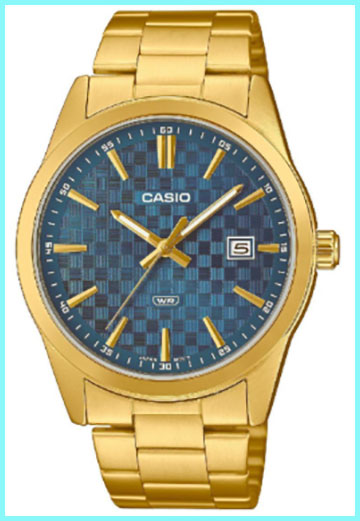
But my most vivid experience comes from the humble F91W.
I bought one for a backpacking trip because I didn’t want to risk a nice watch.
That little plastic square went through hell.
It was covered in mud, soaked in river water, and baked in the sun for weeks.
Not only did it survive, but it was also so light I forgot I was wearing it.
That is the magic of this brand. You don’t “experience” it; you live with it, and it disappears until you need it.
However, I have also experienced the frustration of the “chrome” peeling.
I had an A158 that I wore daily to an office job.
After about a year, the underside of the case where it touched my sweaty wrist started to pit and peel, revealing the white plastic. It looked trashy. It annoyed me that a watch with such a perfect design was handicapped by cheap materials. I eventually upgraded to an A1000 to get that full steel feel, but it cost me five times as much. That is the tradeoff. You get incredible reliability for the price of a lunch, but you have to accept that the housing is essentially disposable.
Pros Of Casio
- Legendary Durability: There is a reason you see these watches on the wrists of construction workers, soldiers, and chefs. Even the cheapest plastic models are built like tanks. The resin used by Casio is specially formulated to absorb shock and resist chemical degradation. I have dropped my F91W onto concrete, banged it against door frames, and submerged it in dishwater, and it just keeps ticking. If you step up to the G-Shock line, you are entering a territory of indestructibility that Armitron simply cannot compete with. When you buy a Casio, you are buying the peace of mind that your watch will likely outlive the battery inside it.
- Intuitive User Interface: One of the most underrated features of this brand is that if you know how to use one, you know how to use them all. The “Casio Logic” is ingrained in the industry. Mode is almost always bottom left; Light is top left (or top right on some older models, but predictable). The stopwatch and alarm functions are easy to access and simple to operate. There is zero friction when switching between watches in their lineup. It is a user experience that has been refined over 40 years to be as frictionless as possible.
- Incredible Backlight Technology: The “Illuminator” is the gold standard for digital watch legibility in the dark. Whether it is the electroluminescent panel on the A168 that glows a cool blue-green across the entire face, or the super-bright LEDs on the newer models, you can always read the time. They do not just put a light in; they engineer the display to light up evenly. For anyone who works night shifts or camps often, this feature alone is often the deciding factor.
- Massive Modding Community: Owning a Casio opens up a new hobby. Because they are so popular, there is an endless market of third-party parts. You can buy sensor-equipped modules, hydromod kits (filling the case with oil for better visibility), custom steel cases, sapphire crystals, and colored filters. You can take a $15 watch and turn it into a unique personalized artifact. I have spent more time modifying my Royale (AE1200) than I have wearing some of my expensive Swiss watches. It is a fun, creative outlet that other brands just do not offer.
- Iconic Status: Wearing a Casio sends a message. It says you value function over pretension. From the humble F91W to the billionaire-favorite Duro, these watches have a cultural cachet that transcends price. They are respected by high-end collectors and casual wearers alike. You can wear a vintage digital model with a suit (ironically) or with gym shorts, and it never looks out of place. It is a design language that has defined the digital age, and owning one feels like owning a piece of history.
Cons Of Casio
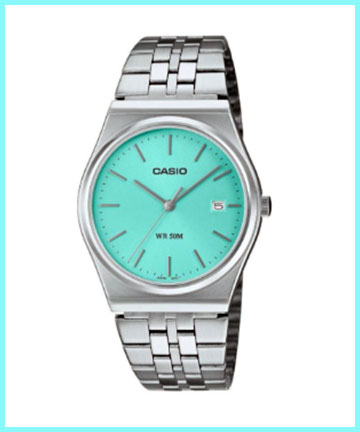
- Chrome-Plated Resin Cases: My biggest gripe with the “vintage” lineup (like the A158, A168, etc.) is that they are not actually metal. They are resin plastic painted with a chrome finish. It looks great in photos and when it is brand new, but give it six months of hard wear, and that chrome starts to chip and bubble. Underneath, the greyish plastic shows through, making the watch look cheap and tattered. It is frustrating because the movements are bulletproof, but the shell is disposable. You often have to pay significantly more to get a full stainless steel case from this brand (like the A1000 series).
- Hair-Pulling Bracelets: The folded link bracelets on the lower-end models are notorious hair-nippers. If you have hairy arms, wearing a standard A158 bracelet can feel like a mild torture session for the first week until it has essentially waxed a patch of your wrist bald. The links are often stiff and can rattle cheaply. While they are easy to adjust, they lack the comfort and solidity of higher-end machined bracelets, and they are often the first thing enthusiasts swap out.
- Price Creep: While they are still affordable, the prices on popular models have been slowly creeping up. What used to be a $10 watch is now $20. The “Casio Oak” G-Shocks are pushing well over $100. As the brand realizes its fashion status, they are charging a premium for “vintage” colorways that are functionally identical to the cheaper basic models. You are increasingly paying for the hype and the colorway rather than just the tool, which alienates some of the die-hard budget utility fans.
- Strap Rot on Older Models: While the resin cases are tough, the resin straps on older or cheaper models have a shelf life. After a few years of exposure to sweat, UV light, and saltwater, the resin can become brittle and snap without warning. This is known in the community as “resin rot.” It is fixable by buying a new strap, but it is a known weak point. You pick up a watch you haven’t worn in five years, go to buckle it, and the strap just crumbles in your hand.
- Confusing Model Numbers: The catalog is so vast that it is baffling. You have the A158, A159, A163, A164, and A168, and to the untrained eye, they look identical. Yet, they have slight differences in size, light quality, and bracelet width. Trying to figure out which specific model you want can be a research project in itself. It is easy to accidentally buy the model with the terrible light when you thought you were buying the one with the Illuminator because you missed a single digit in the model number.
Comparison With Other Brands
- Timex: When you compare Armitron and Casio to Timex, the conversation shifts to backlighting and noise. Timex is famous for Indiglo, which is arguably better than even the best Casio Illuminator. It lights up the dial perfectly. However, Timex analog watches are notoriously loud. You can hear the “tick-tick-tick” from across the room at night. Neither Armitron nor Casio suffers from this level of auditory intrusion. In terms of build, Timex sits somewhere in the middle—better brass cases than Casio’s resin, but often more expensive than Armitron’s steel digital offerings.
- Skmei: This is a Chinese brand that essentially clones Casio designs for half the price. While they are cheaper, I have found the quality control to be nonexistent compared to Armitron or Casio. The water resistance is often a lie, and the buttons feel mushy. Armitron is a legitimate heritage brand with a warranty; Skmei is a gamble. If you are debating saving $5 by going with a clone, don’t. Stick to the two giants we are discussing.
- G-Shock (as a sub-brand): It is unfair to compare standard Armitrons to G-Shocks, but it is worth noting. If you need true “survival” toughness, neither a standard Casio nor an Armitron cuts it. You need a G-Shock. Armitron has “rugged” sports watches, but they lack the floating module protection and shock absorption structure of a true G-Shock. If your life involves jackhammers or cliff diving, skip the standard lines and go straight to the G-Shock DW5600.
Also Read: My Thoughts On Larsson & Jennings Watch
Frequently Asked Questions (FAQ)
No. Armitron is owned by the E. Gluck Corporation, a family-operated American company based in New York.2 Casio is a Japanese electronics multinational. They are completely separate entities.
Armitron is an affordable brand, but “cheap” implies poor quality, which is not accurate. They offer high value, often using stainless steel cases and durable movements in the $20–$50 range, making them a quality budget option.
“Better” is subjective. For backlighting, Timex (Indiglo) is often considered better. For mechanical prestige at an affordable price, Seiko or Orient are superior. However, for digital durability and value, Casio is rarely beaten.
Bill Gates is most frequently seen wearing the Casio Duro (MDV106), a simple analog dive watch that retails for about $50–$70. He has also been spotted wearing the digital Casio W214H Illuminator.
Conclusion
If you are looking for a watch that feels like a premium piece of jewelry on your wrist, has a hefty steel construction, and rocks a unique 1980s sci-fi aesthetic, Armitron is your winner. It is the choice for the person who wants to stand out from the sea of generic digital watches and appreciates the tactile feel of metal over plastic.
However, if your priority is pure, unadulterated function, legendary durability, and a user interface that you can operate in your sleep, Casio remains the undisputed champion. It is the tool watch for the masses. Whether you choose the American underdog or the Japanese giant, you are getting a piece of timekeeping that punches far above its weight class. Choose the one that fits your vibe, and wear it into the ground.